11 min read · Updated 19 May 2026
This glossary defines the yacht racing terms you will hear around the dock and on the water, from points of sail and sail names to handicap systems and tactics. Each entry is a plain-English, one or two sentence definition, listed alphabetically. A few key terms link to fuller deep-dive guides.
- Apparent wind — the wind a moving boat actually feels, combining the true wind with the headwind created by the boat's own speed.
- Asymmetric spinnaker — a downwind sail with one side longer than the other, tacked to the bow or a bowsprit and flown without a pole; also called a gennaker.
- Backstay — a wire or rod running from the top of the mast to the stern that supports the rig and, when tensioned, bends the mast to flatten the mainsail.
- Bear away — to steer the boat away from the wind, turning the bow towards a more downwind heading; the opposite of luffing up.
- Beat — to sail upwind in a zig-zag of tacks, because a yacht cannot sail directly into the wind; the windward leg of a course.
- Bow — the front of the boat, and the name of the crew member (the "bowman") who works there handling sails and calling the start line. See crew positions.
- Broach — a sudden, uncontrolled rounding-up into the wind, usually when overpowered downwind, that heels the boat hard and can stall it.
- Canard — a small retractable foil mounted forward of a canting keel that provides lateral grip the swinging keel can no longer supply.
- Canting keel — a yacht keel that pivots from side to side, swinging its heavy ballast bulb out towards the wind to add righting moment. See what is a canting keel.
- Corrected time — a boat's finish time after a handicap rating is applied, used to compare boats of different designs fairly. See line honours vs handicap.
- Displacement — the weight of water a hull pushes aside, equal to the weight of the boat; a heavier boat is said to be more "displacement" and a lighter one more easily driven.
- Downwind — sailing with the wind coming from behind, on the legs of the course that head away from the wind.
- Foredeck — the deck area forward of the mast where headsails and spinnakers are hoisted, gybed and dropped.
- Gennaker — an asymmetric spinnaker, a cross between a genoa and a spinnaker, flown from the bow without a pole for fast reaching and running.
- Gybe — to turn the stern through the wind so the sails swing across to the other side; the downwind equivalent of tacking (also spelled jibe).
- Halyard — a rope or wire used to hoist a sail up the mast and hold it aloft.
- Handicap — a rating system that adjusts boats' finish times so vessels of different size and design can race on equal terms. See IRC vs ORC.
- Headsail — any sail set forward of the mast, such as a jib or genoa.
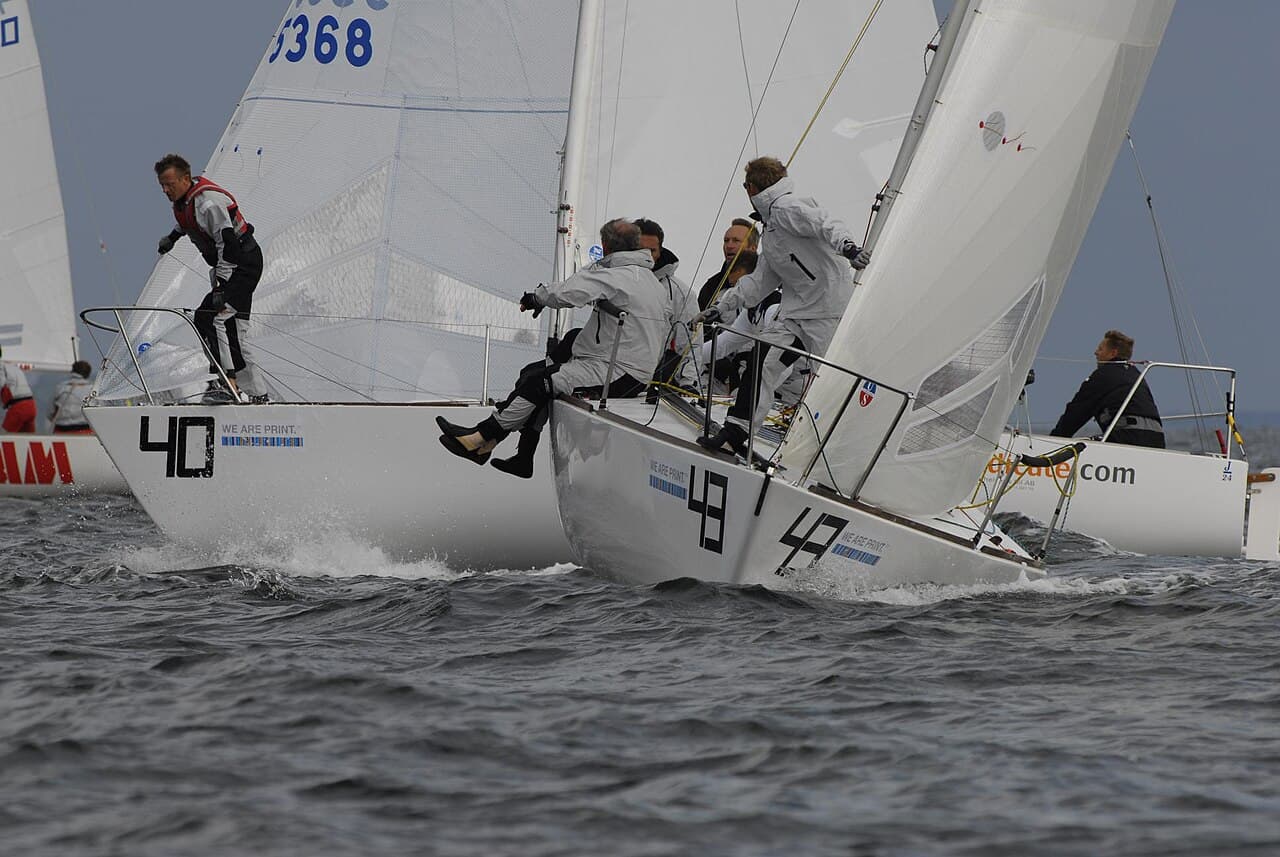
- Hiking — leaning the crew's body weight out over the windward rail to counteract heel and keep the boat flatter and faster.
- IRC — a widely used measurement handicap rule with a confidential formula, popular for offshore and mixed-fleet racing. See IRC vs ORC.
- Jib — a triangular headsail set forward of the mast, smaller than a genoa and used for upwind and tighter reaching work.
- Kite — the crew's informal name for a spinnaker, the large downwind sail.
- Knot — a unit of speed equal to one nautical mile per hour, the standard measure of boat speed and wind speed.
- Laylines — the imaginary lines marking the closest angle a boat can sail to reach a mark; once on the layline you can fetch the mark without another tack or gybe.
- Leeward — the side or direction the wind is blowing towards, the sheltered side; the opposite of windward.
- Line honours — the prize for the first boat to cross the finish line, independent of handicap or corrected-time results. See line honours vs handicap.
- Luff — the leading edge of a sail; also, to steer closer to the wind until the sail's front edge begins to flap.
- Mainsail — the principal sail set behind the mast, the main driving sail of most yachts.
- Mark — a buoy or fixed point that competitors must round or pass in a set order to complete the course.
- One-design — a class in which every boat is built to one identical specification, so racing is won by skill rather than equipment, like the Melges 40 Invicta sails. See one-design yacht racing.
- ORC — a measurement handicap system based on a published velocity prediction of each boat's likely speed in different conditions. See IRC vs ORC.
- Pit — the cockpit station that manages halyards and control lines during hoists, drops and manoeuvres. See crew positions.
- Planing — when a light, fast hull lifts and skims across the surface of the water rather than ploughing through it, sharply increasing speed.
- Port — the left-hand side of the boat when facing forward, marked by red; a boat on port tack must usually give way to one on starboard.
- Rating — a number assigned by a handicap rule that expresses a boat's measured speed potential and is used to calculate corrected time.
- Reach — a point of sail with the wind coming from the side, ranging from a close reach (wind forward) to a broad reach (wind aft of the beam).
- Regatta — an organised series of races held as a single event, often over several days.
- Righting moment — the leverage that resists a boat heeling and keeps it upright, generated by ballast, hull form and crew weight to windward.
- Rig — the mast, boom, standing rigging and sails together; the whole arrangement that supports and shapes a yacht's sails.
- Run — the point of sail dead downwind, with the wind coming from directly astern.
- Spinnaker — a large, lightweight sail set forward of the boat for downwind and reaching legs, either symmetric (flown from a pole) or asymmetric.
- Square-top mainsail — a mainsail with a wide, squared-off head rather than a pointed peak, adding sail area aloft for more power; standard on modern racers like the Melges 40.
- Starboard — the right-hand side of the boat when facing forward, marked by green; a boat on starboard tack has right of way over one on port.
- Tack — to turn the bow through the wind so the sails cross to the other side; also, the lower forward corner of a sail, or which side the wind is coming over.
- Tactician — the crew member who reads the wind, fleet and course to decide where and when the boat should go. See crew positions.
- Tell-tales — short lengths of yarn or ribbon on the sails or rigging that show the airflow and help the crew trim sails accurately.
- Transom — the flat or curved surface across the stern that forms the back of the hull.
- Trim — to adjust a sail's shape and angle with its sheets and controls for the best speed and balance in the conditions.
- Upwind — sailing towards the wind, on the windward legs where the boat must beat in a series of tacks.
- VMG — velocity made good, the part of a boat's speed measured directly towards or away from the wind, the figure crews optimise on upwind and downwind legs.
- Windward — the side or direction from which the wind is blowing, the weather side; the opposite of leeward.
- Windward-leeward — a common racing course made up of straight upwind and downwind legs between marks set directly into and away from the wind.
Technical and performance terms
This section goes a level deeper — the measurement, rig-tuning and performance vocabulary used by designers, sailmakers and the afterguard.
- Apparent wind (AWA / AWS) — the wind a moving boat actually feels, combining the true wind with the headwind of the boat's own motion; apparent wind angle and apparent wind speed are what the instruments read and what the sails are trimmed to.
- True wind (TWA / TWS) — the real wind over the water, true wind angle and true wind speed, calculated by removing the boat's motion from the apparent wind.
- Polar diagram — a chart of a boat's predicted speed at every wind angle and strength; crews compare actual speed against the "polars" to judge whether the boat is sailing to its potential.
- Target boat speed — the speed the polars say the boat should be doing for the current wind angle and strength; hitting target upwind and downwind is the basic measure of good trim and helming.
- Velocity Prediction Program (VPP) — the physics-based software that predicts a boat's speed across all conditions from its measured dimensions; it underpins ORC ratings and most modern polars.
- Hull speed — the natural speed ceiling of a displacement hull, roughly 1.34 times the square root of the waterline length in feet (the answer in knots); planing hulls climb over it by rising onto the surface.
- Displacement-to-length ratio (D/L) — how heavy a boat is for its length; low values mark a light, easily driven racing hull, high values a heavy cruiser.
- Sail area-to-displacement ratio (SA/D) — a measure of power for weight; high values mark a powered-up performance boat, and a planing one-design like the Melges 40 sits at the high end.
- Ballast ratio — the share of a boat's weight carried as keel ballast; a canting keel wins high righting moment without a high ballast ratio.
- Prismatic coefficient — a hull-shape number describing how the underwater volume is spread along the hull; designers tune it to the boat's target speed range.
- Wetted surface area — the area of hull and foils in contact with the water and the main source of drag in light air, so designers work to minimise it.
- Leeway — the small sideways slip a boat makes to leeward while sailing upwind, resisted by the keel, canard or daggerboard.
- Heel — the angle a boat leans under sail; most hulls are fastest sailed relatively flat, which is why crews hike and depower to control it.
- Forestay sag — the curve the forestay takes under load; controlling it with backstay or runner tension changes the jib's depth and the boat's pointing.
- Mast rake — the fore-and-aft lean of the whole mast, adjusted to balance the helm and tune power.
- Pre-bend — the gentle forward bow built into a mast at rest, which sets up how the mainsail sits as the rig loads up.
- Mast bend — how much the spar flexes under load; bending the mast flattens the mainsail to depower, straightening it adds depth and power.
- Cunningham — a control that tensions the mainsail luff to draw the draft forward and flatten the sail as the wind builds.
- Outhaul — the control that tensions the foot of the mainsail along the boom, flattening or deepening the lower part of the sail.
- Vang (kicker) — a control that pulls the boom down to tension the leech and limit twist, especially off the wind.
- Traveller — the athwartships track that positions the mainsheet block, setting the boom's angle without changing leech tension.
- Twist — the progressive opening of a sail's leech from bottom to top; crews add twist to depower and reduce it for power and pointing.
- Draft and camber — the depth (draft) and overall fullness (camber) of the curve built into a sail — deeper for power, flatter for speed and control in a breeze.
- Entry and exit — the leading-edge (entry) and trailing-edge (exit) shape of a sail, governing how forgiving it is to steer to and how cleanly it sheds air.
- Sheeting angle — the athwartships angle at which a headsail is trimmed, set by the lead position — narrower for pointing, wider for power and reaching.
- TCC / TCF — the time correction coefficient (IRC) or time correction factor used to turn elapsed time into the corrected time that decides handicap results, explained in IRC vs ORC handicap racing.
Frequently asked questions
- What does windward mean in sailing?
- Windward means the side or direction from which the wind is blowing, sometimes called the weather side. The opposite is leeward, the sheltered side that the wind blows towards. In a race, a boat to windward of a rival sits upwind of it and generally holds a tactical advantage.
- What is the difference between a spinnaker and a gennaker?
- A spinnaker is a large, balloon-shaped downwind sail; the traditional version is symmetric and flown from a pole. A gennaker, also called an asymmetric spinnaker, is a cross between a genoa and a spinnaker, with a fixed luff tacked to the bow or a bowsprit and no pole. Asymmetrics are faster and easier to handle on reaching angles, which is why modern racers like the Melges 40 carry them.
- What does line honours mean?
- Line honours goes to the first boat to physically cross the finish line, regardless of its size or handicap. It is distinct from the handicap or corrected-time win, where finish times are adjusted by a rating so boats of different designs compete fairly. A boat can take line honours yet still lose on corrected time.
- What is VMG in yacht racing?
- VMG stands for velocity made good, the component of a boat's speed measured directly towards the wind (upwind) or away from it (downwind). Because boats cannot sail straight into the wind, sailing a little faster on a wider angle often produces better VMG than pointing as high as possible. Crews trim and steer to maximise VMG on the windward and downwind legs.
- What is a one-design class?
- A one-design class is a fleet of identical boats built to a single strict specification, so racing is decided by crew skill rather than equipment. There are no handicap corrections; the first boat across the line wins. The Melges 40 is a modern Grand Prix one-design example.