Action Cameras for Sailing: What We Look For
On a Grand Prix boat an action camera does two jobs — sponsor media and coaching evidence. This note goes deep on the engineering that decides whether footage is usable: sensor and readout, IMU-driven stabilisation and its crop stack, the thermal envelope, bitrate and codec, wind-noise physics, and the salt-corrosion failure modes that actually kill cameras.
Research Note
This is a research note in the Invicta Labs review framework — we are documenting what we are looking for and the options we are weighing, before any purchase or testing. We do not publish ratings or ownership claims until we have genuinely tested the equipment ourselves.
11 min read
This is a research note, not a rated review. Specifications cited are manufacturer figures; verify current models before purchase.
An action camera earns its place on a race boat by doing two jobs at once — capturing sponsor media and creating a timestamped visual record for coaching review. Get the sensor, stabilisation, thermal envelope and workflow right and one small camera feeds both the content machine that keeps sponsors visible year-round and the debrief that makes the boat faster. Get them wrong and you collect hours of shaky, wind-roared, salt-smeared footage that is unusable. This note goes past "buy the new GoPro" into the engineering that decides the outcome, without pretending we have bench-tested every model.
The imaging chain — and where sailing stresses each link
An action camera is a fixed-lens, fixed-aperture unit built around a small CMOS sensor, a rolling-shutter readout, an inertial measurement unit (IMU), a hard-working system-on-chip (SoC) doing real-time encode, and a sealed body. Every one of those links is stressed differently by sailing than by the mountain-bike and ski use the cameras are engineered around: the vibration is lower in frequency but relentless over hours, the spray is corrosive salt, sessions run for a full regatta day rather than a two-minute run, and the highest-value moments — a start, a mark rounding — are unrepeatable, so a dropped clip is gone for good.
Two decisions upstream set everything else: sensor size and the rolling shutter. Sensor area governs low-light behaviour and dynamic range, which matter at dawn starts and in the deep shadow-and-glare contrast of a sunny sea. The current flagships have grown their sensors precisely for this reason — the GoPro Hero 13 Black uses a 1/1.9-inch sensor, while the DJI Osmo Action 5 Pro moved to a larger 1/1.3-inch sensor with a roughly 2.4-micrometre pixel pitch and a claimed 13.5 stops of dynamic range (manufacturer figures; verify against the model you buy). More sensor area and larger photosites collect more photons per pixel, which is what keeps the water reading as clean blue rather than noisy mush when a cloud passes.
The rolling shutter is the hidden enemy at sea. These sensors do not expose the whole frame at once; they scan line by line over several milliseconds. When the camera rotates during that scan — every slam, every snatch on a sheeted-on mount — the top and bottom of the frame are captured at different attitudes, so straight lines like the mast, the horizon and the forestay skew and wobble. This is the "jello" effect, and low-frequency boat motion sits right in the band that produces it. The defence is not just the lens but the IMU, which we come to next.
Stabilisation is the feature that transformed on-board sailing footage, and it is worth understanding rather than just switching on. GoPro's HyperSmooth and DJI's RockSteady/HorizonSteady are electronic (EIS) systems, not mechanical gimbals. The IMU — a gyroscope plus accelerometer — samples the camera's angular velocity and acceleration at up to around 500 times a second, far faster than the frame rate, so the processor knows the exact attitude at which every scan line was captured. It uses that data twice: to smooth frame-to-frame motion (inter-frame), and to un-skew the rolling shutter line by line (intra-frame), which is what removes the jello. Horizon-levelling modes — Horizon Lock on GoPro — then hold the sea flat through heel and chop, even through a full broach, which reads as calm and professional footage.
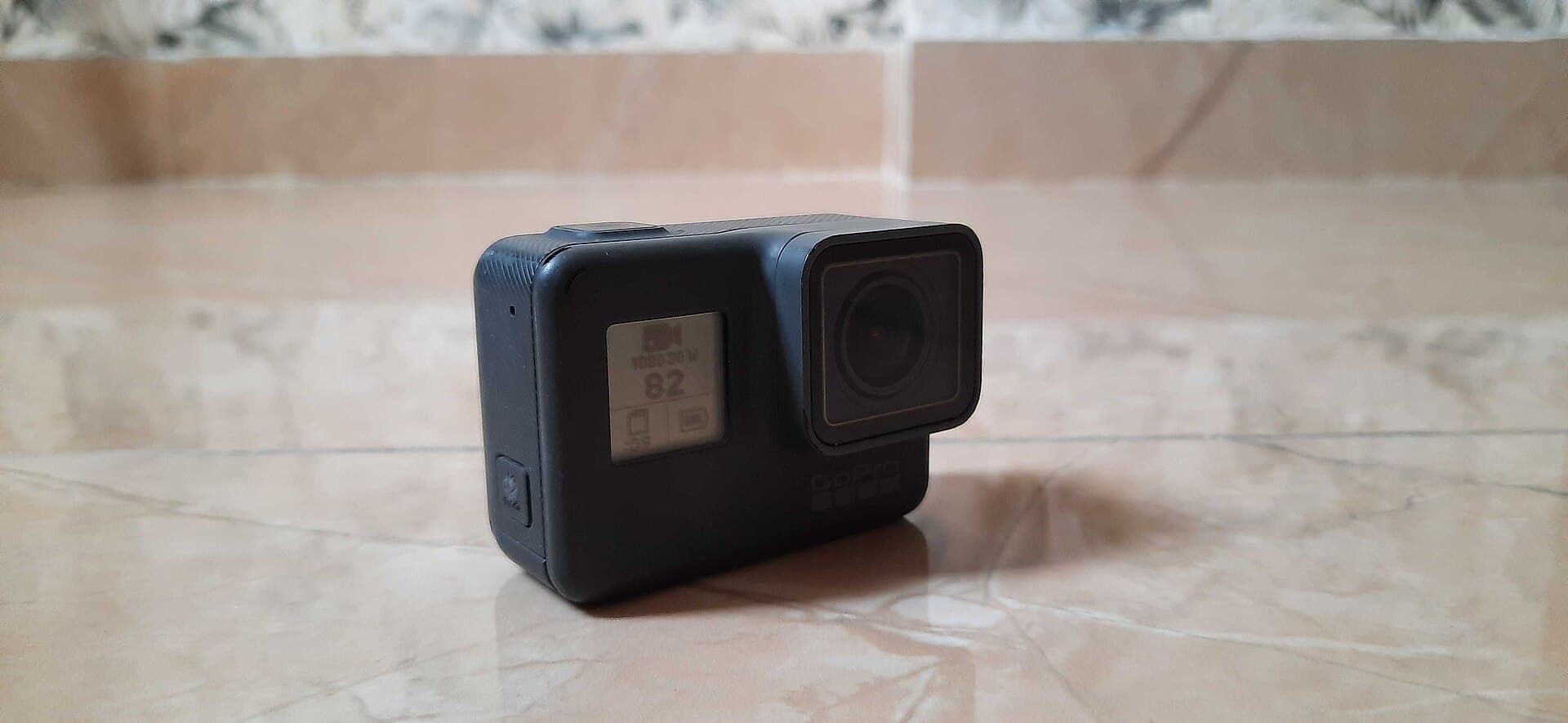
That smoothness is not free, and the cost is geometric. Stabilisation works by capturing a wider frame than it outputs and shifting a crop window around inside it to cancel motion — so it eats field of view. Published GoPro crop figures are roughly 10% for standard HyperSmooth, 12–15% for High, and 15–20% for Boost, stacked on top of whatever you lose choosing the rectilinear Linear lens (about 30% narrower than Wide) to kill fisheye. On a boat this compounds: pick Linear plus Horizon Lock plus Boost and you have cropped so hard the deck no longer fills the frame from a transom mount. The practical rig is to frame wider than you think you need, accept a little barrel distortion at the edges, and reserve maximum stabilisation for the body-mounted shots that genuinely need it.
Codec, bitrate and colour — the data side of image quality
Resolution is the number on the box; bitrate and codec decide whether fast-moving water and a bucking rig actually hold together. Current flagships encode in HEVC (H.265) rather than the older H.264, because HEVC delivers similar quality at 25–50% lower data rate — which matters when the SoC is already thermally limited. The Hero 13 Black tops out around 120 Mbps at 5.3K60; the Osmo Action 5 Pro caps its bitrate near 100 Mbps (manufacturer figures). Water is a worst case for any codec: a broken, high-frequency, constantly moving texture is exactly what compression struggles to encode, so a spray sheet or a churned wake is where a too-low bitrate shows up as blocky mush. If a camera exposes a higher-bitrate mode — GoPro's Labs firmware unlocks up to 200 Mbps — it is worth using for hero water shots, at the cost of card space and heat.
Two settings pay off specifically for a campaign that colour-grades its media. First, 10-bit HEVC: it records around a billion tonal values versus roughly 16 million at 8-bit, which prevents banding in the big smooth gradients sailing throws up — a dawn sky, a flat sea, a spinnaker. Note that 10-bit is typically unavailable at the highest frame rates (120fps and up), so you trade slow-motion for bit depth. Second, a log profile (GP-Log): it captures a flatter, wider-latitude image that protects highlight detail in a blown-out sail and sky and gives the editor room to grade to a consistent campaign look. Both raise the encode load and therefore the heat, which is the constraint we turn to now. All of this presumes the storage keeps up: sustained 100–200 Mbps HEVC needs a genuinely rated card (a V30 UHS card or better), and a slow or counterfeit microSD is a classic cause of dropped frames and corrupt clips mid-race.
The thermal envelope — the real ceiling on a race day
This is where marketing resolutions collide with physics. The SoC handles an enormous pixel throughput — at 5.3K30 the Hero 13's GP2 chip processes on the order of one billion pixels per second — and essentially all of that computation converts to heat inside a small sealed body with no fan. The camera protects itself with a thermal cutoff when internal temperature reaches roughly 65°C, at which point it stops recording — and it will do so mid-mark-rounding without asking. Because these bodies rely on passive conduction through the aluminium frame and shell, the thing that saves you is airflow or water flow over the housing; a camera sitting still in still air on a light day is far more likely to cook than one with apparent wind and spray washing over it.
The controllable variable is resolution and frame rate, because encode load scales steeply with both. Dropping from 5.3K to 4K cuts the processor's work per frame by roughly 40%, lowering the steady-state temperature and buying much longer clips. For a sailing campaign that logic is decisive: 4K30 is more than enough for social delivery and coaching analysis, runs cooler and longer, and roughly halves the card and offload burden versus 5.3K. Reserve 5.3K and high frame rates for short, deliberate hero shots taken when the camera can shed heat.
Battery is the other end-of-day constraint. GoPro's Enduro cell (1720 mAh) is chemistry chosen for temperature range — rated to operate down to about −10°C and, in one published test, still recording for 87 minutes after hours at −18°C where a standard cell died in seconds. That cold performance matters less in Australia than the runtime, and the honest numbers are short: a windward-leeward day with a long pre-start and multiple races will outrun a single charge, especially since the extended-runtime gains show up only at higher resolutions, not at 1080p. The disciplined answer is several charged spares in a dry bag and a battery swap between races, not a heroic attempt to run one cell all day. An external USB feed can give a continuous record, but on most bodies it means running with the door open — surrendering the waterproofing you are relying on — so weigh it carefully on a wet boat.
Mounting: geometry, loads, and why glue is the enemy
Mount position decides whether footage is evidence or decoration, and it also decides how hard the stabiliser has to work. Three positions earn their place:
- Low, looking forward — a transom, pushpit or toe-rail mount low and aft, framing the length of the deck with the rig for scale. The money shot for content, and a stable, near-horizontal reference the stabiliser handles cleanly.
- Rig, looking down — a mast or spreader mount aimed at the cockpit. The coaching angle: it shows the choreography and timing of a manoeuvre from above, which is exactly what overlays against the numbers. A rig mount is high-vibration, so it is where rolling-shutter correction and a rigid clamp matter most.
- Body, point of view — a helmet, shoulder or chest mount on the helm or a trimmer. Intimate and immersive, but it shakes more and adds wearer motion the IMU cannot separate from boat motion, so it is the shot most dependent on maximum stabilisation.
The load environment on a Melges 40 or any Grand Prix one-design is the reason to be conservative. High apparent wind over the deck, slamming in a seaway, and the sheer violence of a broach apply cyclic loads that fatigue adhesive bonds — and salt and UV degrade the acrylic-foam pads further over a season. Favour captive clamp mounts, bolt-through hardware or purpose-made rail mounts over sticky pads anywhere near the rig or the working deck, and back up every camera with a tether. A camera lost overboard is gone; a camera that lets go on the mast becomes a missile in the cockpit. Keep mounts and lenses clear of the sail and sheet paths, keep the mast base clear of halyards and grinders, and check that the mount does not shadow a trimmer's sightline to the telltales.
Fixed-lens versus 360 — an angular-resolution decision
The genuine fork is between a conventional fixed-lens camera and a 360 camera such as the Insta360 X-series, and the right way to reason about it is pixels per degree. A fixed-lens camera points all its sensor at one framing, giving the best image quality per dollar and a familiar workflow. A 360 camera spreads its resolution across the whole sphere in a 2:1 equirectangular image, then lets you choose the framing later in software — you can reframe one mast-cam clip into a tack from three virtual angles, and its "invisible selfie stick" trick yields drone-like orbits without a drone. The catch is that when you crop a flat frame out of the sphere, you only get the pixels that fell in that slice: reframing 8K 360 footage yields roughly 4K at a wide field of view but drops toward 1080p at a narrow (around 110°) linear crop. That is why 360 needs 8K to be taken seriously — you are budgeting resolution for the crop, not the capture. For a campaign that wants flexible content and multiple coaching angles from a single mount, a modern 8K 360 camera is worth real evaluation; for clean, simple, highest-quality single-frame clips with the least editing, fixed-lens still leads.
What good versus bad looks like, and the workflow that pays twice
Good on-board footage is level, jello-free, framed with the rig for context, clean on the front element, correctly exposed for a bright sea, and long enough to catch the whole manoeuvre from set-up to completion. Bad footage is horizon-tilted, skewed and wobbling, salt-smeared, blown out or blocky in the wake, cut off before the release completes, or roared out by wind. Almost all of that difference is settings and discipline, not the price of the camera.
Workflow is where most campaigns quietly fail. Offload and name cards the same day, before they are overwritten or lost, and run a real post-session routine on the hardware: a genuine freshwater soak with the buttons actuated to dissolve salt out of the switch shafts, then a dry, because dried salt is abrasive and will score the door and port O-rings until the seals leak — the same discipline as any salt-corrosion routine, and the single biggest determinant of whether a camera survives a season. Clip the two or three teaching moments — the start, the tricky rounding, the gybe that went wrong — while the day is fresh, and pair them with the boat-speed debrief so the vision and the numbers tell one story. That same library then feeds the sponsor and media stream, so a single, well-mounted, well-configured camera pays off twice. Fit action cameras into the broader on-board kit picture — power budget, storage and dry stowage — alongside the rest of the race-boat electronics, and treat the footage as a system input, not a novelty.
Frequently asked questions
- Where should you mount an action camera on a race boat?
- Three positions earn their keep: a low transom or pushpit mount looking forward down the deck for context and scale; a mast or spreader mount looking down at the cockpit for the coaching geometry of a tack or gybe; and a helmet or shoulder mount on a trimmer or the helm for point-of-view intimacy. Rig points give a fixed reference frame the stabiliser loves — a static horizon and known geometry make Horizon Lock and reframing far cleaner. Body mounts shake more and add wearer motion the IMU cannot distinguish from boat motion. On a Melges 40 the deck loads are severe, so favour bolt-through or captive-clamp mounts over adhesive pads anywhere near the rig, and tether everything.
- How waterproof does a sailing action camera need to be?
- You need spray, green-water and brief-immersion survival, not diving depth. Current GoPro and Insta360 flagships are rated to roughly 10 metres unhoused; the DJI Osmo Action 5 Pro reaches 20 metres unhoused and 60 metres in its case, with an IP68 rating — far beyond on-deck needs. The real risks are ingress paths, not hydrostatic pressure: a battery or USB door knocked ajar by a sheet, a smeared front element ruining every frame, and — the season-killer — dried salt crystals, which are hard and abrasive, scoring the door and port O-rings until a seal that held at 10 metres leaks at the dock. A hydrophobic lens treatment and a genuine freshwater soak after every session matter more than the depth number on the box.
- How do you get usable audio in wind on a sailboat?
- Wind noise is turbulence: air separating over the mic ports sheds vortices whose pressure fluctuations sit mostly in the 10–100 Hz band, and above roughly 5 km/h of apparent wind that low-frequency energy swamps the small MEMS capsules. Foam windscreens absorb high-frequency hiss but do little against that low-frequency pressure; a fur cover (a 'dead cat') works because the fibres break the flow into fine micro-turbulence before it reaches the capsule, effective to around 6 m/s (~22 km/h). On a fast boat the apparent wind is well past both, so treat on-camera audio as a scratch track for syncing and run a separate wireless lapel mic — a DJI Mic or similar — on the helm, marrying it to the vision in the edit. Note that fitting a media-mod frame to expose a 3.5 mm port usually breaks the camera's native waterproofing.
- How is on-board footage used for coaching, not just content?
- Footage turns a debrief from opinion into timestamped evidence. A mast-down angle of a tack shows the exact sequence and timing — release, grind, trim-on — which you lay against the boat-speed and heel traces to find where you dropped a tenth. The camera clock is the tricky part: cheap microSD timestamps drift, so bury a hard sync event (a hand clap, or a GPS-stamped mark rounding) at the start of each session and align to that. Mark roundings, spinnaker sets and the start sequence are the highest-value moments. The discipline is workflow: offload and name cards the same day, clip the two or three teaching moments while they are fresh, and the same media feeds both the coaching loop and the sponsor content stream.
- Is this a ranked review of specific cameras?
- No — this is a research note on how action cameras fit a Grand Prix campaign and the engineering we would assess, not a rated head-to-head. Per the Invicta Labs framework, we do not publish scores until we have used the gear ourselves in real racing. The specifications cited here are manufacturer figures and should be verified against current models before you buy, because the category iterates roughly annually and sensor size, unhoused depth rating, bitrate ceiling, codec support and stabilisation crop factors all change between generations.
Related articles
The Boat-Speed Debrief: Turning Races into Lessons
A rigorous, data-grounded debrief method for a grand-prix keelboat crew: how to derive and trust the instrument channels, compare boat speed and TWA against polar targets, quantify manoeuvre loss in seconds and boat lengths, and separate a speed problem from a tactical one. The analytical procedure, the maths behind each number, and the failure modes it catches.
Read the articleCrew Tech Tees and Caps: What We Look For
A crew technical tee is a moisture-transport and UV-barrier engineering problem worn eight hours a day. Here is the fibre physics, the AS/NZS 4399 wet-and-dry UPF question, seam mechanics and the real polyester-versus-merino trade-off.
Read the articleRace Crew Backpacks: What We Look For
The engineering of a race crew gear bag: hydrostatic head and coating chemistry, HF-welded versus stitched-and-taped seams, waterproof zip mechanisms and their pressure limits, denier and abrasion ratings, and how to size and maintain kit that survives a season of salt.
Read the article