Bilge Pumps Compared: Whale, Jabsco and Rule
An engineering comparison of Whale, Jabsco and Rule bilge pumps — centrifugal submersibles versus self-priming and hand diaphragms, head-derated flow, field-effect versus float switching, ISO 8846/8849 compliance and OSR 3.23 fit for a Grand Prix boat.
Comparison
This is a comparison in the Invicta Labs review framework — an objective comparison based on published specifications, materials and category experience, with hands-on field comparison to follow. We do not publish ratings or ownership claims until we have genuinely tested the equipment ourselves.
12 min read
This is an independent, objective comparison — we have no partner in this category. Built from published specifications and the governing standards, not a hands-on test; field notes to follow.
Bilge pumps live or die on two numbers the marketing hides: delivered flow at real head, not open-flow at zero head; and mean time to a jammed switch. Whale, Jabsco and Rule do not compete pump-for-pump — they sit at three different points on the pumping-principle map (hand diaphragm, powered diaphragm, centrifugal submersible), each with a distinct head/flow behaviour and a distinct failure mode. Because these are safety-critical, the real work is testing the ones you fit — but specifying them correctly starts with the engineering below. For the wider picture, see the race yacht safety systems guide.
At a glance
| Dimension | Whale | Jabsco | Rule |
|---|---|---|---|
| Pumping principle | Hand double-diaphragm (Gusher 30) | Powered belt-drive diaphragm (36600/36680) | Centrifugal submersible (impeller/volute) |
| Headline flow | 117 L/min @ 70 spm (Gusher 30, positive-displacement) | ~475 US gph open flow, holds at head | ~7571 LPH (2000 GPH) open flow @ 0 head, collapses with head |
| Flow vs head | Near-constant per stroke to ~4 m self-prime | Near-constant to ~3 m (10 ft) lift | ~60% of rating in situ; negligible past 4–7 ft |
| Self-priming / run-dry | Yes / yes (manual, no motor) | Yes (~3 m) / yes, indefinitely | No / spins in air, no prime |
| Switching | n/a (manual) | Panel or separate float | Rule-A-Matic Plus float (20 A, >1M cycles) or field-effect |
| Ignition protection | n/a (no motor) | ISO 8846 / USCG 183.410 compliant | ISO 8846, double-insulated motor |
| Serviceability | Twin nitrile diaphragms + valve/seal kits, rebuildable | Belt + diaphragm service kit | Replace as a unit; strainer/switch swappable |
| Our pick | Manual backup (OSR 3.23) | Above-bilge powered diaphragm | Primary auto submersible |
The three pumping principles
Everything downstream — flow curve, priming, dry-running, failure mode — falls out of which principle a pump uses.
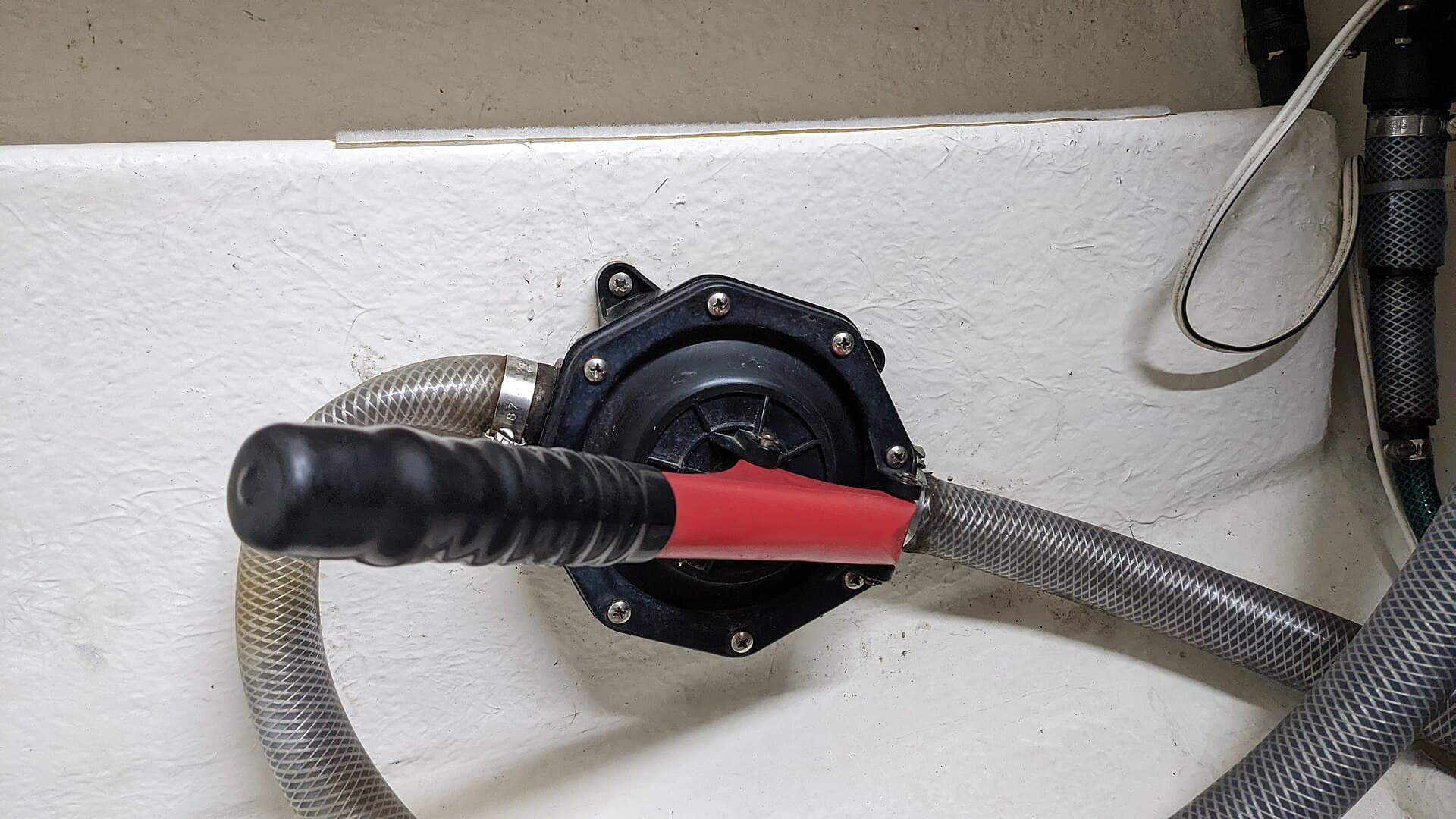
- Whale builds positive-displacement hand diaphragm pumps. The flagship Gusher 30 is a double-diaphragm design in a powder-coated die-cast aluminium (LM6-type) alloy body with twin nitrile diaphragms and nitrile flap valves; the maker quotes up to 117 L/min at 70 strokes/min. Positive displacement means output is volume-per-stroke times stroke rate — it barely cares about discharge height until self-priming lift is exceeded (the maker quotes self-prime and lift to ~4 m). No motor, no battery dependency: the failure mode is a perished diaphragm or valve, which degrades gracefully rather than dying.
- Jabsco builds powered belt-drive diaphragm pumps (36600/36680 series). A 12 V motor drives a diaphragm through a belt and connecting rod, so it is self-priming to ~3 m (10 ft) of vertical lift, runs dry indefinitely, passes small debris, and mounts high and dry above the bilge. Published open flow is ~475 US gph, and unlike a centrifugal it holds most of that against head. Built-in hydraulic pulsation damper and permanently-lubricated ball bearings; NMMA-accepted to USCG 183.410 and ISO 8846 (ignition protection) / ISO 8849 (electric bilge pumps).
- Rule builds centrifugal submersibles — an impeller in a volute on a stainless shaft, double-insulated ignition-protected motor. Enormous open-flow numbers (the 2000 model: 7571 LPH open flow, 8.4 A at 12 V, 15 A fuse, ~2500-hour motor life, 28 mm barb), silent and cheap, but not self-priming and steeply head-sensitive. This is the everyday automatic pump on most boats — and the one whose rating flatters most.
The engineering that actually separates them
Head/flow: why the box number is fiction
A centrifugal submersible produces a head/flow curve: maximum flow at zero head (shut-off is at maximum head, zero flow). The advertised GPH is the run-out point of that curve — 12 V, no static lift, no friction. Put the same pump in a boat and two things eat the rating: static head (the vertical lift to the skin fitting) and friction head (hose bore, length, bends, check valve, fitting restriction). The rules of thumb from the standards work are brutal: roughly 8% of rated flow lost per foot of lift, so ~24% gone at 3 ft and ~40% at 5 ft, landing most installs at about 60% of the box figure. Rule's own guidance is that small submersibles are rarely useful past ~4 ft (1.2 m) of head and even large ones fall off a cliff past ~7 ft (2.1 m). This is exactly why ABYC now requires makers to publish a second and third rating — 1 m head with 3 m of hose, and 2 m head with 6 m of hose — and why you size on those, never on open flow.
The Jabsco diaphragm behaves oppositely: as a positive-displacement pump its flow is nearly flat against head until the motor stalls, so its modest 475 gph open-flow number is close to its delivered number at a realistic 1–2 m lift — where a "bigger" 2000 GPH centrifugal may have collapsed below it. On a Melges 40, mounting the submersible low with a short, straight, full-bore run and a smooth-bore skin fitting is worth more real litres than buying a bigger pump and plumbing it badly through a loop and a restrictive one-way valve.
Priming and dry-running: the install constraint
A centrifugal cannot self-prime — it must be submerged to move water, and once the level drops below the impeller it simply spins in air. That is fine for a pump that lives at the lowest point, useless for one you want mounted high. Run a Rule dry and nothing breaks (it is designed to tolerate it), but nothing pumps either. A diaphragm — hand (Whale) or powered (Jabsco) — is self-priming (Whale to ~4 m, Jabsco to ~3 m) and runs dry indefinitely without damage, which is precisely what lets the Jabsco sit on a bulkhead above a wet bilge and pull water up to it, and what lets the Whale clear the last of the water a submersible leaves behind. On a race boat with a deep, awkward bilge and gear stacked over the sump, the self-priming diaphragm's ability to draw from a remote low point through a pickup hose is often the deciding practical factor.
Switching: the real weak link in the auto system
For an automatic pump the switch, not the pump, is the component most likely to strand you. Two philosophies:
- Mechanical float — Rule-A-Matic Plus. A snap-action switch actuated by a hinged float, mercury-free, rated 20 A at 12 V (10 A/24 V, 6.5 A/32 V), tested past one million cycles, on at ~2" (50 mm), off at ~3/4" (19 mm), with a detachable base for cleaning. Simple and proven, but the moving arm is the enemy: bilge grime, a stray sail tie or a length of old line can jam it off (pump never runs) or on (pump runs the battery flat and can burn out). The impact-resistant shroud reduces, not eliminates, jamming.
- Field-effect / solid-state — Rule-Mate integrated, and third-party capacitive units (Water Witch). No moving parts. Rule's field-effect sensing detects water specifically and, per the maker, will not trigger on a 100% oil film — so it won't chatter on a diesel sheen, a real problem for probe-type conductive switches. On at ~2", off at ~3/8" (9 mm). The trade-off: a slimy conductive film can hold a sensor on, and very clean rainwater can read as no-water and leave the pump off. Capacitive units add microprocessor delay to purge hose runs and counter surging.
Neither is fit-and-forget on a race boat. The defensible build is a separate, accessible float switch you can lift and wipe (not a sealed integrated pump that must be pulled entire when the sensor sulks), a manual override at the panel so the pump runs on command, and a dock test every regatta. Note OSR 3.23 here: required pumps must be operable with cockpit seats, hatches and companionway shut, must not discharge into a contained cockpit or via the cockpit drains, and must be accessible for clearing debris.
Materials, ignition protection and standards
The certifications diverge with the electrics. The Whale hand pump has no motor, so ignition protection is moot — its material story is the die-cast aluminium body and, critically, twin nitrile diaphragms: if one splits, the pump keeps working on the other, redundancy built into a single unit. The Jabsco and Rule carry the standards that matter aboard: ISO 8846 (ignition protection — non-negotiable near a fuel-vapour-capable space), ISO 8849 (electric small-craft bilge pumps), and USCG 183.410 with NMMA type-acceptance. Rule's motor is double-insulated on a stainless shaft, ~2500-hour life; Jabsco uses permanently-lubricated ball bearings and a belt drive on rubber mounts to cut noise and vibration. For a boat that may sail under Category-rated offshore regs, ISO 8846 on any powered pump is the entry ticket, not a bonus.
Serviceability over a hard season
This is where the diaphragm architecture earns real points. Both Whale and Jabsco diaphragm pumps are designed to be rebuilt in situ: a service kit (diaphragm(s), valves, seals; a belt for the Jabsco) restores the pump rather than replacing it, and the Whale opens for diaphragm and valve access without tools to clear a jammed valve mid-race. A Rule submersible is a sealed unit — you can swap the snap-lock strainer base or an external float switch, but a failed motor means a new pump. Over multiple seasons the rebuildable manual pump is the component you keep alive with a cheap kit; the submersible is a consumable you carry a spare of. The Gusher's twin-diaphragm design and available seal kits are why the line has survived essentially unchanged since the 1940s.
The layered system for a Melges 40
The correct architecture is not one "best" pump but defence in depth, and the three brands map onto it cleanly:
- Primary automatic — Rule centrifugal submersible, mounted at the low point, short/straight/full-bore discharge, sized on the derated (60%) figure, on a separate accessible float or field-effect switch with a panel override. Silent, hands-off, clears routine water while the crew races the boat.
- Secondary powered — optionally a Jabsco belt-drive diaphragm mounted high and dry, self-priming from the sump, for when the bilge floods past what the submersible can prime in or when you need a pump that lives above the water.
- Manual backup — Whale Gusher (30 for high volume, Urchin/10 for a compact install), plumbed to satisfy OSR 3.23 (operable with the boat sealed, handle on a lanyard, discharge not into the cockpit). This is the pump that still works after a flat battery, a tripped breaker or a jammed switch — i.e. exactly the moment you need it.
Choose flow by realistic worst-case ingress and available discharge height, not by the largest number on the box. A Gusher 30 at a sustainable 60–80 spm is delivering ~100 L/min regardless of battery state; a nominal 2000 GPH submersible at 2 m of head through mediocre plumbing may be delivering less than a third of its label.
Our take
With no partner in this category, our engineering view: don't rank these three against each other — they are different machines for different jobs. Rule owns the primary automatic slot on the strength of centrifugal simplicity and huge low-head flow, provided you specify to the head-derated figure and treat the switch as the weak link it is. Jabsco's belt-drive diaphragm is the answer when the pump must mount above a wet bilge, self-prime and run dry — a near-flat flow curve that beats a "bigger" submersible once there's real lift. Whale's hand Gusher is the non-negotiable manual backup: twin-diaphragm redundancy, tool-free service, and independence from every electrical failure mode that takes the other two down.
Our pick: build the layered system — Rule submersible as the automatic primary (sized on delivered, not open-flow), an optional Jabsco diaphragm where you need an above-bilge self-priming powered pump, and a Whale Gusher as the OSR-compliant manual backup. On a safety-critical item the badge matters far less than the engineering discipline: right pump for the head, right switch you can actually clean, and proof it moves water.
Who each is best for
- Whale — the manual backup and any application wanting a rebuildable, twin-diaphragm hand pump that survives every electrical failure (Gusher 30 for volume, Urchin/10 for tight installs).
- Rule — the primary automatic submersible for hands-off, high-volume, low-head bilge clearing — specified on the derated figure with an accessible switch.
- Jabsco — the above-bilge powered diaphragm, self-priming and dry-running, where a submersible can't live or can't prime.
All three are reputable; the decisive work is the layered design, correct head sizing and switch access — and proving it, not the badge.
The takeaway
Bilge pumps separate by pumping principle, not by ranking: Rule centrifugal for the automatic primary, Jabsco powered diaphragm for the above-bilge self-priming role, Whale hand diaphragm for the manual backup. Carry layered pumps for redundancy, size the electric one on delivered flow at your real discharge head (≈60% of open-flow, worse past 4–7 ft), prefer designs you can service and get kits for, and treat the switch as the component most likely to fail. Above all these are safety-critical: the pump you never test is the one that fails you. Put every pump through the bilge pump test, and log it in the safety audit.
Frequently asked questions
- Why does a 2000 GPH Rule pump not actually move 2000 GPH?
- Because that number is open-flow at zero head. A Rule submersible is a single-stage centrifugal — impeller in a volute — and its output collapses along a head/flow curve as it has to lift water. ABYC now requires a second and third rating at 1 m head with 3 m of hose and at 2 m head with 6 m of hose, and those figures are far lower: expect roughly 60% of the open-flow rating in a real installation, and Rule's own guidance is that small submersibles are ineffective past about 4 ft (1.2 m) of static lift, larger ones past about 7 ft (2.1 m). On a Melges 40 with the pump low and a short, straight, full-bore discharge you keep more of the rating; add a loop, a check valve and a restrictive skin fitting and you lose it to friction head. Size on the derated figure, not the box.
- Diaphragm or centrifugal for the primary electric pump?
- They fail differently, and that decides it. A Rule centrifugal submersible sits in the bilge, is cheap, silent and moves large volumes at low head — but it is not self-priming, must be submerged to prime, has no positive shut-off against backflow, and a dry-run just spins the impeller in air. A Jabsco belt-drive diaphragm (36600/36680 series) mounts high and dry above the bilge, self-primes up to about 3 m (10 ft), runs dry indefinitely, and passes small debris through its nitrile valves — at the cost of pulsation, current draw and a more involved install. For an inshore Grand Prix boat kept dry, a submersible is the pragmatic primary; the diaphragm earns its place where the pump must live above a wet or intermittently flooded bilge.
- Field-effect sensing or a float switch?
- A mechanical float — Rule-A-Matic Plus — is a snap-action switch (mercury-free, rated 20 A at 12 V, tested past a million cycles) whose weakness is the moving arm: bilge grime, sail ties or fishing line can jam it off, or worse, on, flattening the battery. Rule's field-effect sensing (Rule-Mate integrated pumps) has no moving parts and ignores pure oil, so it will not chatter on a diesel film — but a slimy conductive film can hold it on, and very clean rainwater can read as no-water. Neither is fit-and-forget. For race use, keep the switch a separate, accessible unit you can lift and clean rather than a sealed integrated pump, wire the manual override to the panel, and prove it on the dock. OSR 3.23 also bars discharge into a contained cockpit.
- Is this based on hands-on testing?
- No — this is an engineering comparison built from each maker's published specifications and the relevant standards (ISO 8846 ignition protection, ISO 8849 electric bilge pumps, USCG 183.410, World Sailing OSR 3.23), not a hands-on side-by-side. All flow, current and cycle figures are the makers' own. Bilge pumps are safety-critical, so the load-bearing work is testing the pumps you actually fit: confirm each runs and moves water at the real discharge height, keep intakes and strainers clear, and prove the manual backup before you need it. Field notes on reliability will follow through the season.
Related articles
Bilge Pump Testing
Bilge pumps are rated at zero head and open circuit — conditions you never see afloat. Test them wet against real plumbing, cycle every switch on rising water, and understand the head, hose, voltage and corrosion losses that quietly halve installed flow before you ever need it.
Read the articleThe Race Yacht Safety Audit: A Complete Guide
A safety audit verifies every item of safety equipment against four independent tests — present, in date, functional, accessible — on the boat's own schedule, not the inspector's. This is the category-by-category procedure with the real service intervals, expiry rules and failure modes each check exists to prevent.
Read the articleRace Yacht Safety Systems and Inspection
Race-yacht safety kit engineered to the event's category: ISO 12401 tethers, 150N ISO 12402-3 lifejackets, 406 MHz EPIRBs and AIS MOB beacons — with the load numbers, failure modes and service intervals that decide whether it works.
Read the article