Block and Clutch Inspection
Race blocks lose efficiency when plastic ball bearings creep or the sheave runs off-axis; clutches lose holding load and burn covers as cam teeth polish. The bearing physics, cam mechanics, D/d ratios and the inspection and test procedure that catches both while they are cheap.
12 min read
Blocks quietly shed efficiency when their plastic ball bearings creep or the sheave is dragged off-axis, and clutches lose holding load and start burning covers as the cam teeth polish smooth — both cost measurable speed and reliability long before they fail outright. A disciplined inspection of the boat's blocks and rope clutches catches the drift in its quiet phase, while it is still a cheap sheave or a replacement cam rather than a shredded halyard, a soft rig or a released control line in a breeze. The whole discipline rests on understanding two failure mechanisms at the level of the bearing race and the cam tooth — because both fail gradually and invisibly first, and only announce themselves under load.
How blocks actually work — and where efficiency goes
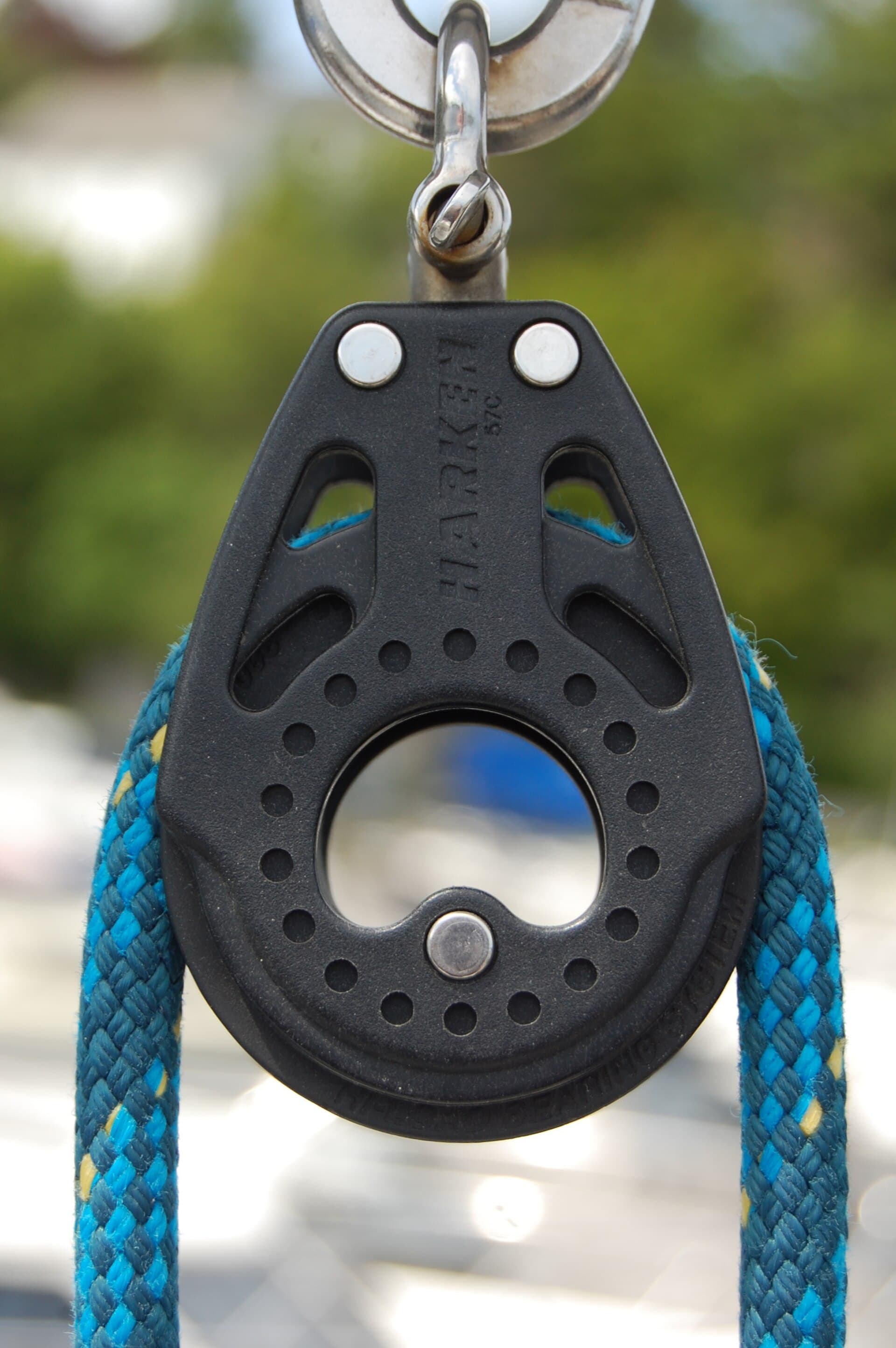
A block is a sheave turning on a bearing between two cheeks, hung off an attachment head. The bearing is what determines how much of the applied load survives the turn. Block efficiency — the fraction of load that comes out the far side after the friction of the turn is paid — is a real, measurable number, and on a good ball-bearing block under working load it sits above roughly 95 per cent; a worn or plain-bearing block can drop well below that. In a purchase system those losses compound: a 6:1 mainsheet passes the load through five or six turns, so a few points of efficiency lost per sheave multiplies into a system that is noticeably heavier and slower to respond in the trimmer's hand.
The bearing type sets the efficiency floor and the load ceiling. Rolling elements — ball or roller bearings — beat sliding (plain/bushing) bearings on friction because rolling contact dissipates far less energy than sliding contact, but they trade load capacity for it. Ball bearings give the lowest friction at low to moderate load. Roller bearings carry high load with low friction, which is why heavily loaded systems favour them, frequently with a ring of ball bearings around each shoulder to keep the sheave aligned and rolling cleanly under off-axis load. Plain bushings win only at very high static load, where they spread the reaction over a large sliding surface and accept the friction penalty. Ceramic and Zircon balls sit at the low-friction extreme, absorbing less energy before they break into rolling.
The bearing material is the crux of block wear. Acetal (Delrin) is an economical thermoplastic used for lighter-load sheaves, but it creeps — it deforms plastically under sustained load. Torlon (a polyamide-imide, part thermoplastic and part thermoset) is the high-load choice in Grand Prix hardware because it has markedly better creep resistance, a lower coefficient of thermal expansion and a higher flexural modulus, so it holds its round geometry and its clearances under pressure where acetal would flatten. A block's safe working load is, in engineering terms, the limit on how far those plastic elements can be squeezed before they take a permanent set. Exceed it, even once, and the balls or rollers deform to oblong and never recover — the sheave stiffens or stops turning and reverts to a high-friction plain bearing. So block failure is rarely dramatic. It is a sheave that used to coast for two seconds when you flicked it and now stalls instantly, taxing every trim. Salt crystallisation, abrasive grit and UV embrittlement of the plastic do the slower version of the same damage across a season.
The D/d ratio — why sheave size is a wear control
Sheave diameter is not just packaging; it governs how hard the line is bent and therefore how fast the rope wears. The controlling number is the D/d ratio — sheave diameter divided by line diameter. A tighter bend loads the outer yarns of the rope harder than the inner yarns, so a small sheave on a fat line concentrates fatigue on the outside of the bend and shortens the rope's life. The industry rule of thumb is a sheave 6 to 8 times the line diameter; for Dyneema and other HMPE running rigging, a ratio of 8:1 to 12:1 is favoured because the fibre is strong but sensitive to tight-radius bending fatigue. When inspecting, this reframes a grooved or ridged sheave: it often means the block has been run on a line finer than it was cut for, or has been overloaded, and it is now sawing at the cover on every cycle. Undersizing the sheave for the rope is a slow, self-inflicted rope-wear problem masquerading as a hardware one.
Inspecting a block
Work through each block by hand:
- Spin it and time the coast. A healthy sheave turns freely, near-silently, and coasts for a beat after a flick. Stiffness, grinding, a gritty rasp, or a sheave that stalls instantly means contamination or bearing breakdown. Compare against a known-good sister block on the same boat — the ear calibrates quickly.
- Load it sideways and read the alignment. Pull the sheave off its plane and watch how it sits. A wheel that rubs or binds against one cheek, or wears on one side, is running off-axis. Side load drags the block off its natural line so the sheave twists rather than running square — it concentrates the bearing load on one edge of the race and wrecks bearings fast. It is nearly always a lead-angle fault, cured with a swivel head or a Dyneema soft attachment that lets the block align to the load.
- Inspect the pin bore and sheave groove. An elongated, egg-shaped pin hole is the signature of repeated off-axis reaction or overload. A grooved, ridged or tapered sheave groove means overload or a wrong-diameter line — cross-check the D/d ratio above.
- Check the structure. Cheeks, becket, shackle, head and any composite or carbon parts must be crack-free and secure. A hairline crack in a cheek is a failure waiting for peak load — and the peak arrives when the block is most loaded, which is the worst possible moment for the released line to whip.
Good looks like a sheave that free-spins, coasts, runs square and shows even, minimal groove wear. Bad is notchy rotation a fresh-water flush does not clear, one-sided wear, play in the pin bore, or any crack — replace rather than nurse those, because a block that lets go under load is a whipping-line hazard to the crew.
How clutches wear — the cam physics and why it accelerates
A rope clutch grips the line with a spring-loaded, eccentric cam whose toothed or ribbed face bites into the cover. The mechanics are essentially a self-energising wedge: line tension tries to drag the rope aft, that motion rotates the cam so it presses harder into the cover, and the harder it presses the more friction it develops — the clutch grips itself tighter the more you load it. Holding load is therefore the product of how much normal force the cam geometry can generate against the cover and the coefficient of friction between cam teeth and cover material. Both terms degrade with wear: as the teeth polish smooth they need to bite deeper into the cover to develop the same grip, and once the line begins to creep under load the rate of both cam wear and cover wear accelerates sharply — a slipping clutch generates frictional heat and saws the cover off a halyard remarkably fast, and a burned or glazed cover then grips even worse, a runaway loop.
Cam geometry is where the engineering has moved. The simplest clutches press a flat cam against a matching lower surface, gripping the rope on two sides and concentrating the load on a narrow band of cover. More recent designs spread the grip: a V-shaped upper cam against a curved lower surface grips the rope on three sides, and opposed V-wedges grip on four. Spreading the bite over more of the cover circumference and a longer length of rope does two things — it raises holding load for a given cover, and, crucially for a Grand Prix inventory, it distributes the clamping load rather than point-loading one spot, which protects expensive cores. Class hardware spans a wide load range: as a rough guide to what modern jammers hold, a Spinlock XTS is rated near 1000 kg, and toothed and V-grip clutch families run from roughly 500 kg up past 6000 kg for the heaviest jammers, across line ranges from about 6 mm to 14 mm and larger. Sizing is the single biggest lever on holding power — run a line at the fine end of a cam's range and holding collapses, because the cam cannot close far enough to bite properly.
The cover material sets the friction term, and this is where high-tech line fights back. Dyneema (HMPE) has an inherently low coefficient of friction — the same slipperiness that makes it a good anti-chafe fibre makes it hard for a cam to hold. A pure-Dyneema cover can slip in a clutch that grips polyester securely. This is why raced halyards and control lines carry a grippier cover — polyester, or an aramid such as Technora — spliced over the working section that sits in the jaw, adding both diameter and a higher-friction surface for the cam to bite. If a Dyneema-cored line keeps slipping, the fix is usually a cover change or a diameter build-up over the clutch, not more spring tension. Replacement cams are sold for all the major brands at a small fraction of a new unit, and swapping one is straightforward, so a worn cam is a cheap repair caught in time.
Testing and inspecting a clutch
Two questions matter: does it hold, and is it damaging the line.
- Holding test. Put full working tension on the actual line, close the lever, and mark the cover where it exits the jaw. Sight that mark against a fixed reference and load hard. Aft creep means the cam is not generating the normal force the load demands — it is slipping. Test the line in its raced condition — wet, compressed, salt-loaded, mid-season — because a tired cover has a lower friction coefficient and reveals a marginal clutch a fresh cover would hide. The test is deliberately worst-case.
- Release test. It must release cleanly under load without the crew fighting the lever, and re-engage without the line snatching or jumping the cam.
- Cam inspection. Open the clutch and read the teeth under a good light. Rounded, polished or flattened teeth have lost their bite; grit and salt packed into the mechanism jams the cam and kills grip. Flushing salt out after every use is what keeps a cam sharp — the spring and cam pivot are as sensitive to contamination as the teeth.
- Read the rope. Look at the section that sits under the cam. Localised fuzzing, a flattened or glazed cover, or a nicked patch means the clutch is marking the line — cross-reference the rope wear guide. Persistent marking on an expensive Dyneema halyard is a clutch problem — a worn tooth profile point-loading the cover — not a rope problem.
When to replace, and protecting the line
Replace the clutch cam when the holding test shows creep, when the teeth are visibly rounded or polished, or as preventive maintenance on an ageing unit — a cam more than a decade old on a well-used boat is usually due, because the tooth profile has slowly rounded even without a single overload event. Replace the whole clutch if the body, base, spring or lever is damaged or corroded, since those govern the normal force the cam can develop. For blocks, replace on permanent stiffness, cracked structure, pin-bore play, or any deformation from overload. The governing principle for both is a cost hierarchy: the hardware is far cheaper than the rope it runs and the race it protects. A worn cam or a seized sheave quietly abusing a five-figure inventory of running rigging is a false economy. Size lines toward the upper diameter the cam is rated for, keep the teeth sharp and the cover grippy, and you get the most holding for the least cover damage.
On a Melges 40 Grand Prix campaign
The Melges 40 — a Botin Partners design, built in carbon and foam by Premier Composite Technologies, with a fractional square-topped rig and a canting keel that swings up to 45 degrees for righting moment (public class facts; verify any specific figure against the class rules and the boat's own documentation) — runs a dense network of high-load blocks and clutches: mainsheet system, halyards, runners and controls, all sheeted hard and cycled through short, intense races. Because loads sit near hardware limits and the boat is packed and travelled between regattas, the deck gear takes both mechanical and handling abuse, which raises the stakes on two failure modes. A mainsheet or runner block that has quietly seized — bearings crept oblong — adds drag exactly where the trimmer needs feel and speed, and its lost efficiency compounds through the purchase. A halyard clutch that slips can drop a headsail or soften the rig in a breeze, precisely when holding load is highest and creep is most punishing.
The specific hardware layout — sheave sizes, cam models, purchase ratios — must be read from the boat's own rigging and the class rules rather than assumed, since one-design fleets standardise these and figures should not be guessed. What the campaign controls is cadence and consistency: a fresh-water flush after every day on the water; a hands-on block-and-clutch check at least monthly with extra attention to the loaded systems; and a deeper strip on the annual maintenance schedule. Follow the hardware maker's servicing rule for ball-bearing gear — flush with fresh or warm soapy water and, critically, do not use spray lubricant, because it makes the balls skid instead of roll and destroys the low-friction behaviour you paid for; a single drop of a proprietary bearing conditioner is the most a race sheave wants. Keep spare cams for the halyard clutches and a couple of common sheaves in the spare parts inventory so a marginal fitting is swapped on the dock, not discovered on the water.
The takeaway
Blocks and clutches fail quietly first — a few points of lost efficiency, a millimetre of creep — then loudly under load. The whole job is catching the quiet phase: spin and coast every sheave, load-test every clutch against a marked reference, read the cover for the clutch's fingerprints, and replace cheap wear parts before they cost you rigging or a race. Fold it in beside winch service, deck hardware servicing and salt corrosion prevention so the whole control system stays free-running, high-holding and dependable at the loads that decide races.
Frequently asked questions
- How do you test whether a rope clutch still holds?
- Load the exact line the clutch is meant to hold at full working tension, close the lever, and mark the cover where it exits the jaw. Sight that mark against a fixed reference — the clutch body edge — and load it hard: any aft creep while the lever is closed means the cam is no longer generating enough normal force to develop the friction the load demands, and the clutch is slipping. Test with the line in its raced condition — wet, salt-loaded, compressed, mid-season — never a clean dry offcut. A tired cover with a depressed, glazed surface has a lower coefficient of friction against the cam teeth, so it exposes a marginal clutch that a fresh grippy cover will mask. The test is worst-case by design.
- How worn is too worn for a block bearing?
- A ball- or roller-bearing block should spin freely and near-silently by hand and coast for a beat after you flick it. Stiffness, grinding, a gritty rasp, or a sheave that stalls immediately means the bearings are contaminated or have taken a permanent set. Acetal and Torlon bearings creep — deform plastically — under sustained or shock load, and once a block has been driven past its safe working load the balls or rollers go oblong and never recover their geometry, so the sheave stops rotating and reverts to a high-friction plain bearing. Notchy or noisy blocks that do not clear after a fresh-water flush are adding measurable drag to every trim and should be serviced or replaced; a block that has visibly deformed is finished.
- What does side-load damage to a block look like?
- Side load is any force component that pulls the block off the plane of its sheave, twisting the wheel against one cheek instead of letting it run square to the load. It concentrates the bearing load on one edge of the race rather than distributing it, so it wrecks bearings far faster than an equivalent in-plane load. Signs are a sheave that rubs or binds against one cheek, one-sided or tapered wear on the sheave groove, an elongated egg-shaped pin bore from the off-axis reaction, and a block that runs rougher under angle than it does hanging free. On a Melges 40 it usually means the lead angle is wrong or the block needs a swivel head or a Dyneema soft attachment that lets it self-align to the load.
- How often should you inspect blocks and clutches on a race boat?
- Flush salt out with fresh water after every day on the water — this is the single highest-value habit, because salt crystals and grit are abrasive and hygroscopic and do most of the slow damage. Give blocks and clutches a hands-on inspection at least monthly through a racing season, more often on the highest-load systems: mainsheet, halyards and runners. Do a deeper strip on the annual maintenance schedule — pull clutch covers to read the cams, cycle every sheave by hand, and check pin bores and structure. A Grand Prix campaign earns tighter cadence than a cruiser because loads sit near hardware limits and a slipped clutch or seized sheave in a breeze costs a race, not just a service interval.
Related articles
Deck Hardware and Servicing: Winches, Blocks and the Traveller
Winches, blocks, tracks, clutches and cleats carry a Grand Prix boat's biggest point loads. The engineering of each mechanism, the greases and oils that belong on it (and the ones that destroy it), the corrosion electrochemistry at every fastener, and the service intervals that keep them holding.
Read the articleWinch Service Basics
A winch is a two-regime lubrication problem: a calcium-sulfonate grease film on the 17-4 PH gears and stainless bearing races, a light oil on the pawls and springs, and nothing at all on the self-lubricating Torlon rollers. Here is the engineering behind the strip, clean, inspect and lube — and why the wrong grease backwinds the drum.
Read the articleRope and Line Wear: When to Retire a Line
HMPE running rigging fails at one worn spot, not evenly. Judge the worst single point: cover cut to the core, a glazed or flat core, milking, or heat above the 70-degree continuous-use limit — and know which failure is recoverable by end-for-ending and which is permanent.
Read the article