Race Start Timers Compared: Velocitek, Optimum Time and Garmin
An engineering comparison of race start timers — Velocitek ProStart, Optimum Time OS Series and Garmin quatix 7 — on GPS solution rate, distance-to-line geometry (perpendicular vs bow-offset), sync-to-gun mechanism, display physics and NMEA 2000 integration, with published figures. Objective, not a hands-on test.
Comparison
This is a comparison in the Invicta Labs review framework — an objective comparison based on published specifications, materials and category experience, with hands-on field comparison to follow. We do not publish ratings or ownership claims until we have genuinely tested the equipment ourselves.
12 min read
This is an independent, objective comparison — we have no partner in this category. Figures are the makers' published specifications; we have not bench-tested these units.
Three devices, three different jobs, three different physics. The Velocitek ProStart is a purpose-built GPS start computer that turns two pings into a live perpendicular distance-to-line. The Optimum Time OS Series is a pure programmed countdown — no GPS, no positioning, just a loud, correctable clock the whole cockpit works to. The Garmin quatix 7 folds a sail-racing app (virtual line, burn-time, Tack Assist) into a multi-band GNSS marine smartwatch that also reads the boat's NMEA 2000 bus. They are not three versions of one product, so the comparison below is about which error each one actually solves on a Melges 40 line. For the tactics these tools feed, see the racing start explained; for where a timer sits in the wider system, see race-boat electronics.
At a glance
| Dimension | Velocitek ProStart | Optimum Time OS Series | Garmin quatix 7 |
|---|---|---|---|
| Core function | GPS distance-to-line + timer | Programmed countdown only | Sail-racing app in marine watch |
| Positioning solution | 72-ch multi-GNSS, 25 Hz internal / 4 Hz display | None | Multi-band GPS/GLONASS/Galileo, wrist-class rate |
| Distance-to-line | Perpendicular to infinite line, 0.1 m res, ~1 m quoted accuracy | Not offered | Virtual line + "time to burn" (± seconds early/late) |
| Bow reference | Bow offset + heading → bow-tip-to-line | n/a | Entered boat length, antenna-at-wrist |
| Sync-to-gun | Trim seconds on the fly | Original "Sync" — snap to nearest minute | Sync to official clock, add/subtract seconds |
| Display | Bonded Gorilla Glass, white-on-black, red/white backlight | 68 mm case, 36 mm face, 23 mm digits final 59 s (OS14) | 1.3" MIP (Std) / AMOLED (Pro/Sapphire), wrist-sized |
| Cockpit-wide readability | On-deck mast/pushpit mount | Loud buzzer + big digits, shared | Personal wrist only |
| Boat-data integration | Standalone | Standalone | NMEA 2000 via GNT 10: wind/depth/RPM + Tack Assist |
| Power | 75 h Li-ion, USB | 5 ATM, coin-cell / OS12R–OS14 rechargeable | ~57–60 h GPS, up to 18 days watch mode |
| Our pick | Line-critical starts, shared display | Loud, foolproof crewed countdown | Tactician's wrist + boat data |
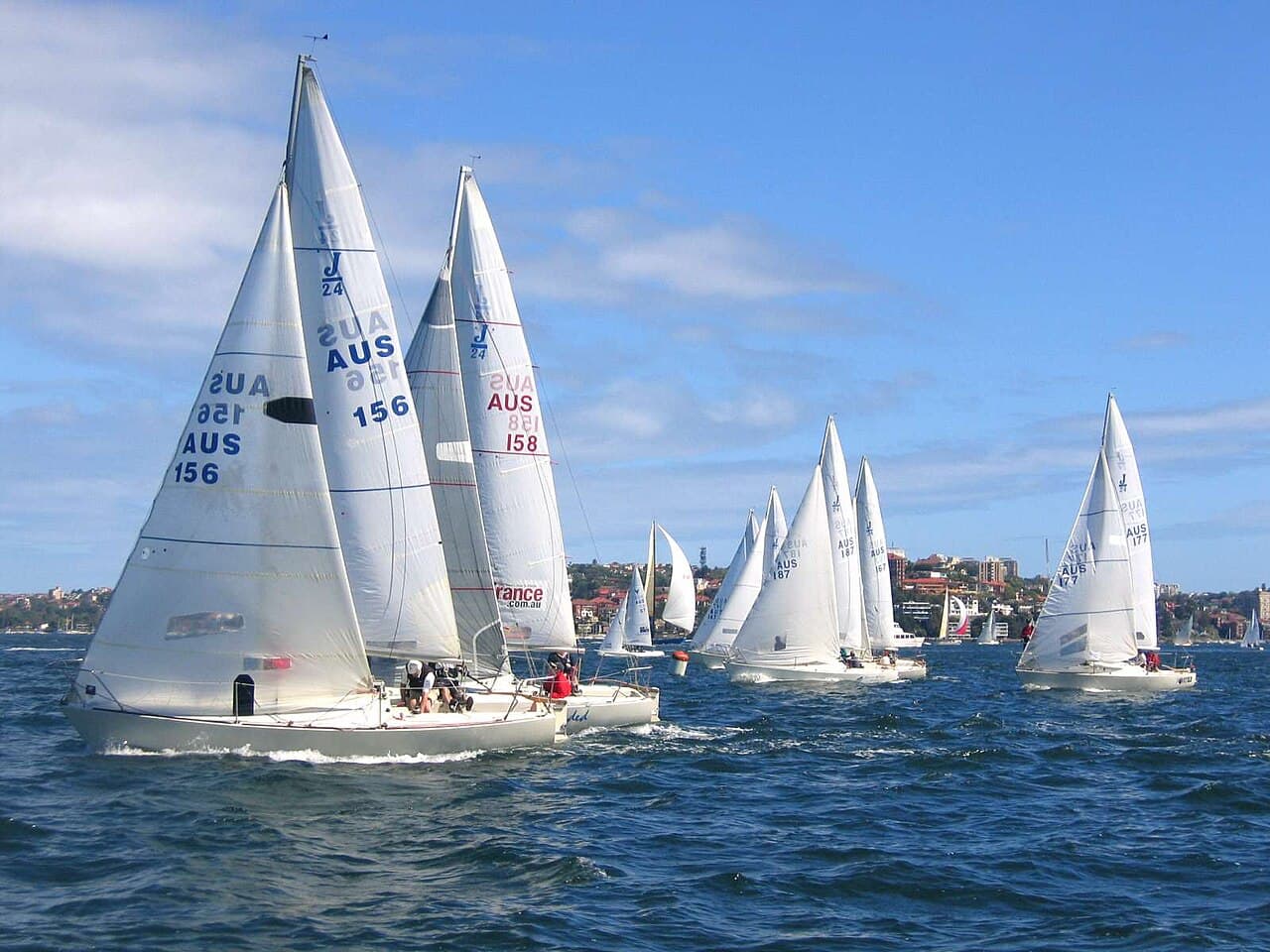
The category, at engineering level
A start device is trying to defeat one or both of two errors: a temporal error (your clock has drifted off the committee's real sequence) and a spatial error (you don't precisely know your range and closing rate to the actual line). Optimum Time attacks only the first, mechanically and superbly. Velocitek attacks the second with a dedicated GNSS solution and a line-geometry model. Garmin attacks both in software on a general-purpose watch and then adds a third axis the others ignore — live boat data off the network. Everything below follows from those design choices.
Distance-to-line geometry — the real Velocitek difference
Perpendicular-to-the-infinite-line, not range-to-mark
The single most misunderstood spec in this category is what "distance-to-line" means. The ProStart does not report your range to the nearest mark. It defines the infinite straight line through your two pings and reports your perpendicular distance to that line, at 0.1 m resolution between 99.9 and −9.9 m, with Velocitek's published accuracy around 1 m. That is the correct quantity for judging a square run-in — but it carries a known failure mode at the ends. Approach at an angle, or slide toward the pin, and the perpendicular number understates your true distance to the real line segment: you can be reading a comfortable few metres while your bow is about to cross outside the pin. On a Melges 40 with serious approach speed this is exactly the geometry a good bowman/tactician learns to cross-check by eye. The digits are a closing-rate and square-to reference, not a literal "metres to burn".
Bow offset — why the number describes your bow, not your antenna
The feature that separates a serious GPS start device from a bare GPS is the bow offset. You enter, in metres (rounded to the nearest metre), the distance from where the unit is mounted to the bow. The ProStart then fuses that offset with live compass heading so the displayed distance is bow-tip-to-line, continuously corrected for the boat's orientation — not the position of the box on the pushpit or coachroof. On a ~12.4 m Melges 40 that offset can be a large fraction of the reading; without it the device would be honest about where the antenna is and useless about where the bow is. The related "Line Square To" helper aligns the boat perpendicular to the line and depends on you having entered your local magnetic declination — get that wrong and the square-to logic is wrong by the declination angle.
The bar graph and shift indicator
Beyond the raw number the ProStart drives a distance bar graph at 10 m per segment and a wind-shift indicator at 2.5° per segment, referenced to the tack angle at ping. Both update twice a second. For the afterguard that means peripheral, glance-able closing information without reading four digits under load — and a coarse persistent-shift cue in the pre-start that the Optimum Time simply cannot produce.
Positioning solution and update rate — why "GPS" is not one thing
All GNSS is not equal, and this is where a dedicated device justifies itself against a watch. The ProStart runs a 72-channel multi-constellation receiver with a 25 Hz internal solution and refreshes the display at 4 Hz (twice a second in start mode). A 25 Hz solution matters not because you read the screen 25 times a second but because the underlying velocity and position estimate is being computed from far more fixes, which tightens closing-rate and heading derivation in the final, high-workload seconds. The quatix 7 uses multi-band (L1/L5) multi-GNSS — GPS, GLONASS and Galileo — which genuinely helps raw positional accuracy near rigs and structures, but it is a wrist fitness-grade solution and pipeline, not a 25 Hz start-tuned one; its sail-racing outputs are computed for a personal display, not a shared-instrument refresh. The Optimum Time has no GNSS at all: nothing to acquire, nothing to lose, no cold-start wait on the dock — which, perversely, is part of its reliability story.
Sync-to-gun — a temporal fix, and it is not the same as a ping
Optimum Time's claim to fame is the Sync button: press it and the running countdown snaps to the nearest whole minute, correcting any drift between the clock you started and the committee's actual signals. It is elegant precisely because it is narrow — it fixes when you think zero is, to the second, with one thumb, and it works when the RC fires off your count. Both the ProStart and the quatix let you trim seconds on the fly and the quatix explicitly syncs its regatta timer to the official clock with add/subtract. But none of the second-trimming is a substitute for a ping: sync corrects time, a ping corrects space. If the line is skewed, if the boat end is favoured, if you're closing early because the line geometry (not your clock) put you there, only the pinged-line devices know. Conversely, a GPS unit with a mis-synced timer will confidently drive you to a perfect line position at the wrong second. On a well-drilled Melges 40 the two corrections are complementary, not redundant.
Time-to-burn — Garmin's headline number, and its assumptions
The quatix 7 sail-racing app computes "time to burn" from your speed over ground, an entered boat length, and the distance to the virtual line: positive burn means you'll reach the line before the gun (you have time to kill), negative means you'll arrive late. It is genuinely useful single-number guidance for one sailor. But its honesty is bounded by its inputs — it assumes present SOG holds, and it references the line the watch pinged from wherever the watch was on the boat (there is a boat-length setting, but the antenna is on your wrist, wandering as you move). The ProStart's bow-offset-plus-heading model is a more rigorous treatment of where the boat actually is; the quatix's burn-time is a smarter treatment of what to do about the time you have. Different halves of the same problem.
Display physics and cockpit readability
This is where the "dedicated vs personal" split is most physical. The Optimum Time OS14 puts a 36 mm dot-matrix face in a 68 mm ABS case, three rows dropping to a single row of 23 mm digits for the final 59 seconds, with an adjustable viewing angle so it can be aimed at the afterguard, plus a loud (silenceable) buzzer and vibration; it is 5 ATM and shock-resistant. The OS12 shrinks that to a 28 mm face with 19 mm final-minute digits in a wrist form; the OS11 is a 26 mm single-row entry unit. The point is a shared signal — everyone in the cockpit hears the beep and reads the number without asking. The ProStart uses a bonded Gorilla Glass panel with high-contrast white-on-black digits and a selectable red/white LED backlight, engineered to stay legible through polarised sunglasses and mounted on the mast or pushpit for continuous crew reading. The quatix 7 is the readability compromise of the three: the 1.3-inch transflective MIP Standard is excellent and always-on in sunlight, while the AMOLED Pro/Sapphire is brighter but a wrist-sized, single-user screen with beeps and vibration — a personal cue, never a cockpit-wide one.
Beyond the start — integration and the second job
Here the ranking inverts. The ProStart and Optimum Time do exactly one thing and stop. The quatix 7, paired with a GNT 10 NMEA 2000 transceiver, pulls true/apparent wind, boatspeed, depth, water temperature and engine RPM off the boat's network onto the wrist, offers Tack Assist (headed/lifted against a user-entered target tack angle) through the beat, and can drive select Garmin chartplotter and autopilot functions. On a Grand Prix boat with a real instrument system that turns the watch from a start toy into a tactician's wrist repeater and a redundant data head — a role neither single-purpose device attempts. It is the strongest argument for the Garmin that has nothing to do with the countdown itself.
Power and reliability
The ProStart carries a 75-hour Li-ion pack charged over USB — regatta-week endurance with no cell to lose mid-series, though it is one more device with a battery to remember. The Optimum Time is the reliability benchmark by simplicity: 5 ATM, shock-resistant, coin-cell longevity on the base models with rechargeable OS12R/OS14 options, no GNSS to acquire and effectively nothing to configure under pressure — you can hand it to a new crew member at the two-minute gun. The quatix 7 offers roughly 57–60 hours in GPS mode and up to 18 days in watch mode, but it is a full smartwatch: the race timer lives among menus, and a general-purpose device asks more of the user in the last thirty seconds than a single-button one.
Our take
For the shared, decisive job of putting the whole afterguard on one clock, the Optimum Time OS Series is still hard to beat — the Sync button is the cleanest temporal correction in sailing, the OS14's 23 mm final-minute digits and loud buzzer are a genuine cockpit-wide signal, and there is essentially nothing to go wrong. For line-critical starts where geometry decides the race, the Velocitek ProStart is the more serious instrument: a 25 Hz dedicated solution, a perpendicular-line model, and — crucially — a bow-offset-plus-heading calculation that reports where your bow is, not where the box is, on a boat where that difference is metres. Respect its end-of-line perpendicular limitation and it is the most rigorous "where am I on the run-in" tool of the three. For the tactician who wants one device to also read the boat, the Garmin quatix 7 is the pick — burn-time, virtual line and, above all, NMEA 2000 wind/speed and Tack Assist on the wrist — accepting that as a start display it is a personal 1.3-inch screen, not a cockpit instrument. Many well-run Melges 40 programmes end up running two: a dedicated audible countdown or a mast-mounted ProStart for the crew, and a quatix on the afterguard's wrist for data and backup.
Who each is best for
- Velocitek ProStart — crews who want a shared, on-deck GPS start computer with true bow-referenced distance-to-line and closing rate on long or skewed lines, and who will drill its ping and bow-offset routine.
- Optimum Time OS Series — any crewed boat that wants a loud, big-digit, foolproof countdown the whole cockpit works to, with the definitive sync-to-gun and nothing to acquire or configure.
- Garmin quatix 7 — the tactician's wrist: virtual line and burn-time plus live NMEA 2000 boat data and Tack Assist, best as a data head and start backup alongside a dedicated cockpit unit.
The takeaway
Choose by the error you most need solved. A temporal problem — is the crew on the right second? — is Optimum Time's home ground and the Sync button is the tool. A spatial problem — where exactly is the bow on a long, skewed line? — is the ProStart's, and the bow offset is why its number means something. A tactical/integration problem — I want the line, the burn, the wind and the shifts on one wrist — is the quatix's, via NMEA 2000. None of it pays off unless the crew has rehearsed the sequence it counts down (see the racing start explained) and knows where the timer sits in the wider race-boat electronics picture.
Our pick: for one loud, correctable countdown the whole crew works to, choose the Optimum Time OS Series; for bow-referenced distance-to-line and closing rate on line-critical starts, choose the Velocitek ProStart; and for burn-time plus live NMEA 2000 boat data and Tack Assist on the tactician's wrist, choose the Garmin quatix 7.
Frequently asked questions
- How does the Velocitek ProStart actually calculate distance-to-line?
- It computes the perpendicular distance from a reference point to the infinite line defined by your two pings, not the range to the nearest mark. On a Gen 2 unit the internal GPS solution runs at 25 Hz and the display refreshes at 4 Hz (updated twice a second in start mode), with 0.1 m resolution shown between 99.9 and −9.9 m and roughly 1 m quoted accuracy. Critically, once you enter a bow offset (in metres, rounded to the nearest metre) the ProStart fuses that offset with heading to report bow-tip-to-line rather than antenna-to-line — so on a 12 m Melges 40 it isn't telling you where the transom-mounted unit is, it's telling you where your bow is. The 'Line Square To' feature needs your local magnetic declination entered to work.
- What does sync-to-gun do at the mechanism level, and does it help if the line is skewed?
- Optimum Time's Sync button snaps the running countdown to the nearest whole minute on a keypress, correcting drift between the clock you started and the committee's actual signals. It is a purely temporal correction — it fixes when you think zero is, not where the line is. A GPS unit's ping is the spatial equivalent: it fixes the geometry. They solve different errors. The ProStart and quatix let you trim seconds on the fly as well, but only the pinged-line devices know if the boat end is favoured or if you're closing the line early because the line itself is skewed to the run-in.
- Perpendicular distance-to-line has a known failure mode near the ends — what is it?
- Because the ProStart reports distance to the infinite line, its number is only trustworthy when you are running in square to the line and inside the two marks. Approach at an angle, or drift toward an end, and the perpendicular reading understates your true range to the actual line segment — you can read a comfortable few metres while the bow is about to poke past the pin. Professionals treat the digits as a closing-rate and square-to reference in the final approach, not as a literal 'metres to burn', and cross-check the pin and boat ends by eye. The bow offset removes the antenna-position error but not this end-of-line geometry limit.
- Is a Garmin quatix 7 a real substitute for a ProStart on a Grand Prix boat?
- For the individual it does a lot: virtual start line between two pinged marks, a regatta timer synced to the official clock with seconds add/subtract, and 'time to burn' (positive means you arrive early, negative means late) computed from SOG, entered boat length and line distance. But it is a 1.3-inch wrist display with a 4 Hz-class fitness GNSS solution and no shared cockpit output, versus the ProStart's dedicated 25 Hz solution on a bonded Gorilla Glass panel the whole afterguard reads. Where the quatix pulls ahead is integration: paired with a GNT 10 it streams true wind, boatspeed, depth and engine data off the NMEA 2000 bus onto the wrist and offers Tack Assist (headed/lifted against your target tack angle) — a tactical role the single-purpose devices don't touch.