Sailmon Max Display: A Research Note
Engineering read on the Sailmon Max: a sealed, portless racing display fusing a 25Hz multi-GNSS receiver and 9-DOF IMU behind a 4.4-inch transflective LCD. Now discontinued and supported by Vakaros.
Research Note
This is a research note in the Invicta Labs review framework — we are documenting what we are looking for and the options we are weighing, before any purchase or testing. We do not publish ratings or ownership claims until we have genuinely tested the equipment ourselves.
13 min read
This is a research note — a deep look at the product and what we would assess, before hands-on testing. We do not publish ratings or ownership claims until we have used it ourselves. Specifications below are the maker's published figures unless flagged otherwise.
The Sailmon Max is a sealed, portless racing display that fuses a 25Hz multi-constellation GNSS receiver and a 9-degree-of-freedom inertial measurement unit behind a 4.4-inch transflective LCD, producing live speed, heading, heel, VMG and start-line data with nothing wired to the boat. It built its reputation on sportboats and one-design keelboats on the strength of that transflective screen, its self-contained sensor package and a clean start engine. The caveat up front: the Max is no longer in production. Vakaros acquired the Sailmon Max line from North Technology Group — announced March 2025, with the Max and Max mini withdrawn from sale around the end of January 2025 — and support has since moved to Vakaros. We treat it here as still-relevant kit; plenty are in service and on the second-hand market.
At a glance
| Spec | Sailmon Max (published) |
|---|---|
| Display | 4.4-inch transflective LCD, 320 x 240 px, anti-reflection front glass |
| Positioning | 25Hz multi-GNSS: GPS, GLONASS, Galileo, BeiDou (single-band) |
| Motion | 9-DOF IMU — heading, heel, pitch |
| Derived data | BSP, SOG, COG, heading, position, heel, pitch, VMG, header/lift |
| Augmented data | AWA, AWS, TWA, TWS, TWD (with NMEA wind or cloud model) |
| External inputs | NMEA 0183 and NMEA 2000 (speed, depth, wind) |
| Connectivity | WiFi 2.4GHz, Bluetooth — no wired ports |
| Charging | Inductive (Qi-style) wireless pad; no charge socket |
| Battery | 3600mAh Li-po; ~16 h quoted, everything running |
| Water rating | IP67; the unit floats |
| Size / weight | 93 x 118.5 x 22 mm; 275 g |
| Controls | Soft keys top and sides — menu, calibrate, ping, start timer |
| Logging | Unlimited on-device logging; syncs to Sailmon app |
| Status | Discontinued; supported by Vakaros |
The sensor package and why it stands alone
The defining engineering choice in the Max is that it is not a network head. It carries its own primary sensors, so it outputs meaningful racing data the instant it is powered — no masthead unit, no paddlewheel, no processor, no commissioning.
Positioning comes from a 25Hz multi-constellation GNSS receiver tracking GPS, GLONASS, Galileo and BeiDou. The 25Hz solution rate matters more than the constellation count for a race boat: at 25 fixes per second the receiver resolves sub-second changes in SOG and COG, which is what makes GPS-derived speed usable for trim feedback and lets the start engine draw a live distance-to-line that does not lag the boat. Tracking four constellations widens the visible-satellite pool, firming up the fix in the partial sky-blocking under a big square-top main and improving geometry (lower DOP). Critically, it is a single-band (L1) receiver — a qualifier we return to against the dual-band successor, because L1-only positioning is more exposed to ionospheric error and, at the start, to multipath off the water, the rig and nearby hulls.
Attitude comes from a 9-degree-of-freedom IMU — 3-axis accelerometer, gyroscope and magnetometer — sensor-fused for heading, heel and pitch. Gyro and accelerometer give responsive, drift-corrected heel and pitch; the magnetometer supplies heading. A professional treats that magnetometer heading with care: it is a strapdown magnetic compass sitting near a carbon rig, sheet winches and a mass of hardware, so it needs an honest swing calibration and is never a substitute for a properly sited fluxgate feeding a calibrated system. What it does very well is report, at high rate, what the platform is doing — heel through a gust, pitch over a wave — data a bare GPS puck cannot give. The exact IMU update and fusion cadence are not published to the precision of the GNSS figure — a gap we would characterise on the water.
The transflective display — the real reason it earned its name
The Max's screen is a 320 x 240 pixel, 4.4-inch transflective LCD behind anti-reflection front glass, and the panel is the single most-quoted reason crews rated it. A transflective LCD is a hybrid, carrying a partially reflective (semi-mirror) layer behind the liquid-crystal cell. In sunlight it runs reflective — incoming light passes through the pixels, bounces off that layer and returns to the eye — so the brighter the ambient light, the higher the effective contrast. Only in low light does it switch to transmissive, lit by the backlight. This is the opposite of the emissive TFT/OLED panels on a phone or chartplotter, which fight the sun and wash out; a transflective display uses the sun rather than competing with it, and draws far less power doing so, since in daylight the backlight can be dialled right down.
The trade-offs are equally real. Resolution is low by design — 320 x 240 buys enormous, glanceable digits, not graphics; you read one or two big numbers from the rail, you do not study a chart. Transmissive (backlit) mode is dimmer than an emissive screen at night, an inherent property of a semi-mirror in the light path. And the front polariser can interact with polarised sunglasses: at some head angles the crossed polarisers darken the panel, the one recurring criticism against otherwise strong daylight legibility. Independent users — including SailGP professionals — describe the numbers as large, glare-free and readable across wide viewing angles, exactly what the physics predicts. What that means for a helm reading over a shoulder from behind the wheel, and how real the sunglasses interaction is, we would confirm ourselves.
The sealed, portless architecture
The Max has no sockets or external ports of any kind. It charges on an inductive pad (Qi-style, contactless) and talks to the world over WiFi (2.4GHz) and Bluetooth. This is sound marine engineering: the commonest failure mode for a deck-mounted electronic is water ingress at a connector or a charge port left open, so deleting the port deletes the failure mode. The result is an IP67-rated unit — dust-tight and survivable to immersion — that also floats, no gimmick on a boat that can put its rail and instruments underwater. The cost is that everything, firmware and log offload included, goes over the air, and inductive charging is slower and fussier about alignment than a cable, so the pad becomes kit you cannot forget dockside.
Physically it is compact — 93 x 118.5 x 22 mm, 275 g — suiting mast-, bulkhead- or sole-mounting facing the crew. The 3600mAh lithium-polymer battery is quoted for all-day use, the realistic full-load figure around 16 hours with GNSS, IMU, screen and radios all live. Comfortable for one long regatta day; back-to-back days without pad access is where you would watch it.
The start engine and race pages
Beyond raw numbers, the Max was bought for its start engine, and this is where the sensor fusion earns its keep. The published feature set is countdown timer, distance to line, estimated distance from the line at the gun, line bias, VMG, an instant session report and instant rankings. The countdown runs off three top buttons — one to reset/sync, two to add or subtract time — so you synchronise the clock to the sound signal on the fly, the same sync-to-gun logic sailors know from an Optimum Time watch, here tied to a live GPS distance-to-line.
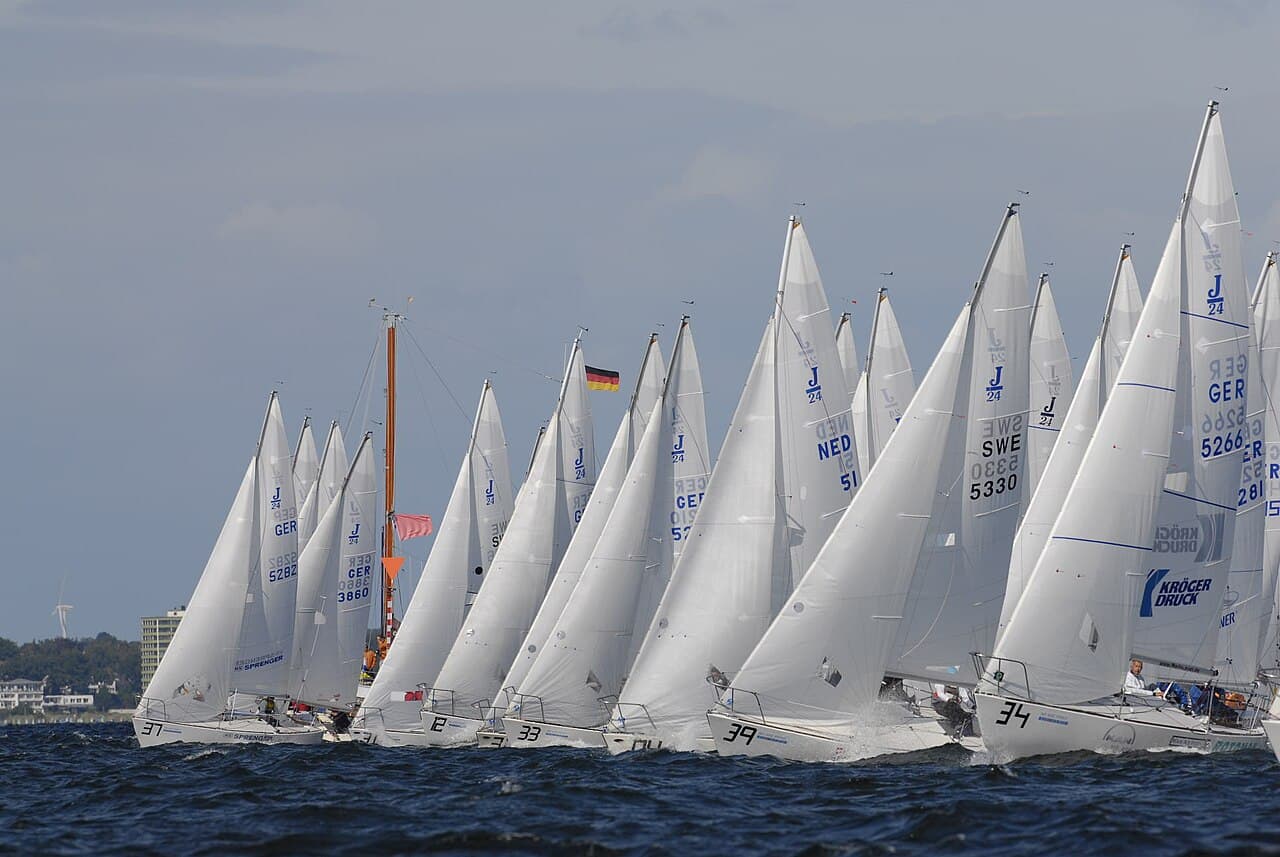
The mechanism a professional assesses is the pin-and-boat ping: sail to each end of the line, press the soft key to record a GPS point, and the Max computes perpendicular distance-to-line continuously and projects where you will be at zero. Its usefulness is capped by one thing — the accuracy of the underlying single-band GNSS. Line bias, distance-to-line and time-to-burn are only as trustworthy as the fix, and near the line, surrounded by carbon rigs and hulls, single-frequency L1 positioning is at its most multipath-exposed. On a boat as quick as a Melges 40, where a metre of sag or a second of timing decides between a lane and a bad start, that accuracy ceiling is the thing to test under pressure rather than take on faith.
The header-and-lift page tracks heading shifts to call the favoured tack, and VMG is computed continuously. True wind and a true-wind-based bias only become honest once real wind is bridged in — hence Sailmon's "augmented" label: absent a calibrated onboard wind system, some wind data is resolved against cloud models rather than measured, and a professional will treat model-inferred wind as guidance, not gospel.
The app, logging and data workflow
Every session logs on-device (Sailmon quotes unlimited logging) and syncs to the Sailmon app, which auto-splits a session into legs, surfaces best speed, best upwind and fastest-500m figures, and replays the race on a GPS-style map to scrub through speed, heading, heel and pitch at any moment. For structured training that leg-splitting is the real value — objective, high-rate numbers to review against crew calls; export historically fed platforms such as KND and Sailnord. The friction points to weigh are a fiddly initial configuration and export formats — how much either slows a training loop is something we would judge in use.
Variants and where it sits in Sailmon's own range
The Max mini shares the platform without a screen — a puck for boards and foilers where you race off phone or watch. Published figures: IP67, 190 g, 29 mm high, 3600mAh (~16 h), Bluetooth, WiFi 2.4GHz and, tellingly, LTE-M with an integrated SIM for live tracking — the same core sensing in a display-less body. Both fall under the same discontinuation.
Up the range sit the Element displays and the E4 processor — a different tier and owner, which stayed with North Technology Group under Synapse. That is the true instrument system: the E4 runs wind calibration at 25Hz with heading and linear-channel calibrations, drives up to 32 displays, and slots in as a processor upgrade against B&G H2000/H3000, NKE and Fastnet. The distinction matters for a Grand Prix reader — the Max is a self-contained display and start engine; the E4/Element is the calibrated processor-and-mast-display system. Different problems.
Where it fits on a race boat — and on a Melges 40
The Max lives in the ground between a start-line GPS watch and a full networked system. It gives far more than a Velocitek-class puck — real IMU motion data, a proper transflective screen, app analytics, a genuine start engine — while staying enormously simpler than a wired B&G, Raymarine or NKE install. For readers weighing that spectrum, our marine electronics compared overview and the race boat electronics guide set out how portable instruments, chartplotters and full systems relate; the broader sailing instruments and electronics piece frames the tiers.
On a fully instrumented Melges 40 with calibrated masthead wind, a fast paddlewheel and a processor feeding large mast displays, the Max's role narrows to a supplementary GPS-and-start device — a very good one, but not the centre of the system; the calibrated processor-and-display tier owns that role. Where the Max shines even on a top programme is as a portable, self-contained training and start tool: bolt it on, sail, review by leg, no commissioning.
An honest read versus the alternatives
The reference point today is the Vakaros Atlas 2, which Vakaros positions as the Max's successor, and the comparison is instructive. Both use a 4.4-inch, 320 x 240 transflective LCD and a 25Hz multi-constellation receiver — effectively shared display lineage. The decisive difference is the receiver band: the Atlas 2 runs dual-band L1+L5, the Max single-band L1. L5 (1176.45 MHz) lets the receiver model out ionospheric delay and, more relevantly for a start line, reject multipath off water and rigs far better — Vakaros publishes positional accuracy on the order of 25–50 cm (their materials cite both, layered with a differential "RaceSense" network) against the roughly metre-class accuracy typical of a good single-band unit. The Atlas 2 also publishes a larger 4600mAh battery, 100+ hours logging, an optically bonded Gorilla Glass front (160-degree viewing angle, RGB backlight) and 256MB storage. For pure start-line and line-bias precision, dual-band is a real, physics-based advantage — the honest reason a buyer choosing new hardware today would look at the current generation. We hold no view on Vakaros beyond that technical context.
Against the simpler end — a Velocitek ProStart or an Optimum Time watch — the Max is in a different class: those are excellent, rugged, single-purpose start instruments, but they carry no IMU heel/pitch, no app leg-analytics and no true-wind path. Against the heavy end — a wired B&G, NKE or Sailmon E4 system — the Max is not a competitor at all; it does not calibrate wind or drive a mast display, and it is not meant to.
The complicating fact is availability. With the Max discontinued and its owners now supported by Vakaros, a sailor shopping today is choosing between a used Max and current-generation kit — most directly the dual-band Atlas 2. "Buy a Max" is now a second-hand decision, and that, more than any weakness in the hardware, is what should shape it.
What we would assess
We have not tested the Max, so we would confirm the following on the water before forming a view:
- Single-band accuracy at the line. How the L1 GNSS holds distance-to-line and bias under real starting pressure amid massed carbon rigs — where its single-band receiver is most multipath-exposed and where a metre or a second decides the start.
- Display at helm angle and in polarised sunglasses. Whether the panel stays legible at the shallow angle a helm reads from behind the wheel, and whether the polariser/sunglasses interaction is a nuisance or a quirk.
- Data honesty and latency at pace. Whether GPS speed and IMU heel/heading feel trustworthy under load, and how cleanly TWA/TWD resolve on bridged NMEA wind versus the cloud-augmented mode.
- Magnetometer heading near a carbon rig. How well the IMU compass calibrates and holds against a boat full of ferrous and carbon hardware.
- Setup and data workflow. How much friction the fiddly initial configuration and export path add to a training routine, and how useful the leg-splitting analytics prove.
- Battery, charging and support longevity. Real endurance across a long day, how forgiving the pad is day to day, and — given the discontinuation — how dependable warranty and app updates prove under Vakaros.
The takeaway
The Sailmon Max is a genuinely well-engineered racing display: a sealed, portless, IP67, floating instrument fusing a 25Hz multi-GNSS receiver and a 9-DOF IMU behind a transflective screen built to use sunlight rather than fight it, with a competent start engine on top. On sportboats and one-design keelboats it earned its following honestly, and as a self-contained training-and-start tool it still has a clear place even alongside a full system. Two facts should shape any decision now. First, it is single-band L1 where the current-generation successor is dual-band L1+L5 — a real accuracy advantage precisely where a race is won, at the line. Second, it is discontinued: production has ended, support has moved to Vakaros, and a purchase means the second-hand market. Our read is that the Max remains a capable, well-conceived tool for its niche, and that its withdrawal from sale and single-band receiver — not any weakness in build or screen — are what a buyer should weigh today. We would want time on the water with a unit before saying more.
Frequently asked questions
- Is the Sailmon Max still available to buy?
- No. Vakaros acquired the Sailmon Max instrument line from North Technology Group, announced March 2025, and the Max and Max mini were withdrawn from sale around the end of January 2025. Vakaros now handles warranty and support for Max and Max mini owners; the Element display and E4 processor line stayed with North Technology Group under Synapse (a Future Fibres brand). Existing units still run and the app is still live, but no new stock is produced. Vakaros positions its dual-band Atlas 2 as the current-generation replacement.
- What data does the Sailmon Max show?
- From its own sensors the Max derives boat speed and SOG, heading and COG, heel and pitch, position, and VMG, plus a header-and-lift indicator, all off a 25Hz multi-constellation GNSS receiver and a 9-degree-of-freedom IMU with no wiring. Bridge in NMEA masthead wind and a paddlewheel and it adds augmented AWA/AWS and computed TWA/TWD/TWS, which is where true-wind laylines and a meaningful start-line bias become possible. Sailmon calls the wind data 'augmented' because part of it is resolved against cloud models rather than a fully calibrated onboard wind system.
- Can the Sailmon Max read data from boat instruments?
- Yes. The Max runs standalone from its internal GNSS and IMU, but it also ingests speed, depth and wind over NMEA 0183 or NMEA 2000. On a keelboat that lets masthead wind and paddlewheel boat speed feed the display alongside the GPS-derived figures, which is the only way to get honest true wind and layline output rather than GPS course-and-speed inferred wind. It is a display and start engine, not an instrument processor: it will not calibrate a wind system or drive mast displays the way a Sailmon E4, B&G or NKE processor does.
- Is the Sailmon Max readable in bright sunlight?
- By design, yes. The screen is a 4.4-inch transflective LCD behind anti-reflection front glass. A transflective panel reflects ambient light off an internal semi-mirror layer rather than relying on the backlight, so contrast holds up — and in effect improves — as the sun gets stronger, while the backlight only carries the display at night. The trade-off is a dimmer transmissive mode in the dark. Independent users, including SailGP professionals, reported the numbers were large and legible from wide angles; the known caveat is that some polarised sunglasses interact with the panel's polariser and can darken it at certain head angles.
Related articles
Racing Instruments Compared: B&G vs Garmin vs Raymarine
An engineering comparison of three sailing instrument ecosystems — B&G (H5000/Hercules/WTP3), Garmin (gWind/GNX/SailAssist) and Raymarine (i70S/Axiom/Alpha) — on the axes that decide a race: processor update rate, motion-corrected true wind, sensor quality, loadcell handling and tactical-software integration.
Read the articleRace Boat Electronics: What You Actually Need
A performance keelboat's electronics are a sensor-fusion problem, not a shopping list. This is the engineering: how apparent wind is measured and motion-corrected, how the true-wind vector is solved and calibrated for upwash and leeway, how boat speed is derived and trued against GPS, and how the whole system is networked and powered so the numbers stay trustworthy under load.
Read the article