VMG in Practice: Sailing to Your Targets
VMG is the projection of the boat-speed vector onto the wind axis — VMG = V·cos(TWA). The optimum is where d(V·cosθ)/dθ = 0, the tangent to the polar runs horizontal, and the marginal speed gained no longer pays for the angle spent. Here is the calculus, the apparent-wind coupling, the instrument error budget, and how a canting-keel Melges 40 is steered to it.
10 min read
VMG — velocity made good — is the scalar projection of the boat-velocity vector onto the wind axis: VMG = V·cos(TWA). On a race boat it is the number that resolves the two hardest steering questions on the course — how high to point upwind and how deep to soak downwind — by reducing a two-variable trade-off (speed and angle) to a single quantity you can maximise. A yacht generates no useful drive within roughly 30 to 35 degrees of the true wind, because inside that cone the sails cannot hold attached flow and lift collapses; so it foots off to an angle where the plan works, and VMG isolates the progress that actually counts from the raw speed through the water.
The calculus of the trade-off
Write VMG as a function of angle: VMG(θ) = V(θ)·cos(θ), where θ is TWA and V(θ) is the boat's steady speed at that angle — the polar. The optimum is the stationary point, d(VMG)/dθ = 0, which by the product rule gives
V'(θ)·cos(θ) − V(θ)·sin(θ) = 0 ⟹ V'(θ)/V(θ) = tan(θ).
That is the whole physics in one line. At the best-VMG angle, the fractional rate at which the boat gains speed as you bear away (V'/V) exactly equals tan(θ), the rate at which the cosine projection is bleeding that speed off the wind axis. Point higher and V'/V exceeds tan(θ) — you are losing more speed than the better angle returns. Foot lower and the reverse holds. Geometrically this is identical to the classic construction: the solution is where a line perpendicular to the wind axis is tangent to the polar curve, i.e. where a horizontal tangent touches the top of the upwind lobe on a conventionally oriented polar. Downwind, the same condition finds the tangent to the bottom of the running lobe.
The cosine term is unforgiving because its slope steepens with angle. At 45 degrees you keep about 71 per cent of V as VMG; at 50 degrees, 64 per cent; at 60 degrees, exactly 50 per cent. Crucially the optimum is a broad, flat maximum in VMG but a much sharper one in cost: within a couple of degrees of target the VMG penalty is second-order (fractions of a per cent), which is why chasing the last tenth is pointless — but stray five degrees and you are giving away real course. This flatness is also why the fastest boat on the water routinely loses the beat: footing off looks and feels quick, the speedo climbs, yet cos(θ) is quietly pointing that speed sideways.
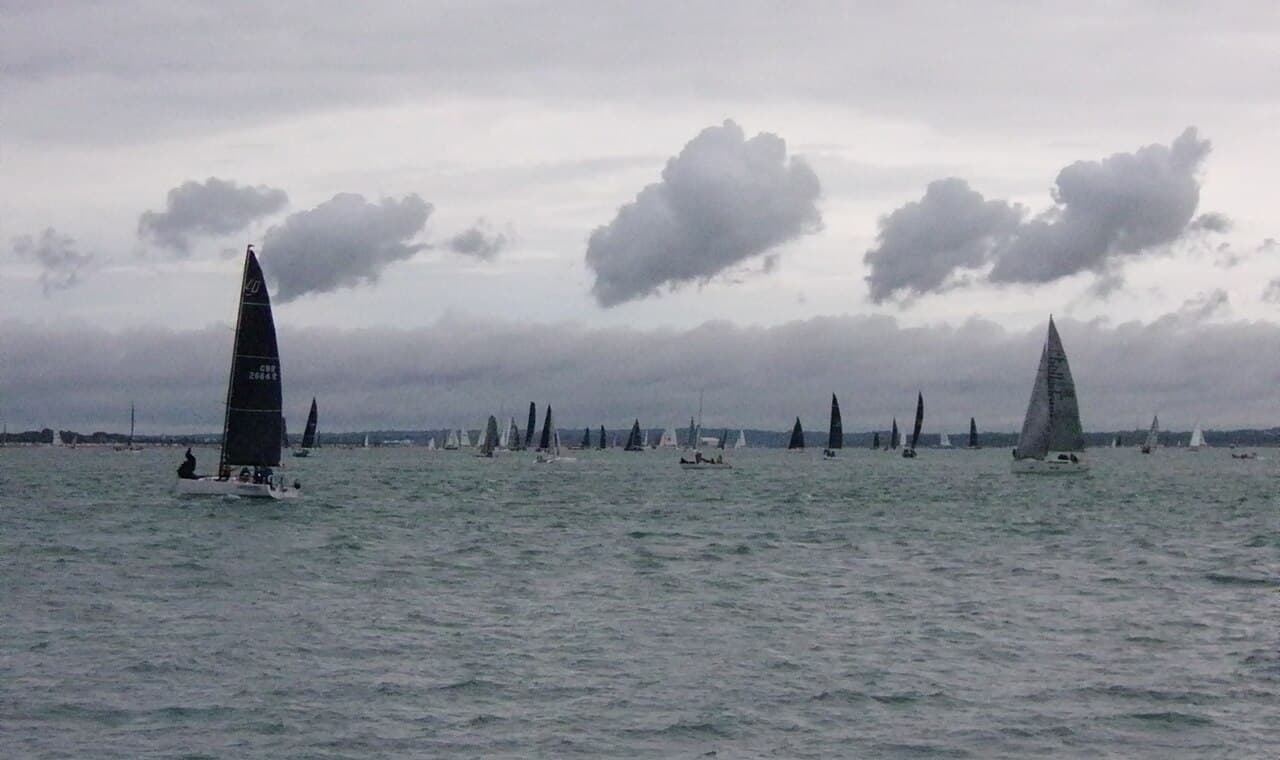
Why the target moves: apparent-wind coupling
Targets are not constants, and the reason is that the polar itself is a curve through apparent wind, not true. The boat sails in the vector sum of the true wind and its own reversed velocity. As true wind speed rises, V rises, the apparent wind vector both strengthens and rotates forward, so the sails see a lower apparent wind angle for the same TWA — and the boat can hold that lower angle without stalling. The net effect upwind is counter-intuitive to a beginner: as it breezes on you point lower and go faster at the same time. A typical modern sportsboat might move its upwind target from roughly 44 degrees TWA at 8 knots true to around 39 degrees at 16 knots, with target speed climbing the whole way. (These illustrative bands must be replaced by the boat's own measured polars before they are trusted on the water; a modern keelboat commonly targets somewhere near 40 to 50 degrees TWA upwind and 140 to 155 degrees downwind, but only the boat's paperwork is authoritative.)
The same coupling governs the downwind picture even more strongly, because the boat's speed is a larger fraction of the wind. On an asymmetric the sail must keep flow attached across it, so the crew effectively holds the apparent wind angle roughly constant — near 90 degrees — across a huge span of conditions, and it is the true gybing angle that swings: perhaps 90 degrees of gybing angle in light air collapsing toward 20 degrees when the boat is fully powered and generating its own breeze. That is why a planing boat can point far deeper downwind than its static speed would suggest — the apparent wind it manufactures on the bow lets it soak while the sail still sees reaching flow.
Reading targets off the polar, and the error budget
The polar comes from a velocity prediction program (VPP) that balances aerodynamic drive against hull, appendage and induced-drag resistance at each angle and wind speed, then it is corrected against on-water two-boat testing. The instruments do the live arithmetic from a paddlewheel or ultrasonic log, a masthead vane and anemometer, a compass, and a heel sensor — and this is where most of the day's confusion is manufactured, because VMG is a computed, not a measured, quantity, and every input feeding it carries a systematic error:
- Leeway means the paddlewheel, which reads flow parallel to the centreline, understates true speed through the water by roughly a factor of
cos(leeway), and the boat's track differs from its heading by the leeway angle — several degrees when pressed upwind. Uncorrected, this poisons both the speed term and the true-wind solution. - Heel tilts the masthead vane and anemometer, so raw apparent wind must be de-heeled before true wind is derived; get this wrong and TWA — the cosine argument — is off.
- Upwash and mast-head flow acceleration bias masthead wind, and the bias differs upwind versus downwind, so a rig calibrated on the beat reads optimistically deep.
Because VMG then differentiates these noisy signals, the displayed number lags real changes by seconds and flickers with every wave and puff. Treat it as a 10-to-20-second trend average confirming a decision the helm and trimmers already made by feel, never as a dial to hunt. The gap between live target VMG and achieved VMG is a scoreboard, but only once the calibration is honest.
Steering to the number without chasing it
The rudder is the reason chasing the box is expensive. A rudder generates side force by carrying an angle of attack, and with it induced drag that scales with the square of the lift coefficient — so drag rises roughly with the square of helm angle. Worse, on top of the boat's leeway the blade is already carrying a few degrees of effective angle before you touch the tiller; add helm and you climb the drag curve steeply, and as effective angle of attack approaches the section's stall — for typical rudder foils somewhere in the low tens of degrees, but the useful working limit is far lower because drag has already ballooned — flow separates off the low-pressure side, side force collapses and the blade becomes a pure brake mid-turn. Every saw-tooth correction therefore costs speed exactly when you were trying to build it, and the losses do not cancel: the drag penalty is nonlinear, so ten small corrections cost more than the one you avoided.
The reliable method is to steer to feel and to target boat speed, and let VMG confirm the trend. The helm senses load in the tiller and the groove long before any instrument resolves it; the trimmers sense whether the leech is choking flow or the sail is soft. That continuous two-way call — helm reporting "loaded and grooved" or "soft and sticky", trimmers calling "up two for speed" or "down for height" — is what actually holds the target. Expressed tactically it becomes the oldest rule on the course: in a lift the improved angle is free VMG, so take the height; in a header you bear away to keep the boat driving, VMG drops, and that drop is the signal to tack onto the freed board. Sail the lifts, tack on the knocks — VMG as tactics rather than a display.
When VMG is the wrong tool: VMC
VMG optimises progress dead up- or downwind. The instant the next mark sits off the wind axis — a reaching leg, a skewed course, an offset gate, or a beat crossed by current — maximising VMG steers you confidently toward the wrong bearing. The correct objective becomes VMC, velocity made good on course: the projection of boat velocity onto the rhumb-line to the actual waypoint, VMC = V·cos(angle between heading and bearing-to-mark).
Current sharpens the distinction because VMG is computed through the water while the mark is fixed to the ground. Your polar VMG can be unchanged while your made-good over the bottom is transformed. A boat making 5 knots of VMG into 1.5 knots of adverse tide is really progressing at 3.5 knots up the course; the same tide astern adds instead of subtracts. So with fair current you can deliberately sail wider, faster angles — the stream buys back the VMG you spend on speed — while against the current you tighten up to minimise the time you spend being pushed backward, even though the through-water VMG is nominally lower. On the layline, near a headland eddy, or in a river, watch VMC over VMG and let the ground track, not the polar, cast the deciding vote.
What good looks like on a canting-keel Grand Prix one-design
On a strict one-design the hulls are identical, so VMG discipline is the whole game. The Melges 40 makes the point sharply: a Botin Partners design of roughly 11.99 m LOA on an 11.10 m waterline, beam 3.53 m, all-up displacement near 3,250 kg of which about 1,200 kg is ballast — the bulk of it a ~1,100 kg bulb — flying 72 m² of square-top mainsail and 49 m² of jib upwind (about 121 m² total) and a ~200 m² gennaker off a retractable carbon bowsprit downwind. (These are public class figures across sailboatdata, the class/Wikipedia entry and press coverage; treat every dimension, and any rig-tune or target number, as needing verification against the current class rules and the individual boat's measurement paperwork before racing on it.)
Two features rewrite the VMG problem versus a fixed-keel boat. First, the canting keel — swinging up to ±45 degrees — decouples righting moment from heel. Cant the bulb to windward and the boat stands up, carries more sail force upright, and the target shifts toward pointing; ease the cant and you trade stability for a freer, faster-soaking downwind mode. The cant angle is therefore a live input to the target, and the matching angles are boat- and configuration-specific — they must come from the campaign's own calibrated numbers, never assumed. Because so much ballast is concentrated low in that bulb, the boat is powered-up early and rewards a driver who protects speed rather than pinches for height. Second, with an asymmetric there is no dead-run option at all: the geometry forbids sailing the rhumb-line downwind, so the leg is a series of gybes through the target TWA, and the gate is won by whoever holds the highest average VMG through the soak-and-heat cycle — pressing to build apparent, then bearing away to bank the depth — rather than by whoever surfs one puff hardest.
The failure modes are universal, just less forgiving on a light, powered-up hull: pinching (above target, trading speed for a height the foils cannot hold, leeway climbing as side force saturates), footing (parked on a fast, low number that quietly loses the beat because cos(θ) is winning), and over-steering (sawing the helm and paying the squared-drag tax). What separates a well-sailed boat is dull to watch — target speed steady on the dial, quiet helm, the crew arbitrating height-versus-speed without pause. Prove it in the boat-speed debrief: overlay the GPS track on the polar, and the boat that spent the most time on its VMG targets almost always sailed the shortest race. For the mechanics that make the targets reachable, pair this with upwind trim, downwind modes, and the common speed killers worth eliminating first.
Frequently asked questions
- What is VMG in sailing?
- VMG — velocity made good — is the scalar projection of the boat-velocity vector onto the wind axis: VMG = V·cos(TWA), where V is speed through the water and TWA is true wind angle. Upwind it measures progress toward the windward mark on the wind axis; downwind it measures progress dead downwind. Because a yacht generates no useful drive within roughly 30 to 35 degrees of head-to-wind — the sails luff and lift collapses — it must foot off to an angle where the sail plan works, and VMG isolates the up-the-course component of that angled progress from the raw speed through the water.
- Why isn't the best VMG just the fastest boat speed?
- Because the cosine projection is nonlinear and its slope steepens as the angle widens. Bearing away adds speed but the cos(TWA) multiplier sheds it faster the lower you go: at 45 degrees you retain 71 per cent of V as VMG, at 50 degrees 64 per cent, at 60 degrees exactly 50 per cent. Pointing high has the mirror failure — the boat decelerates faster than the improving angle can compensate. The optimum is the stationary point where d(V·cosθ)/dθ = 0, equivalently where the tangent to the polar curve runs perpendicular to the wind axis. It sits between max speed and max pointing, and it is a genuine interior maximum, not a corner.
- What are VMG target speeds and angles?
- Targets are the (V, TWA) pair that maximises V·cos(TWA) at a given true wind speed, read off the boat's polar as the tangent point. They are not fixed: as breeze builds, the boat accelerates, apparent wind rotates forward, and the target TWA tightens while target V rises — a typical sportsboat might move from around 44 degrees to 39 degrees TWA between 8 and 16 knots. Downwind the same logic finds the tangent to the bottom of the running lobe. Any specific angle band is illustrative only; the authoritative numbers are the boat's own VPP-derived and on-water-verified polars, cross-checked against class documentation.
- How do you steer to VMG without over-steering?
- Steer to feel and to target boat speed, and treat displayed VMG as a lagging confirmation of trend, not a live setpoint. The readout is doubly corrupted — it is computed from boat speed and true wind angle, both of which carry heel, leeway and upwash errors, and it is differentiated noise, so it jumps. Chasing it drives a saw-tooth of rudder corrections, and the rudder is a brake: induced drag rises with the square of helm angle, and beyond a few degrees of effective angle of attack the blade approaches stall. Sail the target speed with quiet helm, let the trimmers arbitrate height-versus-speed, and read VMG averaged over 10 to 20 seconds.
- When should you use VMC instead of VMG?
- Use VMC — velocity made good on course — whenever the next mark does not lie on the wind axis: reaching legs, offset gates, laylines, or any leg crossed by current. VMG rewards progress dead up- or downwind, so on a skewed leg it optimises toward the wrong bearing. VMC projects boat velocity onto the rhumb-line to the actual waypoint. Current is decisive because VMG is computed through the water while the mark is fixed to the ground: with fair tide you can afford wider, faster angles because the stream returns the VMG you spend on speed; against it you tighten to minimise time in the adverse flow.
Related articles
Upwind Trim Basics on a Powered-Up Keelboat
Expert upwind trim: matching jib and main twist to the 3-5° wind-gradient shear, tuning headstay sag to the sailmaker's luff hollow, holding target heel so induced drag (which climbs with leeway squared) stays low, and steering the groove for best VMG on a canting-keel one-design.
Read the articleDownwind Mode Basics: Pressure, Angles and the Kite
Downwind on an asymmetric planing keelboat you sail the polar, not the rhumb line: the apparent-wind triangle sets the fast angle, the drag bucket at hull speed sets the planing threshold, and the kite lives on the edge of flow separation. The physics behind heat-to-build, soak-to-score.
Read the articlePolars Explained: The Boat's Speed Map
A polar is the solved output of a force-balance model: target boatspeed and angle for every wind strength and direction. Here is the physics inside a VPP, the VMG geometry that fixes the target angles, and how crews calibrate and sail to the curve.
Read the article