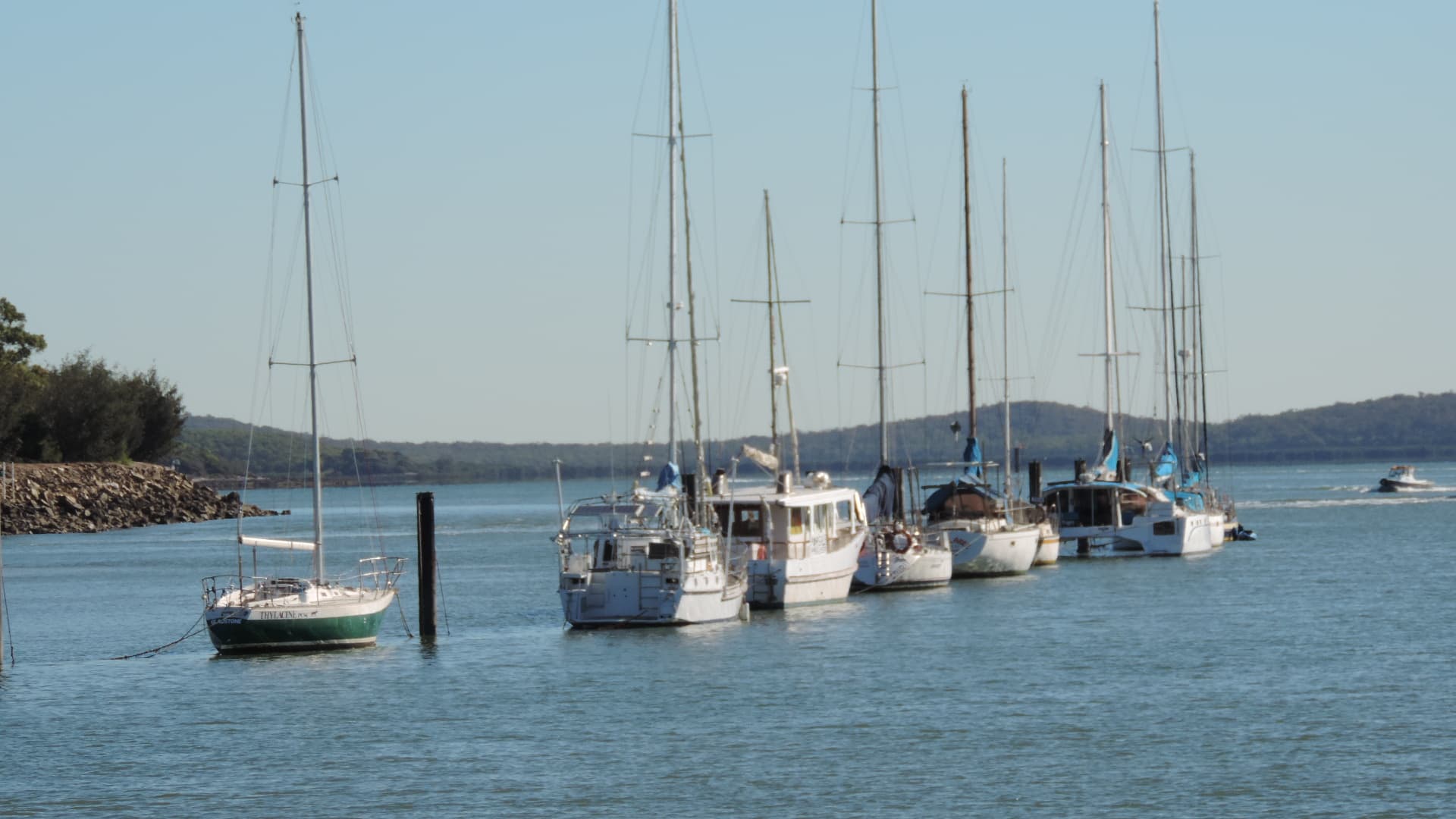
Gladstone Yacht Club
Gladstone Yacht Club, trading name of the Port Curtis Sailing Club, sails on Auckland Creek and Gladstone Harbour in Central Queensland and is the finish port of the Brisbane to Gladstone race.
Photo: Kerry Raymond, CC BY 4.0, via Wikimedia Commons
5 min read
Gladstone Yacht Club is the trading name of the Port Curtis Sailing Club — a Central Queensland club founded in 1941 that sails on Auckland Creek and Gladstone Harbour, runs both keelboat and off-the-beach dinghy racing, and is best known nationally as the finish port of the Brisbane to Gladstone Yacht Race. If you follow Queensland ocean racing, Gladstone is the town where one of the country's oldest bluewater classics ends.
The club
Gladstone Yacht Club and the Port Curtis Sailing Club are two names for the same organisation. The full legal description is "Port Curtis Sailing Club t/a Gladstone Yacht Club": the licensed club that most locals know as the GYC is the social and hospitality face of the body, while the Port Curtis Sailing Club (PCSC) is the name that carries the on-water side — the racing, training and dinghy fleets. When you see "PCSC" on the club's own material, it is referring to the sailing arm of the GYC.
The club's base is on Auckland Creek, a short tidal waterway in the heart of Gladstone that opens straight into Gladstone Harbour. That location gives members direct access to sheltered creek water for dinghies and small boats, and to the wider working harbour for keelboat racing. The fleet is deliberately broad. It takes in racing and cruising yachts — both monohulls and multihulls — alongside a mix of off-the-beach classes including Sabots, Impulse dinghies, O'pen Skiffs (the successor to the O'pen BIC) and ILCA (Laser) singlehanders, plus a couple of heritage boats such as an original Diamond and a Moth.
Training is a core part of what the club does. The Port Curtis Sailing Club is an accredited sail-training school with Australian Sailing and offers tuition for both adults and juniors, which makes it the natural entry point for anyone learning to sail in the Gladstone region. If you are new to the sport, our guide on how to get into sailing in Australia explains how a club-based pathway like this one usually works.

History
The club traces to a meeting on 3 April 1941, when a group of Gladstone people with an interest in rowing and sailing gathered and formed the Port Curtis Aquatic Club. Sailing quickly became the dominant activity, and in 1947 the organisation was renamed the Port Curtis Sailing Club to reflect that focus.
Its most visible piece of history is the clubhouse itself. Built between 1949 and 1959 by members and community volunteers — described at the time as the largest volunteer-labour project Gladstone had seen — it was officially opened in March 1959, in time for that year's Easter Regatta. The building is now entered on the Queensland Heritage Register as the Port Curtis Sailing Club Clubhouse, recognising both its architecture and its place in local social history. The club celebrated the fiftieth anniversary of the clubhouse's completion in March 2009.
The other strand of the club's story is its long association with ocean racing. Gladstone Harbour has been the finishing point of the Brisbane to Gladstone Yacht Race since the event's first running in 1949, and the arrival of the fleet each Easter has been a fixture of the town's calendar for decades. Local boats have featured in that history too — the yacht Wistari, for instance, is recorded as a multiple line-honours winner of the race across the 1970s and early 1980s.
Where it sails
The immediate sailing water is Auckland Creek, which threads through Gladstone and connects to Gladstone Harbour. The creek suits dinghy and small-boat racing close to the clubhouse, while the harbour itself provides the room for keelboat courses.
Gladstone Harbour is a large, well-sheltered natural harbour on Queensland's central coast, guarded from the open ocean by Curtis and Facing islands. It is also one of the busiest industrial ports in Australia, handling coal, alumina and gas exports, so sailing here means sharing the water with commercial shipping and observing the port's traffic and channel rules. For racing sailors, the payoff is protected water and reliable coastal breezes; the trade-off is a genuinely working harbour rather than a purely recreational one.
Gladstone sits well up the Queensland coast, roughly midway between the south-east capital clubs and the tropical cruising grounds further north. It is the gateway to the Southern Great Barrier Reef and islands such as Heron and Lady Musgrave. If you are planning to sail the wider reef region, our guide to sailing in the Whitsundays covers the tropical conditions, seasons and passages that broadly carry across this part of the coast.
Racing
Gladstone's best-known place in the racing calendar is as a destination rather than a host: it is where the Brisbane to Gladstone Yacht Race finishes. That race is one of Australia's oldest bluewater events, first sailed in 1949, and is organised at the Brisbane end by the Queensland Cruising Yacht Club. For the crews who make the passage north from Moreton Bay each Easter, Gladstone Harbour is the finish line and the club is a focal point of the arrival.
Alongside that headline connection, the club runs its own regular sailing program through the Port Curtis Sailing Club — a mix of harbour keelboat racing and off-the-beach dinghy classes, together with the accredited training that feeds new sailors into those fleets. It has also been recognised by Australian Sailing as a Discover Sailing Centre, reflecting the emphasis it places on bringing newcomers into the sport.
For competitive sailors mapping out the Central Queensland scene, Gladstone is worth knowing as the harbour club at the southern edge of the reef coast, a short hop down from the off-the-beach sailing at Keppel Bay Sailing Club near Yeppoon.
Following the club
The most reliable source for the club's sailing calendar, notices of race and training details is its own website at gyc.com.au, which covers both the sailing program and the licensed club. Because programs and fleets shift from season to season, anyone travelling to Gladstone to sail should contact the club ahead of time to confirm what is running and whether visitors can be accommodated — this profile is a general guide, not a substitute for the club's current information.
Frequently asked questions
- Where is Gladstone Yacht Club?
- The club sits on Auckland Creek in Gladstone, Central Queensland, which gives its boats direct access to Gladstone Harbour. Gladstone is a major industrial port city roughly halfway between Brisbane and the Whitsundays.
- When was Gladstone Yacht Club founded?
- The organisation was formed on 3 April 1941 as the Port Curtis Aquatic Club and was renamed the Port Curtis Sailing Club in 1947. It trades today as Gladstone Yacht Club, so the sailing side and the licensed social club are the same body.
- Is Gladstone Yacht Club the finish of the Brisbane to Gladstone race?
- Yes. Gladstone Harbour is the finish port of the Brisbane to Gladstone Yacht Race, a bluewater classic first run in 1949 and organised from the Brisbane end by the Queensland Cruising Yacht Club. Gladstone is where the fleet arrives and celebrates.
- What sort of sailing does the club run?
- Through its Port Curtis Sailing Club arm it runs both keelboat racing on the harbour and off-the-beach dinghy sailing on Auckland Creek, with classes including Sabot, Impulse, O'pen Skiff and ILCA. It is also an accredited Australian Sailing training centre offering tuition for adults and juniors.
Related clubs
Queensland Cruising Yacht Club
The Queensland Cruising Yacht Club is a Brisbane offshore and cruising club at Shorncliffe on Moreton Bay, founded in 1948 and the organiser of the Brisbane to Gladstone Yacht Race.
Read the profileKeppel Bay Sailing Club
Keppel Bay Sailing Club has run sailing at Yeppoon since 1957. A Central Queensland club known for off-the-beach dinghies, youth pathways and all-boats regattas on Keppel Bay.
Read the profile