2 min read · Updated 28 June 2026
The COLREGs are the international "rules of the road at sea" — the rules that prevent collisions. Every vessel, from a container ship to a dinghy, follows them, and every sailor should know them. They set out who gives way and who stands on in every encounter, plus the duties that underpin the whole system. They are the everyday counterpart to the racing rules.
Give-way and stand-on
When a risk of collision exists, the rules assign two roles:
- The give-way vessel must take early and substantial action to keep clear.
- The stand-on vessel holds its course and speed, so its intentions are predictable — but must act itself if the give-way vessel clearly isn't doing enough.
Knowing which role you're in is the heart of applying the rules.
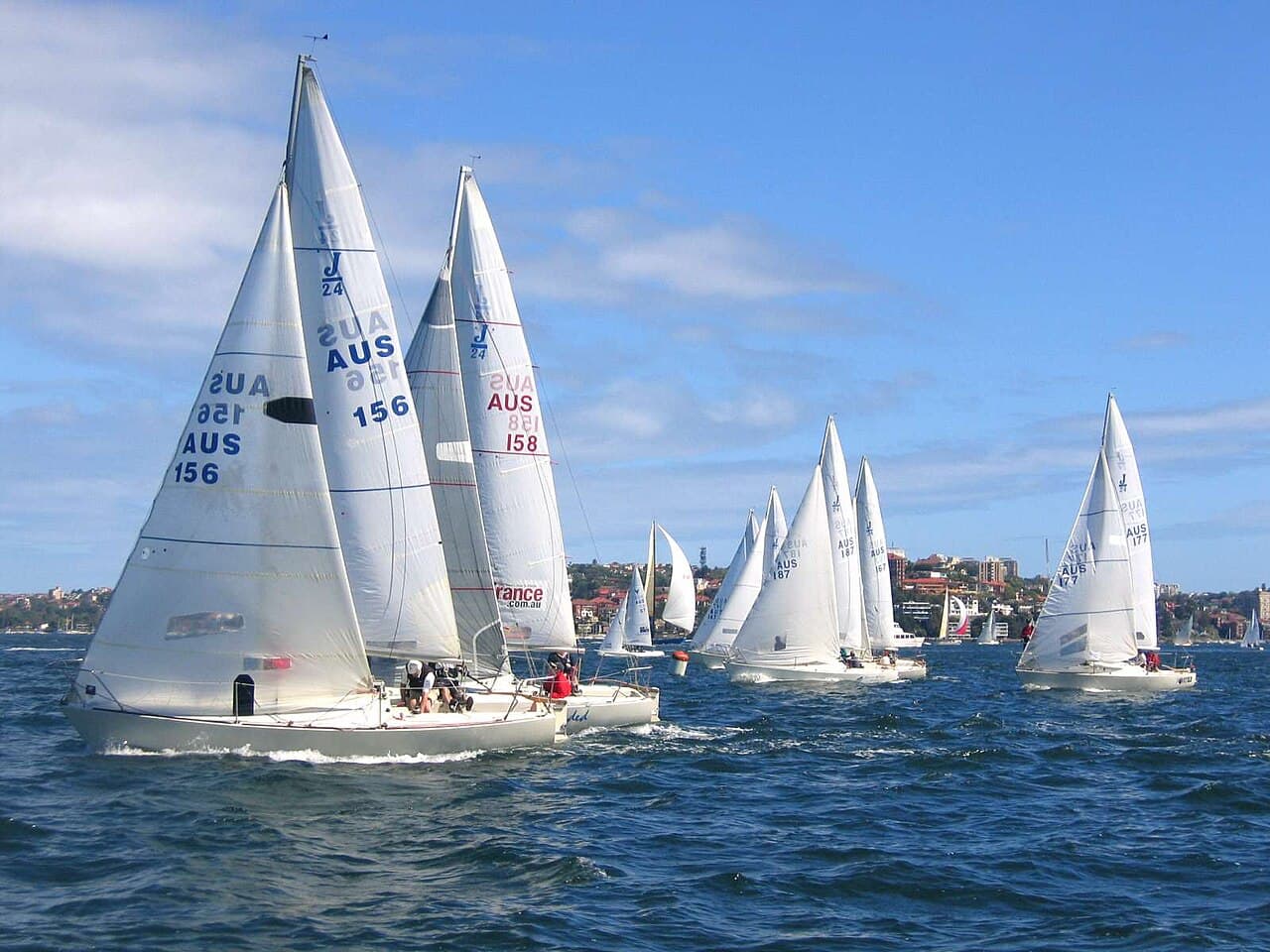
Sail meets sail
Between two sailing vessels, the COLREGs mirror the core right-of-way rules of racing:
- Opposite tacks → the port-tack boat keeps clear of the starboard-tack boat.
- Same tack → the windward boat keeps clear of the leeward boat.
- In doubt about another boat's tack to windward → keep clear.
Sail meets power
The general rule is that a power-driven vessel keeps clear of a vessel under sail — but with important exceptions. A sailing vessel must itself keep clear of a vessel that is:
- Not under command (unable to manoeuvre),
- Restricted in its ability to manoeuvre,
- Constrained by its draught, or
- Engaged in fishing.
And in narrow channels and traffic separation schemes, small and sailing vessels must not impede larger vessels that can only operate there. Crucially, a sailing boat using its engine counts as power-driven — so the simple "power gives way to sail" rule no longer applies to it.
Power meets power
Between two power-driven vessels:
- Head-on → both alter to starboard and pass port-to-port.
- Crossing → the vessel that has the other on her starboard side gives way.
- Overtaking → the overtaking vessel keeps clear.
The overriding duties
Underneath the specific rules sit duties that always apply: keep a proper lookout, proceed at a safe speed, and take early, clear action to avoid collision. Above all, the rules require every vessel to do whatever it takes to avoid a collision, even if that means departing from a specific rule. Learn the roles, learn the navigation lights that reveal them at night, and you have the foundation of safe seamanship. For the vocabulary, see the sailing terms glossary.
Frequently asked questions
- What are the COLREGs?
- The COLREGs are the International Regulations for Preventing Collisions at Sea — the internationally agreed 'rules of the road' that all vessels follow to avoid collisions. Administered through the International Maritime Organization, they set out who must give way and who holds their course in every kind of encounter, along with the lights and shapes vessels display and the overriding duties to keep a proper lookout and proceed at a safe speed. Every sailor should know them.
- Does a power boat give way to a sailing boat?
- As a general rule yes — a power-driven vessel keeps clear of a vessel under sail. But there are important exceptions: a sailing vessel must itself keep clear of a vessel that is not under command, restricted in its ability to manoeuvre, constrained by its draught, or engaged in fishing, and in narrow channels and traffic separation schemes small and sailing vessels must not impede larger ones. And a sailing boat using its engine counts as power-driven, so the simple rule does not apply.
- What is the give-way vessel and the stand-on vessel?
- In an encounter where a risk of collision exists, one vessel is the give-way vessel, which must take early and substantial action to keep clear, and the other is the stand-on vessel, which holds its course and speed so its intentions are predictable. The stand-on vessel must, however, take action itself if it becomes clear the give-way vessel is not doing enough. Knowing which role you are in is the heart of applying the rules.
- How do the COLREGs apply between two sailing boats?
- When two sailing vessels risk collision, the rules mirror the core right-of-way rules of racing: if they are on opposite tacks, the one on port tack keeps clear of the one on starboard tack; if they are on the same tack, the windward boat keeps clear of the leeward boat. If a boat on port tack sees another to windward and cannot tell which tack it is on, it keeps clear. These few rules resolve most sail-on-sail meetings.
- Are the COLREGs the same as the racing rules?
- No, though they share the same foundations. The COLREGs apply to all vessels at all times and are about preventing collisions at sea. The Racing Rules of Sailing apply to boats while racing and add the detail needed for close competition, such as mark-room and starting rules. The core ideas — starboard tack over port, windward keeps clear of leeward, avoid collision — are common to both, but racing boats follow the racing rules during a race and the COLREGs otherwise.