2 min read · Updated 19 May 2026
The J1 — the number one jib — is a yacht's largest and lightest upwind headsail, set in light to moderate winds where its size and full shape make the most power and let the boat point highest. It is the first headsail a crew reaches for as the breeze fills in, and the top of a range of numbered jibs that get smaller and flatter as the wind builds. The J1 sits alongside the mainsail at the heart of the upwind sail wardrobe.
What the J1 does
Upwind, the headsail and mainsail form a single aerofoil. The headsail's job is to accelerate air across the lee side of the main and to do a large share of the driving, and the J1 — being the biggest, lightest headsail — does the most of all. In the soft conditions it is designed for, that extra area and a fuller, more powerful shape are exactly what the boat needs to get up to speed and hold a high lane to windward.
Because it is built from lighter cloth than the heavier jibs, the J1 also keeps its designed shape better in light air, where a heavier sail would hang and distort. The trade-off is range: push it into too much breeze and it overpowers the boat.
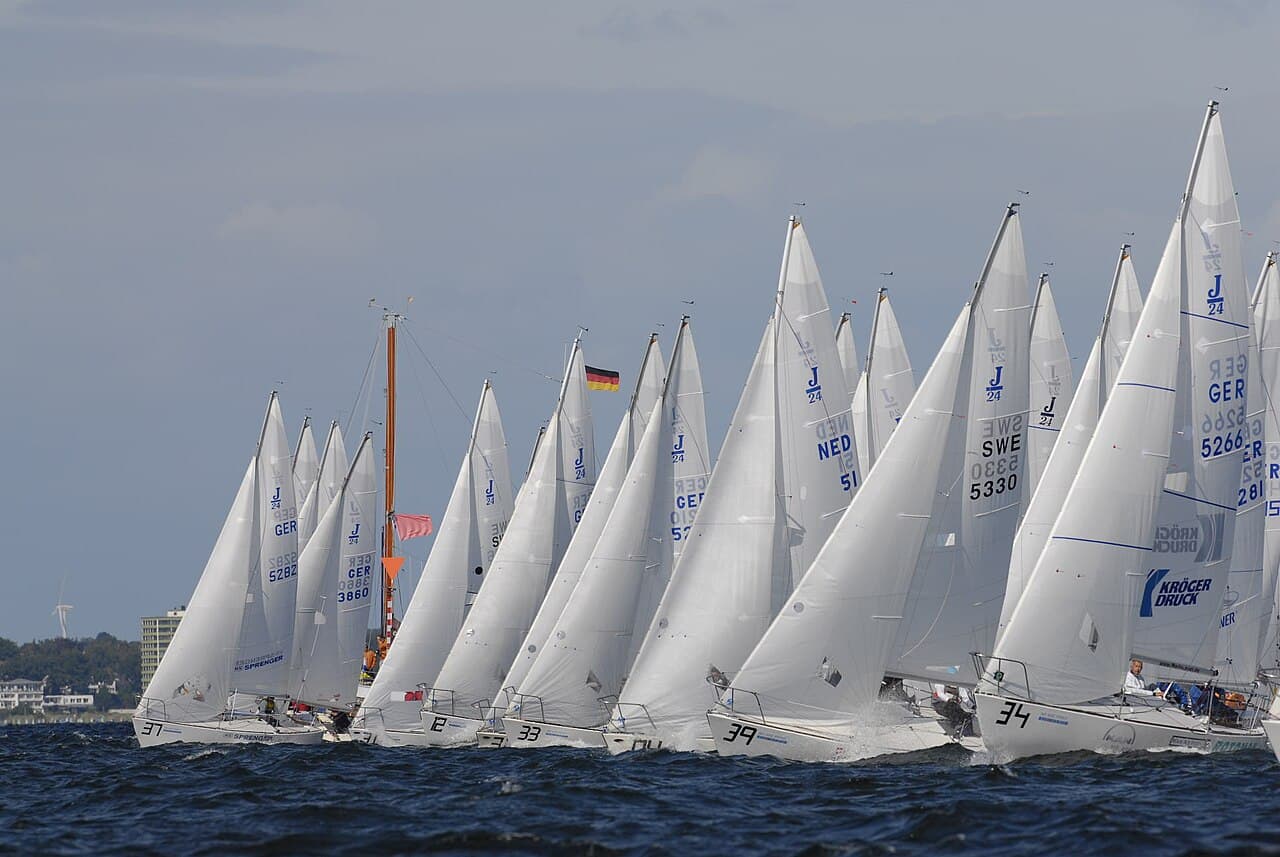
When the J1 is used, and changing down
The J1 covers the lighter end of the upwind range — from the first proper breeze up to the point where the boat becomes overpowered and starts heeling too far and slowing. At that point the crew change down to a flatter, heavier headsail with a smaller range, then again as the wind keeps building. That progression — J1 to J2 to J3 and, in heavy weather, a J4 — lets the boat carry the right amount of power for the conditions all the way up the wind range.
How many of these a boat actually carries depends on its rules. An offshore boat racing under handicap may carry the full set, while a strict one-design class limits the inventory to keep costs down and competition even — which is why the Melges 40 races a single class jib rather than a numbered range. Either way, the J1 is the light-air, maximum-power end of the headsail story. For more on the boat and how its sails are made, see the boat page and the sails pillar.
Frequently asked questions
- What is a J1 jib?
- The J1, or number one jib, is the largest and lightest of a yacht's upwind headsails. It is set in light to moderate breeze, where its full size and shape generate the most power and let the boat point highest into the wind. As the breeze builds beyond its range the crew change down to a smaller, flatter jib.
- When do you use a J1?
- A J1 is used in the lighter end of the wind range, roughly from the first sailable breeze up to a moderate wind where the boat starts to become overpowered. Above that, holding the J1 makes the boat heel too much and slow down, so the crew change to a J2 and then a J3 as the wind increases.
- What is the difference between a J1 and a genoa?
- Both are upwind headsails. A jib is cut so it does not overlap the mast, while a genoa is larger and overlaps the mainsail. Numbered headsails such as the J1 may be jibs or light genoas depending on the boat and its class rules, but the principle is the same — the J1 is the largest, lightest one in the range.
- How many jibs does a racing yacht carry?
- It varies by boat and class rules. A fully optioned offshore boat might carry a J1, J2, J3 and a heavy-weather J4, each cut for a band of wind strength. A strict one-design limits the inventory, so a class like the Melges 40 races a single class jib rather than a full numbered range.