Apple Watch for Sailing: What We're Looking For
An Apple Watch is a wrist-worn start timer and crew-load logger, not a boat instrument. The engineering — WR50 vs WR100 sealing, PPG heart-rate limits, single- vs dual-frequency GNSS, and a tight GPS-workout power budget — decides whether it earns a place aboard.
Research Note
This is a research note in the Invicta Labs review framework — we are documenting what we are looking for and the options we are weighing, before any purchase or testing. We do not publish ratings or ownership claims until we have genuinely tested the equipment ourselves.
11 min read
This is a research note, not a rated review. The technical figures below come from published specifications; our assessments are framed as what we would evaluate, not results from our own testing.
An Apple Watch is a genuinely useful wrist-worn race-start timer and crew-load logger — but it is a consumer smartwatch built around an optical heart-rate sensor and a general-purpose GNSS chip, not a marine instrument. Sealing standard, sensor physics and a tight power budget decide whether it earns a place aboard. Treated as a personal tool rather than a stand-in for the boat's wind and speed electronics, it does real work on a race deck. This note goes into the engineering — what the hardware actually is, where it is strong, and precisely where it breaks down.
What it does well on a race boat
The strongest use is the start sequence. A good native watchOS app runs an ISAF/World Sailing-style countdown you can sync to the committee's signals — a "sync" or "pull-to-round" function that snaps the timer to the nearest whole minute on a button press when your count drifts from the sound signal. The value is not the number on the screen; it is the haptic engine (Apple's Taptic Engine, a linear resonant actuator) tapping the wrist at the minute marks and through the final ten-second sequence, so the person calling time feels the count without staring at a screen through the pre-start scramble. On a boat carrying a dedicated race timer on the mast, the watch is a personal backup; on a smaller or older boat with no timer at all, it is the primary countdown.
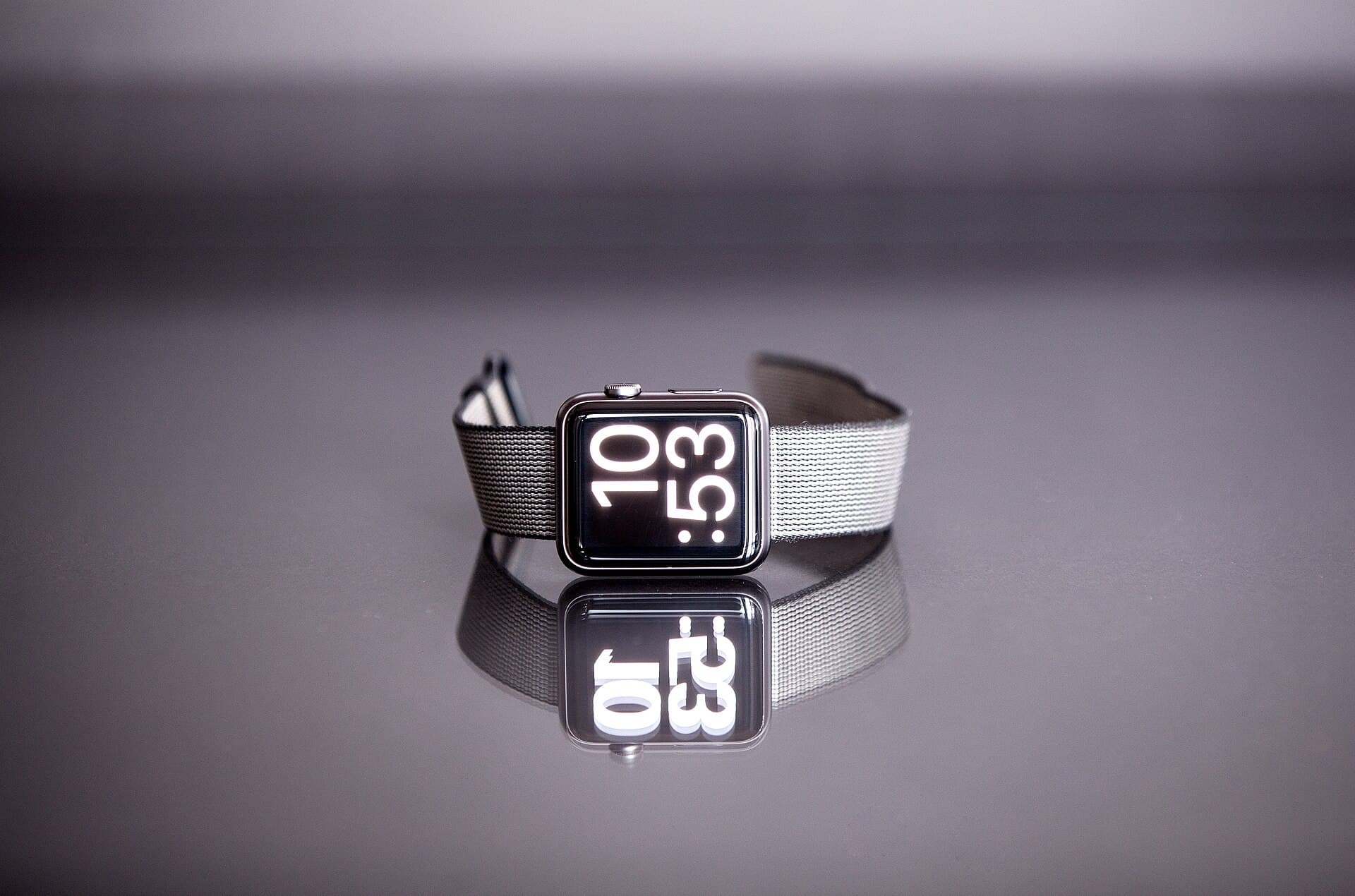
Beyond timing it earns its keep in three ways. Heart rate and effort logging turns a long day of grinding and hiking into reviewable data — useful for a professional crew managing fatigue across a multi-race regatta and building a picture of physical load over a season. GPS speed and course over ground give a rough independent read of pace and heading, handy for a delivery or a shorthanded sail where the boat's own instruments may be off. And notifications — kept ruthlessly filtered — let a boat captain or owner stay reachable ashore without a phone in a pocket. It supplements the instrument package; it does not substitute for it.
Water resistance: the standard matters more than the number
This is where model choice is not optional, and where the marketing depth is the least useful part of the spec. Water-resistance ratings are validated under ISO 22810:2010 using static pressure — a batch of samples held at the rated pressure in still, temperature-controlled water. Nothing in that test moves, gets bumped, or heats up. Real sailing loads the case with dynamic pressure: a wave face slamming the back of the wrist, or green water sheeting across the deck, produces short directional pressure peaks well above the static equivalent of the boat's actual immersion depth. That is the gap the rating does not describe, and it is why the sealing margin — not the headline metres — is what you buy.
- Apple Watch Series 10 is rated WR50 (50 metres) to ISO 22810:2010. Comfortably enough for cockpit spray, rain and the occasional full dunking, but it carries no impact or dive certification — Apple's guidance is swimming, not high-velocity water sports.
- Apple Watch Ultra 2 and Ultra 3 are rated WR100 (100 metres), additionally certified to EN13319 (the European standard for depth gauges and dive accessories), and explicitly cleared by Apple for high-speed water sports and recreational scuba to 40 metres via a real depth-and-temperature sensor. That is a materially higher pressure margin and a case-sealing regime designed for impact, which is the honest match for a wet foredeck.
The rating is only half the story; the interface is the other half. When the watch detects immersion it engages Water Lock, deliberately disabling the capacitive touchscreen so that spray and wave contact cannot register as phantom taps — a capacitive digitiser cannot tell a wet fingertip from a sheet of salt water, because both are conductive. You clear Water Lock afterwards, which drives the speaker at a resonant frequency to physically eject water from the port. The trade-off is real: with Water Lock engaged, a touchscreen-only watch is close to inoperable mid-race. The Ultra's physical Action button is the answer — a mechanical input that keeps working through Water Lock, so you can start or split a timer without fighting a dead screen. Well-designed sailing apps map their primary function (start/sync) to that button for exactly this reason. On a standard model, plan to trigger the timer before the screen gets wet.
One failure mode worth naming precisely: even inside its rating, a continuous film of salt water bridging the glass makes the capacitive sensor sluggish or unresponsive, because the conductive film couples the sense electrodes and floods the controller with noise. That is not a fault — it is how projected-capacitive sensing works — and it is exactly why the Action button matters and why touchscreen-only reliance is a genuine weakness on a race boat.
GNSS: what the wrist can and cannot tell you
Not all Apple Watch GPS is equal, and the difference is directly relevant to how much you should trust the speed readout. The Ultra 2 and Ultra 3 carry precision dual-frequency GNSS, receiving both the L1 (1575.42 MHz) and L5 (1176.45 MHz) civilian bands across GPS, GLONASS, Galileo, QZSS and BeiDou. The Series 10 is single-band (L1-class). Dual-frequency matters because the L5 signal uses a chipping rate roughly ten times higher than L1, which sharpens the code-phase resolution and lets the receiver reject multipath — the reflected copies of the signal that bounce off tall structures — far more effectively. Offshore this is less critical than in an urban canyon, but a carbon rig, a hard bimini and a wet deck all reflect L-band energy, and near a marina or a committee boat the dual-frequency receiver holds a cleaner fix and reacquires faster after a brief obstruction.
Where the honesty has to come in is what wrist GNSS is good for. It reports speed over ground (SOG) and course over ground (COG) — your motion relative to the seabed, which includes tide and current. It is not boatspeed through the water, which is what the tactician trims to and what feeds the true-wind calculation. Consumer GNSS updates at about 1 Hz, and raw GNSS-derived speed is inherently noisy; the receiver applies heavy filtering to produce a readable number, which necessarily adds latency. That filtering is worst-behaved in light air, precisely in the post-tack acceleration window where a helm most wants an instantaneous, low-latency speed reference — the one job a paddlewheel or ultrasonic through-water sensor does well and a filtered wrist reading does not. So the wrist can tell you roughly how fast you are moving over the ground and which way you are pointed; it cannot resolve the tenths-of-a-knot, sub-second boatspeed changes that decide a lane. Treating wrist SOG as boatspeed is the classic mistake, and on a boat with calibrated instruments it is simply wrong data in the loop.
Battery: the real constraint, quantified
Battery is the honest limitation, and the numbers deserve to be stated plainly rather than glossed. Apple's published GPS-plus-heart-rate workout figure is about 14 hours for the Ultra 3 and roughly 12 hours for the Ultra 2; a standard Series watch on a smaller cell has less margin again. A normal single-day regatta fits inside that envelope. A long day — early dock-out, four races, dock back, debrief — with continuous 1 Hz GNSS, an always-on display and a sailing app held in the foreground can push it, because those three loads run simultaneously and continuously, which is the worst case for any wearable.
Three subsystems dominate the draw, and understanding them is how you manage the budget. The GNSS receiver running a continuous 1 Hz fix is a constant radio and correlator load. The PPG optical sensor pulses green (and, for background readings, infrared) LEDs and runs the photodiode and motion-rejection algorithm; a workout that samples heart rate continuously keeps that stack awake. And the display is the single biggest variable you control: the Ultra's OLED peaks near 3,000 nits, superb for reading in glare, but always-on at high brightness across a full day is a large, avoidable cost. Apple's own newer LTPO (low-temperature polycrystalline oxide) backplane lets the refresh rate drop to 1 Hz in ambient mode to claw some of this back, but brightness still dominates.
Two second-order effects matter on the water. Lithium-ion cells lose usable capacity and hold voltage poorly in the cold — a raw, wet winter regatta will show a shorter real day than the spec — and they throttle charge/discharge when hot, so a black titanium case baking in summer sun on deck is not ideal either. Neither is a defect; both are lithium-ion chemistry.
Contrast a purpose-built sailing watch: a Garmin quatix runs for weeks between charges (roughly 16 to 29 days in smartwatch mode depending on model, extended further by solar). That is a different category of endurance, not a marginal difference, and if all-day, no-thought battery life is the priority it is the single biggest reason to look at a dedicated device — see our Garmin quatix review and the broader sailing watches comparison.
Practical discipline makes the Apple Watch workable:
- Charge to 100 per cent the night before every race day — treat it as a rig-check-level checklist item. The Ultra's fast charger gives roughly 12 hours of use from a 15-minute top-up, useful between the delivery in and the warning signal.
- Run Low Power Mode for the day. On the Ultra 3 that stretches a full-GPS workout to about 20 hours, or roughly 35 hours with reduced GPS/HR update rates — cheap insurance at the cost of sampling fidelity you rarely need on the wrist.
- Drop always-on brightness. The 3,000-nit peak is there for glare, not for burning charge all day; let it dim when you are not reading it.
- Close background apps and prune notifications so the SoC and radios idle when they needn't work.
What good versus bad looks like
Good is a wet-tolerant Ultra, charged overnight, running a reputable native app mapped to the Action button, worn as a personal timer and effort logger that never pretends to be the boat's wind gear. Bad is a phone-tethered app that dies the moment the iPhone goes below deck out of Bluetooth range; a touchscreen-only model you cannot operate once spray bridges the glass; a flat battery by the last race; or — worst — a crew member trusting wrist SOG over the calibrated through-water boatspeed the tactician is calling.
Choosing an app
The app matters as much as the watch. The single most important property is that it is a standalone (native) watchOS app that runs on the watch's own processor without the phone aboard — a companion-dependent app relies on the WatchConnectivity link to the iPhone, which drops as soon as the handset goes below deck out of Bluetooth range, taking the timer with it. Beyond that, look for an ISAF/World Sailing-compliant countdown with a sync-to-signal function, haptic minute and ten-second alerts, Action-button control that survives Water Lock, and a display legible through polarised sunglasses — worth checking because a linear polariser rotated against an OLED's own polariser can darken or blank the panel at some wrist angles, though modern Apple Watch OLED panels generally handle polarised lenses well.
Well-known options include Regatta Timer Watch, iRegatta Watch, SailRacer, Race Master Sail Timer + Speed and SailingWatch — several confirmed to run natively on the watch. We would test any candidate for three specific behaviours: reliability of the timer under sync (does it snap cleanly and hold?), operation with Water Lock engaged (does the Action button still drive it?), and how gracefully it degrades when the paired phone drops out of range. (App feature sets change with updates — verify current capabilities before relying on one.)
How it fits an Invicta campaign
On a Melges 40 Grand Prix programme the boat already carries calibrated masthead wind, paddlewheel (or ultrasonic) boatspeed and a proper mast display feeding the afterguard — the core instrument system that resolves true wind from apparent, responds to acceleration in real time, and that an Apple Watch cannot and should not replace. (The specific instrument fit on our boat should be confirmed against the class rules and the boat's own documentation.) Where the watch adds value is personal: a reliable backup start timer on the wrist of the person calling time; heart-rate and effort data for a crew managing physical load across a regatta; and a discreet comms link for the owner ashore. Judged as that — a well-chosen tool doing a defined job, not the boat's brain — it earns its place. When we have used one across real racing we will publish honest findings on what it did well and where it fell short. For the wider trade-offs, start with our sailing watches comparison.
Frequently asked questions
- Can you use an Apple Watch for sailing?
- Yes, as a personal wrist device — a race-start countdown with haptic cues, a heart-rate and effort logger, and a rough source of GPS speed over ground and course over ground. Native watchOS apps (Regatta Timer Watch, iRegatta Watch and similar) run on the watch without an iPhone aboard, which matters because a phone-tethered app dies when the handset drops out of Bluetooth range below deck. It is a general smartwatch built around an optical (PPG) heart-rate sensor and a consumer GNSS chip, so it complements calibrated masthead wind and paddlewheel boatspeed rather than replacing them. The model, the app and battery discipline decide whether it is dependable.
- Which Apple Watch is water-resistant enough for racing?
- The rating that matters is the sealing standard, not the marketing depth. Apple Watch Series 10 is rated WR50 (50 metres) to ISO 22810:2010 — validated against static pressure, adequate for a wet cockpit but not certified for high-velocity impact. Apple Watch Ultra 2 and Ultra 3 are rated WR100 (100 metres), additionally certified to EN13319 (the depth-gauge/dive-accessory standard) and explicitly cleared by Apple for high-speed water sports and recreational diving to 40 metres. For a Grand Prix boat taking green water over the deck at speed, the Ultra's higher pressure margin and EN13319 certification are the honest match. The Ultra also carries a physical Action button that still functions when Water Lock disables the capacitive touchscreen.
- Will the battery last a full day of racing?
- Only with discipline. Apple's published GPS-plus-heart-rate workout figure is about 14 hours for the Ultra 3 (roughly 12 hours on the Ultra 2). That covers a normal single-day regatta but leaves little margin for an early dock-out, four races and a late return with the always-on display at full brightness and a sailing app in the foreground. Continuous 1 Hz GNSS, the PPG sensor sampling, and a 3,000-nit panel are the three biggest drains. Low Power Mode extends the Ultra 3 to about 20 hours of full-GPS workout (roughly 35 hours with reduced GPS/HR update rates), at the cost of sampling fidelity. A dedicated sailing watch such as a Garmin quatix runs for weeks. Charge to 100 per cent the night before and expect to charge daily.
- Does it replace a dedicated sailing watch or the boat's instruments?
- No to both, for engineering reasons. It cannot replace calibrated masthead wind, a paddlewheel or ultrasonic boatspeed sensor, or a mast/cockpit display — those feed the whole afterguard, resolve true wind from apparent, and respond to acceleration far faster than a filtered wrist GNSS reading can. Wrist speed over ground is not water speed and is noisy in exactly the light-air post-tack window where the tactician needs the clearest picture. Against a dedicated sailing watch it trades far shorter battery life and weaker marine-instrument integration (no NMEA 2000 feed, no true-wind calc) for a superior everyday device and a large native-app library. It is a strong personal tool, not the boat's brain.
- Is this a review of the Apple Watch?
- No — this is a research note on the engineering and what we would assess, not a rated review from our own on-water testing. Per the Invicta Labs framework we do not publish ratings, scores or ownership claims until we have genuinely used something across real racing. Technical figures here (water-resistance standards, battery figures, GNSS bands, app names) are drawn from published specifications; our judgements are framed as what we would evaluate, not measured results. Where a figure depends on the specific boat's instrument fit it is flagged as such.
Related articles
B&G Racing Electronics: What We're Looking For
A technical research note on B&G's racing instrument ecosystem — the sensor chain, the true-wind and leeway maths, motion correction, network architecture and calibration model behind a modern H5000/WTP-class system, and the criteria we'd use to evaluate one on a Melges 40. No ratings until we've tested it ourselves.
Read the articleSailing Watches Compared: Garmin, Apple and Suunto
An engineering-level comparison of the Garmin quatix 8, Apple Watch Ultra 2 and Suunto Ocean for racing: SailAssist virtual start line and burn-time logic vs third-party ISAF timer apps, MIP transflective vs AMOLED readability under polarised lenses, multi-band L1/L5 GNSS, titanium and sapphire construction, EN13319 dive ratings and real published battery figures under continuous GPS.
Read the articleGarmin quatix Marine Watch: A Research Note
A technical research note on the Garmin quatix marine smartwatch line — transflective quatix 7 versus AMOLED quatix 8 and inReach-equipped quatix 8 Pro: SailAssist virtual line and tack-assist logic, SatIQ multi-band GNSS, NMEA 2000 data streaming and autopilot control, battery endurance by mode, and how it fits a Grand Prix afterguard.
Read the article