Race Blocks Compared: Harken vs Ronstan
An engineering comparison of Harken and Ronstan race blocks — caged Torlon roller races versus captive needle-and-ball sheaves, aluminium versus composite bodies, load ratings and side-thrust behaviour, soft-attach loop systems and serviceability — with published SWL/MBL figures for the sizes that matter on a Grand Prix 40.
Comparison
This is a comparison in the Invicta Labs review framework — an objective comparison based on published specifications, materials and category experience, with hands-on field comparison to follow. We do not publish ratings or ownership claims until we have genuinely tested the equipment ourselves.
12 min read
This is an independent, objective comparison — we have no partner among hardware brands. Figures are the makers' published specifications, not our own bench measurements.
Every control line on the boat runs through a bearing, and the bearing you cannot see under load is the one that costs you. The two makers most 40-class inventories draw from — Harken and Ronstan — build to the same physics but resolve the bearing, body and attachment questions differently. Below is where those differences are real and where they are marketing. See also blocks and tackle and the block inspection note.
At a glance
| Dimension | Harken | Ronstan |
|---|---|---|
| High-load bearing | Caged Torlon rollers, cage keeps rollers parallel (Black Magic Air) | Torlon needle rollers + captive acetal/Torlon ball races taking side-thrust (Orbit) |
| Body / sheave | Aluminium sheave & cheeks; 316 or forged shackles | Fully machined, anodised alloy cheeks & sheave; 17-4PH forged shackles |
| Side-load design | Discrete side control within cheeks | No side-retainer plates — captive ball races carry thrust, widening the roller bed |
| High-end published load | Black Magic Air range WL 750–13,600 kg, 57–150 mm | Series 100 Orbit HL ~4,240 kg SWL / ~8,480 kg MBL, 100 mm (from 9,350/18,700 lb) |
| Small control-line block | Composite T2 on Delrin balls, curved races; 40 mm = 220 kg / 25 g | 2-stage acetal-ball Orbit/Core; holds friction better as load rises |
| Mid friction under load | Ball lines point-contact; roller lines line-contact | 2-stage Core: acetal balls light, sliding acetal on stainless race heavy |
| Soft-attach system | Patented T2/Loop with SK75 Dyneema loop, dead-end post | SK78 Dyneema link heads (0°/90°), lashing-through-hub failsafe |
| Origin / support | US; deepest global spares network | Australian design & manufacture; strong local support |
| Our pick | Roller stiffness at load; T2 the soft-attach reference | Strength-to-weight of the machined Orbit body; 2-stage mid friction |
Read the bearing, not the brand
The whole argument is contact geometry. A ball bearing touches its race at a point, which is why a lightly loaded ball block feels frictionless in the hand — but that point contact means high Hertzian stress, so as load climbs the balls flatten elastically, can brinell the race, and the sheave starts to distort and drag. A roller (cylindrical) or needle bearing touches along a line, spreading the same load over far more area — published bearing-engineering figures put a cylindrical roller at roughly 1.5–2× the radial capacity of a comparable ball. The penalty is that more contact area means slightly more rolling friction and, if the rollers can touch each other, they counter-rotate at their contact and bind. Both makers answer that the same way: a cage that keeps each roller separated and parallel so no roller rubs its neighbour.
So the design rule both companies follow is: balls for the light, frequently trimmed lines; rollers/needles for the heavily loaded ones. Where they part company is how the roller race is packaged and how the small ball blocks are built.
The comparison
High-load bearing architecture — caged rollers vs needle-and-captive-ball
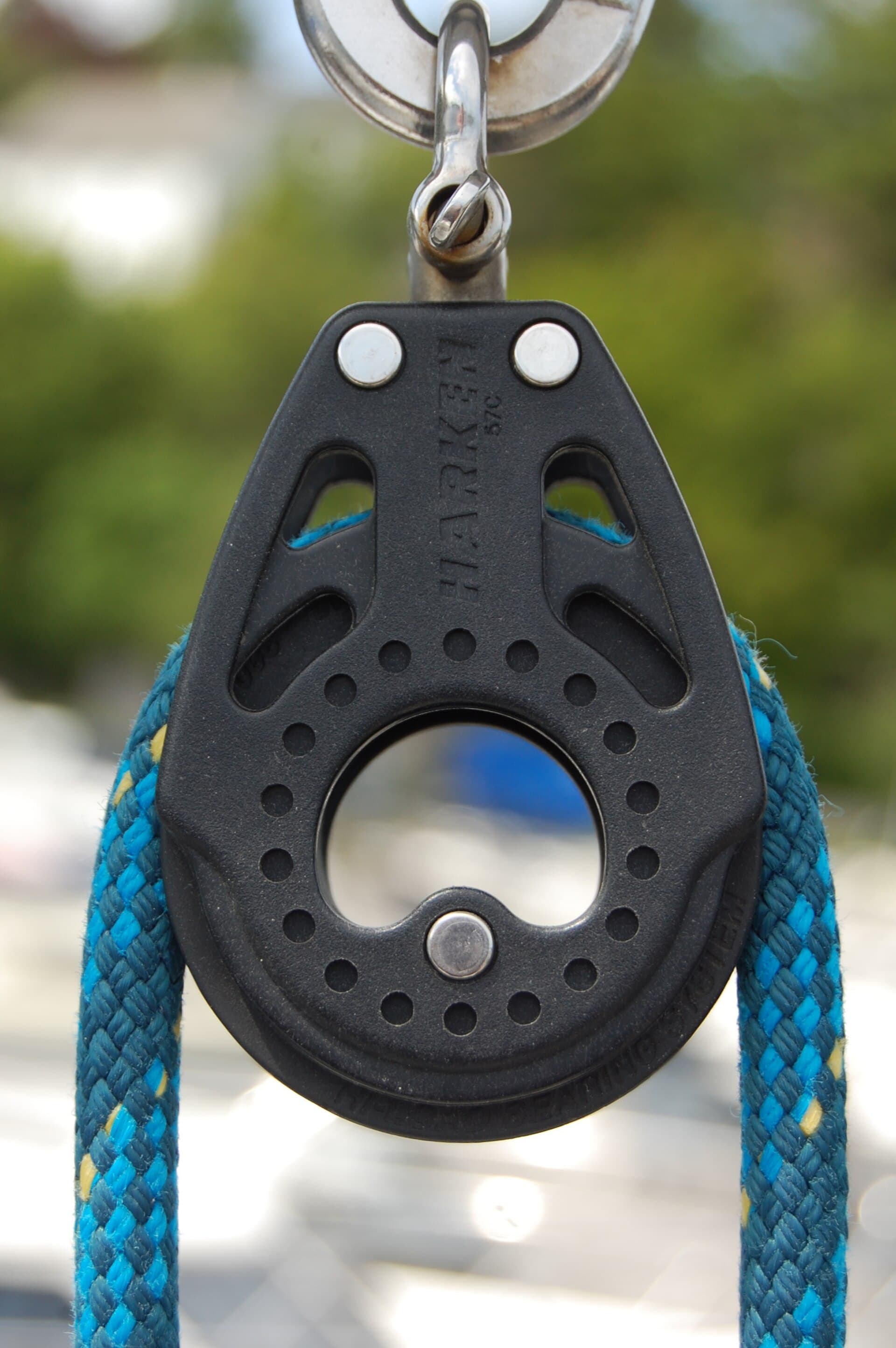
Harken Black Magic Air is the classic caged-roller execution: Torlon rollers running in an aluminium sheave, with a centre cage holding the rollers separated and parallel. Torlon (polyamide-imide) is the right material choice here — it is far more crush- and creep-resistant than the acetal/Delrin used in ball blocks, tolerates shock loading, and unlike stainless it is light and low-maintenance. The result is a sheave that resists distortion under deflection load, which is exactly what a heavily loaded mainsheet or vang block needs. Harken publishes a working-load span of 750–13,600 kg across 57–150 mm for this family — big-boat territory, and more range than a 40 will ever use, but it means the sizes you do fit are running well inside their envelope.
Ronstan Orbit takes a more integrated route. The load-bearing element is a Torlon needle roller — a longer, slimmer roller that packs more line contact into a given sheave width — but the clever part is that the sheave carries captive acetal or Torlon ball races on its faces to take the side-thrust. Because those captive balls handle the sideways load, Ronstan removes the separate side-retainer plates a conventional block needs; that frees width for a wider bearing bed and longer needles, which is where their strong strength-to-weight claim comes from. The body is fully machined from aluminium alloy and hard-anodised, with material left only where it carries load, and shackles are forged 17-4PH stainless. For the actual numbers: the Series 100 Orbit High Load publishes 9,350 lb SWL and 18,700 lb MBL (≈ 4,240 kg / 8,480 kg) at ~720 g on a 4-inch (100 mm) sheave — a genuine runner/backstay-grade block. (Ronstan's US pages quote loads in pounds without metric; the kg figures here are our conversions.)
Net: both are roller/needle blocks at the top, both cage the bearing, both use Torlon for the load elements. Harken's advantage is the sheer proven ubiquity of the caged-roller Black Magic and the stiffness of that architecture; Ronstan's is the packaging trick — killing the side plates to widen the bed — which is a real, not cosmetic, strength-to-weight gain.
Small control-line blocks — Harken's composite T2 vs Ronstan's 2-stage ball
Down at the cascade, bridle and fine-trim end, the priorities invert: weight and free-running at low load matter more than ultimate MBL, and this is where the two philosophies are most distinct.
Harken's T2 / Carbo Air is the benchmark composite block. A high-strength composite sheave spins on Delrin (acetal) ball bearings running in curved bearing races — the curved race lets the balls stay seated and rolling when the block is under an angled load rather than skating to one side — and, critically, it is built with no metal shackles or rivets, which is how it gets so light. The 40 mm T2, for instance, publishes a 220 kg working load at 25 g. Delrin is deliberately chosen over Torlon here: it creeps more under sustained high load, but on lightly loaded control lines that never matters, and it is lighter and cheaper. Harken has also pushed the ceramic option (Zircon: industrial ceramic balls in caged ceramic races, which Harken states are >700% stiffer in compression than same-size stainless) for the highest-cycle low-friction jobs.
Ronstan's answer on its small blocks is the 2-stage "Universal" bearing: Stage 1 runs high-compression acetal ball bearings for minimum friction under light load, and Stage 2 brings a secondary full-contact / sliding acetal bearing on a polished stainless race into play as load rises — so instead of the balls carrying (and flattening under) everything, the load transfers to a plain bearing surface that stays smooth at load. In the Core line this is extended with an integrated thrust bearing and acetal-or-alloy sheave options. The practical upshot: a single ball-and-curved-race block (Harken) is superb until the line loads up, whereas Ronstan's 2-stage system is designed specifically to hold low friction across the whole working-load band — useful on a control line that sees both fingertip trim and a big load in the puffs.
Neither is simply "better." The T2 is the lighter, cleaner soft-attach block and the class-standard on many one-designs; the 2-stage Ronstan is the more load-tolerant small block. For a 40-class primary trim line that spikes hard, the 2-stage argument has merit; for a low-load cascade where grams count, the T2 wins.
Sheave diameter, line size and bend radius
The number that quietly governs rope life is the sheave-diameter-to-line-diameter ratio. Running a modern Dyneema SK78/SK90 control line over too small a sheave forces a tight bend radius, concentrates fibre strain on the outside of the bend, and both raises friction and shortens the line's fatigue life. Both makers size sheave grooves to a maximum line diameter and publish it — Harken's Black Magic and Ronstan's Orbit ranges step up in sheave size specifically so you can keep a sane bend radius as line size grows. This matters more than brand: fitting a larger-sheave block (of either make) to a high-cycle halyard or backstay tail is often a bigger real-world gain than the friction difference between the two brands' bearings. Match the sheave to the line, then to the load.
Side-load, lead angle and where the load really goes
The load into a block is line load multiplied by a deflection factor set by the turn angle — a 90-degree lead applies about 1.41× line load; a 180-degree turn applies 2×. Rate blocks to that resultant, not to the line tension. It also means side-loading — a lead pulling the sheave out of plane — is a real failure mode on a boat where leads change with sail crossover. Ronstan's captive-ball side-thrust design is an explicit answer to this: the sheave has dedicated bearings for lateral load, which is part of why they can delete the side plates. Harken manages side control within the cheek structure. In practice both are robust in-plane; the discipline for the crew is to keep leads fair and let swivel or soft-attach heads self-align the block to the actual load line.
Attachment: soft-attach loops vs shackles vs lashing
Head choice is now as much a performance decision as the bearing. Harken's soft-attach and Loop system threads an SK75 Dyneema loop through the head and over an anchor/dead-end post — no shackle, no rivet, less weight, no metal to gouge the deck, and the block can pivot to align with load. It is the reason the 40 mm T2 Loop (Harken 2148) is on the Melges 40 parts list for exactly these small-block jobs. Ronstan offers SK78 Dyneema link heads with deliberately limited articulation (0° or 90° orientation) so the block sits where you want it, plus lashing-through-the-hub blocks where the rope lashing passes through the sheave hub as a genuine failsafe (if the lashing chafes it degrades gracefully rather than releasing). Both also offer conventional swivel-shackle heads (Ronstan forging in 17-4PH) where full rotation and ultimate durability beat grams.
The trade-off is honest: a Dyneema loop or link is lighter and self-aligning but becomes the primary service item — it takes UV and chafe, and it must be inspected and replaced on a schedule, not run to failure. A stainless shackle is heavier and less elegant but effectively lifetime. On a Grand Prix boat the loop/link is usually correct for the small and mid blocks; shackles earn their place on the highest-load, hardest-to-reach fittings.
Durability, materials and serviceability
Materials tell most of the durability story. Aluminium sheaves and cheeks (both makers, at the top of the range) are stiff and light but rely on anodising for corrosion resistance — Ronstan explicitly hard-anodises its machined Orbit bodies. Torlon load elements resist crush, creep and shock; acetal/Delrin balls are lighter and fine for low load but creep under sustained high load, which is exactly why neither maker uses them for primary high-load rollers. Stainless components are 316 (Harken shackles) and 17-4PH / grade 2205-class duplex (Ronstan forgings and high-load sheaves) for strength and corrosion resistance.
Serviceability is the practical differentiator over a season. Both are designed to shed salt and grit and to be flushed with fresh water; both sell bearing kits, loops and shackle spares. The genuine edge for a boat based in Australia is Ronstan's local design, manufacture and support — faster spares and technical backup. Harken's counter is the deepest global spares and dealer network, which matters when you break something the week of an overseas regatta. On a one-design where the class fixes the hardware, this — spares availability and turnaround — is often the deciding factor, not the bearing.
Our take
At the loads a 40 actually generates, Harken and Ronstan are engineered peers who solved the same problem two ways. Harken's caged-Torlon-roller Black Magic is the ubiquitous, proven high-load architecture and its composite T2 is the reference soft-attach control-line block — lighter and cleaner than anything else at that end, and already on the class parts list. Ronstan's Orbit answers with a smarter package — needle rollers plus captive side-thrust ball races, no side plates, a fully machined anodised body — for a strong strength-to-weight number, and its 2-stage Core/Orbit ball system holds friction across the load band in a way a single-stage ball block cannot. Most well-sorted inventories mix both by function: T2 loops for the light stuff, roller/needle blocks for mainsheet, vang, backstay and runners.
Who each is best for
- Harken — where you want the most-proven caged-roller high-load block, the lightest composite soft-attach control blocks (T2/Loop), and the widest global spares safety net for travelling campaigns.
- Ronstan — where strength-to-weight of the machined Orbit body, side-thrust-tolerant needle sheaves, 2-stage friction control under load, and fast local (Australian) support carry the day.
The takeaway
Buy the bearing and the sheave size, not the logo: rollers/needles for anything heavily loaded, balls for light trim, and a sheave sized to your line for bend radius. Harken owns the proven caged-roller high-load block and the reference composite T2 soft-attach; Ronstan owns the machined Orbit strength-to-weight and 2-stage mid-load friction — and, for an Australian campaign, the closer support. On a one-design, servicing, correct SWL for your lead angles, and spares (see block and clutch inspection) decide more than the badge. See the winches comparison for the other core hardware.
Our pick: it stays genuinely close. Choose Harken for the caged-Torlon-roller Black Magic and the T2/Loop control-line blocks (and the deepest travelling spares network); choose Ronstan for the machined Orbit body's strength-to-weight, its side-thrust needle sheaves and 2-stage friction control, and local Australian support. On a Grand Prix 40, size each block to its load, lead angle and line — and expect the best inventory to run both.
Frequently asked questions
- Which is better, Harken or Ronstan blocks?
- At the sizes that carry real load on a 40, they are engineered to the same brief and the gap is small. Harken's Black Magic Air line runs caged Torlon rollers in an aluminium sheave — high stiffness under deflection load and a proven service record. Ronstan's Orbit line uses Torlon needle rollers with captive acetal/Torlon ball races that also take the side-thrust, so no side-retainer plates are needed; that buys a wider bearing bed and a strong strength-to-weight number in a fully machined, anodised alloy body. Where they diverge usefully is the low end: Harken's composite T2 (Delrin balls on curved races) is the reference soft-attach control-line block and is genuinely light, while Ronstan's 2-stage Core/Orbit ball systems hold friction better once a control line is loaded up. Most Grand Prix boats mix both by function.
- What matters most in a race block?
- Friction under working load, not friction spun by hand on the bench. A ball-bearing sheave is lowest-friction when lightly loaded but the balls point-contact and can brinell or bind as load climbs; a roller (cylindrical or needle) bearing spreads the load over a line contact, so it stays free at high load and resists sheave distortion. That is why serious mainsheet, vang, backstay and runner blocks use roller or needle races and small trim/cascade blocks use balls. After that: correct SWL for the deflection angle (a 180-degree lead doubles line load into the block), side-load tolerance, sheave diameter relative to line (bend radius drives rope fatigue), and how the head attaches — soft-attach Dyneema loops save weight and let the block align to load, but the loop then becomes the service item.
- Do you have a partner in deck hardware?
- No. This comparison reflects each maker's published construction and specifications and general category engineering, nothing else.
- Is this based on hands-on testing?
- No — the figures here are the makers' own published SWL/MBL and weights, not our measurements. On a one-design the blocks are usually specified by the class or builder, so the live questions for an owner are servicing intervals, the correct SWL when you change a purchase system or lead angle, sheave-diameter-to-line ratio, and spares (bearings, loops, shackles) rather than brand. Where a figure is a conversion or looked inconsistent on the source page, we have flagged it.
Related articles
Block and Clutch Inspection
Race blocks lose efficiency when plastic ball bearings creep or the sheave runs off-axis; clutches lose holding load and burn covers as cam teeth polish. The bearing physics, cam mechanics, D/d ratios and the inspection and test procedure that catches both while they are cheap.
Read the articleRace Winches Compared: Harken vs Lewmar vs Andersen
An engineering comparison of Harken, Lewmar and Andersen race winches — power ratios and gearing, load-sensing reversing drives (Harken Rewind), drum materials and grip, self-tailing jaws, bearings, weight trade-offs and servicing — with real published figures. Independent; no hardware partner.
Read the article