Hull and Foil Hydrodynamics
The underwater force balance in engineering terms: skin friction on the ITTC line, wave-making and the Froude wall, and the lift-versus-induced-drag economics of keels, boards and rudders that governs how a race boat is designed and sailed.
14 min read
Underwater, a race boat has two jobs: minimise drag and generate just enough side force to stop it slipping sideways. Every metre sailed is a negotiation between the hull's resistance, which slows the boat, and the lift the keel, board and rudders make to resist leeway. Get the balance right and the boat converts the rig's drive into forward speed at a tight angle to the true wind. This is the physics the whole design philosophy is built to optimise — the underwater half of the picture, with sail aerodynamics above the waterline. The tools are old and unglamorous — a friction line from 1957, Froude's scaling from the 1860s, Prandtl's lifting-line theory — but they still set the numbers a modern crew sails to.
The three sources of hull drag
Naval architects decompose total hydrodynamic resistance into three parts, and knowing which one dominates when is the key to everything else.
Skin friction is momentum lost shearing water in the boundary layer against the wetted surface. Its coefficient follows the ITTC-1957 model-ship correlation line, C_F = 0.075 / (log₁₀ Re − 2)², where the Reynolds number Re = V·L/ν uses the waterline length and the kinematic viscosity of seawater (≈ 1.19 × 10⁻⁶ m²/s at 15 °C). For a 12 m hull at 8 knots that is a Reynolds number around 4 × 10⁷, so the flow over the hull is almost entirely turbulent. Friction force scales with wetted surface area and with the square of speed, and because C_F falls only slowly with Reynolds number, friction is by far the largest component at low speed — typically 70 to 80 per cent of total resistance. It never disappears; it just shrinks relative to the others as speed climbs. A form factor (1 + k) is added to account for the hull's three-dimensional shape thickening the boundary layer over a flat plate.
Wave-making (residuary) drag is the energy irreversibly radiated into the bow and stern wave train. It is governed by the Froude number Fr = V / √(g·LWL), and below about Fr 0.20 it is negligible. From roughly Fr 0.35 it begins to climb steeply, and through Fr 0.40 — the classic hull-speed region — the divergent wave system dominates and residuary resistance can reach 80 per cent of the total. This is the "prismatic hump", so named because its height is strongly set by the hull's prismatic coefficient (the fullness of the ends).
Induced drag is the unavoidable by-product of making lift. To resist leeway the foils generate side force, and Prandtl's lifting-line result fixes its cost: C_Di = C_L² / (π · e · AR), where e is the span efficiency (≈ 0.8 to 0.95 for a well-shaped foil) and AR the effective aspect ratio. Because it scales with the square of lift, induced drag is a real fraction of the total upwind — heeled, loaded, at a few degrees of leeway — and nearly vanishes reaching, when the foils are barely working.
Because the boat pays all three every second it sails, minimising them is the whole game — and it is why hull shape, all-up weight and a clean bottom matter so much. There is no "coasting" underwater; unlike a bike freewheeling downhill, a hull that stops driving decelerates immediately.
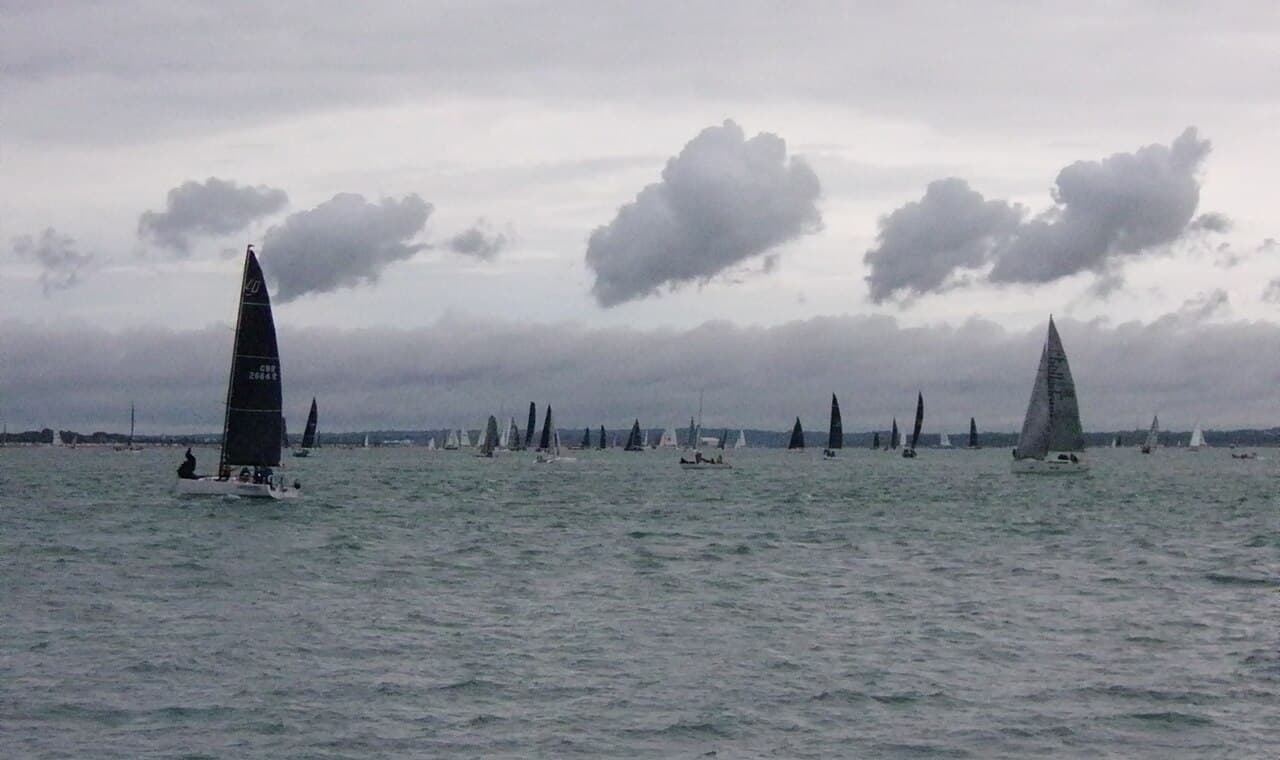
Skin friction and the boundary layer: why light air is a friction game
At low Froude number wave-making is negligible and friction rules, so the winning move is to present less wetted surface to the water: a fine canoe-body section, minimum displacement, and crew weight placed to lift the transom and quarters clear rather than dragging them. Heeling a few degrees in the light stuff can pay because it can slim the immersed section and float the wide, draggy aft sections up. Every kilogram of avoidable weight costs twice — it deepens flotation, wetting more skin, and it lowers the power-to-weight the boat needs to eventually plane.
The subtler lever is the state of the boundary layer. Over a smooth surface at low speed, flow can remain laminar — thin, low-shear — up to a local (chord-based) Reynolds number of order 5 × 10⁵; a genuinely clean, fair surface pushes that transition point aft toward 1–2 × 10⁶, while a rough or turbulent-inflow surface drops it to 3 × 10⁵ or below. That threshold matters because the turbulent skin-friction coefficient is several times the laminar one at the same Reynolds number. Weed, slime, an unfaired join or a sharp step trips transition early, and the boat then carries a thick turbulent boundary layer over a larger fraction of its surface — a penalty paid continuously, on every wave, on every leg. On a full-scale hull most of the surface is already turbulent, so the practical target is not "keep it laminar" but "keep the turbulent surface as smooth and unseparated as possible". See light-air mode for how this translates into settings.
Wave-making, the Froude wall and the planing breakthrough
Every displacement hull has a natural speed ceiling set by its own wave system. Hull speed is where the wavelength of the transverse wave the hull generates equals its waterline length — approximately 1.34 × √(LWL in feet), or in metric roughly 2.43 × √(LWL in metres), corresponding to a Froude number near 0.40. The physics is deep-water gravity waves: wavelength scales with the square of phase speed (λ = 2π·V²/g), so as the boat accelerates its bow wave lengthens until, at hull speed, a single wave spans bow to stern and the hull settles into the trough between the crest at the bow and the crest off the transom. Pushing faster means climbing the back of its own bow wave — the residuary "wall" a heavy boat simply cannot get over, because the power required rises far faster than the square of speed through this region.
The escape is planing. Given enough power-to-weight, a light, beamy hull with a flat run aft generates hydrodynamic lift from the pressure of water deflected downward beneath it. As Savitsky's planing theory describes, the hull trims bow-up, the wetted length shortens, buoyant support gives way to dynamic support, and residuary drag collapses even as speed climbs. There is a cost embedded in it — the pressure (induced) drag of planing rises with the square of trim angle, so there is an optimum running trim, typically only a few degrees, that minimises total drag; too flat and wetted surface is high, too bow-up and induced drag dominates. The transition is not gentle: there is a threshold where the boat is neither displacing cleanly nor planing and drag is high, then a snap onto the plane where the boat accelerates as drag falls. The physics of why light weight and stiffness matter is exactly this — the power-to-weight ratio that decides whether, and how early, a hull breaks through.
Hull shape is tuned to a target Froude number. The optimum prismatic coefficient rises with design speed: a light-air boat wants a low prismatic and fine ends to keep the wave train small below Fr 0.30; a planing boat wants fuller aft sections and buoyancy carried well aft to resist the bow-up trim and support early planing. This is why no single hull wins at every wind speed, and why crews sail modes rather than pretending one attitude suits all conditions.
Foils, angle of attack and the leeway economy
The keel fin, daggerboard and rudders are wings that happen to work in water. Counter-intuitively, a foil resists leeway only by allowing a little of it. The boat crabs at a small leeway angle — typically a few degrees — so water meets each foil at an angle of attack, and the foil develops lift perpendicular to the local flow: the side force that balances the rig's sideways push and holds the boat tracking forward. Water is roughly 800 times denser than air, so a foil of a fraction of the sail area produces the balancing force; the price is that everything happens at very small angles.
The trade-off is the heart of foil design. Lift rises linearly with angle of attack along the lift-curve slope — for a moderate-aspect foil roughly dC_L/dα ≈ 0.1 per degree, less for a low-aspect one — while induced drag rises with the square of lift (C_Di ∝ C_L²). So the first degree or two of leeway is generous in force and cheap in drag; beyond that, extra leeway buys diminishing side force while drag climbs steeply. Overload the foil — pinch too high, or overpower the boat so it makes excessive leeway — and flow separates: the foil approaches stall, lift collapses and drag spikes, and because a keel stall dumps side force the boat slides sideways precisely when it can least afford to. The usable band is narrow and the penalty for leaving it is asymmetric.
The lever that changes the whole economy is aspect ratio. A deep, short-chord foil is high-aspect: it makes its side force at lower angle and lower induced drag than a shallow, long-chord one, because induced drag scales inversely with AR. Two second-order effects matter at this level. First, the free surface: a surface-piercing or shallow foil loses much of the pressure difference near the waterline and behaves as though its aspect ratio were roughly halved relative to the same foil deep in unbounded water — a strong argument for getting lifting area deep. Second, section choice: a symmetric NACA 4-digit section such as 0010–0012 is forgiving and stalls gently, whereas a 6-series laminar section (63-, 64-, 65-0xx) offers a lower-drag "bucket" over a band of small angles but is fussier about surface finish and leading-edge condition, and drops out of its bucket if tripped. That is why modern race fins and boards are deep and slim with carefully chosen sections, and why on canting-keel boats a separate slender daggerboard carries lateral resistance so the ballast fin can specialise in righting moment.
At the top of the speed range a further limit appears. As a foil's suction peak drops the local pressure toward the vapour pressure of water, it can cavitate; but for sailing yachts the more common failure is ventilation — air drawn down from the surface along a rudder or board, breaking the low-pressure side and collapsing lift. Ventilation can occur at quite modest speeds through a surface-piercing shaft or a stalled rudder, whereas true cavitation generally needs boat speeds well above roughly 30 knots. Both are reasons to keep sections fair, leading edges crisp and rudders loaded within their band.
What good versus bad looks like below the waterline
The difference between a fast and a slow underbody is usually invisible from the dock but constant on the water. Good looks like a fair, hard, clean surface with no weed or growth; foils with crisp, undamaged leading edges, no waviness in the section and sharp, un-feathered trailing edges (a rounded trailing edge fattens the wake and adds drag); and trim that holds the hull near its designed attitude and the foils near zero-lift when unloaded. Bad looks like a slime layer or barnacle field tripping the boundary layer turbulent early, leading-edge nicks that seed laminar separation or ventilation, a bogged, unfair repair standing proud of the section, and a boat sailed at the wrong heel so the immersed shape is not what the designer drew.
The failure modes matter because drag is paid continuously — a fouled bottom does not cost you once, it costs you on every wave, every leg, every race, and a tripped or nicked foil quietly narrows the angle band you can sail in before it lets go. Keeping foils and hull clean, smooth and faired is not housekeeping; it is protecting real speed, and the same boundary-layer thinking underlies most common speed killers.
Balancing the forces above and below
None of this works in isolation. The sails make the driving force in the air; the hull and foils manage drag and produce the side force in the water that lets the boat turn that drive into forward motion at an angle to the wind. The two force systems must close: the foils' total side force equals the rig's heeling force, and the forward drive equals total resistance, at the equilibrium heel, leeway and trim the boat finds for a given wind speed. They are coupled — sheeting on adds heeling force and heel, which increases foil loading and leeway and changes the immersed shape, which changes drag, which changes speed, which changes the apparent wind the rig sees. Designing and sailing a boat well means solving that whole coupled balance, above and below the waterline, together — which is exactly what a velocity prediction program does numerically, and what a good crew does by feel.
How this plays out on a Grand Prix one-design
On a light, high-powered Grand Prix boat like the Melges 40, every principle above is dialled up. The class is a Botin Partners design built by Premier Composite Technologies in epoxy-infused carbon over a foam core, deliberately light for its length — public figures put displacement around 3,250 kg on roughly 12 m (11.99 m) overall, with a very high sail-area-to-displacement ratio (published near 56, mainsail ≈ 72 m², jib ≈ 49 m², gennaker ≈ 200 m²). That power-to-weight is precisely what lets it trim bow-up and plane readily, breaking clean through the Froude 0.40 wall once the breeze fills in. (Treat all boat-specific dimensions here as indicative; verify displacement, waterline length, sail areas, foil geometry and any tuning figures against the current class rules and the individual boat's measurement and build documentation before relying on them.)
Its distinguishing feature is the canting keel, a hydraulically actuated fin swinging to windward — publicly described as up to 45° to either side, carrying a lead bulb of order 1,100 kg on a fin of roughly 100 kg, with maximum draft near 3.2 m (about 10 ft 6 in) board-down (all verify against the class rules). Canting the ballast to windward stacks righting moment so the boat can carry its large sail plan, but it creates the classic canting-keel problem: once the fin is canted off the centreline it is no longer aligned to make efficient anti-leeway lift, and a canted, heeled fin can even generate an adverse side-force component with its own induced-drag penalty. The solution is a textbook division of labour — a slender, very high-aspect forward daggerboard takes over lateral resistance upwind (side force on the board), leaving the keel free to specialise in righting moment (ballast on the fin). Because the board's job is pure side force, it can be optimised as a deep high-aspect foil for minimum induced drag, exactly as the leeway economy above demands.
Twin rudders (verify configuration against the class documentation) answer a separate problem: at the large heel angles this boat sails, a single centreline rudder would lift toward the surface and risk ventilation and stall, losing grip when the boat is most loaded. Canting the hull immerses the leeward blade deeply and near-vertically so it bites cleanly, while the windward blade lifts clear — the leeward rudder always working in solid, un-aerated water at an efficient angle. It is the same free-surface and ventilation physics that governs foil depth, applied to steering.
The upshot for the crew is a boat that lives at the transition between displacement and planing, where small changes in heel, trim, crew weight, cant angle and foil loading move it between drag regimes fast. Understanding the hydrodynamics is what keeps it on the efficient side of every trade-off. To go deeper, see what makes the Melges 40 fast, the mechanics of the canting keel and twin rudders, or the full Labs library.
The takeaway
Hydrodynamics is the underwater half of boat speed: as little drag as possible, exactly enough side force, and never a degree of leeway more than you need. Friction on the ITTC line rules below Froude 0.3, wave-making and then planing rule as you approach and pass Froude 0.4, and the foils quietly resist leeway on their linear-lift, square-law-drag budget in between — all of it paid for continuously. That is why a fair, clean, well-trimmed underbody, sailed at the heel and trim the designer drew, converts straight into places on the course.
Frequently asked questions
- What are the three components of hull drag?
- Total resistance decomposes into viscous (skin friction plus a form factor), residuary (mostly wave-making), and induced drag from generating side force. Skin friction follows the ITTC-1957 line, C_F = 0.075/(log₁₀Re − 2)², and scales with wetted surface, so at low Froude number it is 70 to 80 per cent of the total. Residuary drag is trivial until roughly Froude 0.35, then climbs almost vertically toward hull speed. Induced drag is the price of lift: it scales as C_L² divided by (π × span efficiency × effective aspect ratio), so it grows with the square of foil loading and bites hardest upwind.
- What is hull speed and why does a light boat break through it?
- Hull speed is where the transverse wave the hull generates has a wavelength equal to its own waterline, giving roughly 1.34√(LWL in feet), 2.43√(LWL in metres), or a Froude number near 0.40. There the boat sits in the trough of its own bow and stern wave and residuary resistance rises like a wall. A heavy displacement hull cannot climb it. A light, beam-carried, flat-run hull with high power-to-weight develops planing lift, trims bow-up, sheds wetted length, and detaches speed from the √LWL ceiling — Savitsky-type dynamic lift replacing buoyant support.
- How do the keel and rudders resist leeway?
- They are low-aspect lifting surfaces. The boat crabs at a leeway angle of a few degrees, so water meets each foil at an angle of attack and it develops lift normal to the flow — the side force balancing the rig's heeling force. Lift rises linearly with angle (lift-curve slope near 0.1 per degree for a moderate-aspect foil), but induced drag rises with the square of lift. Deep, high-aspect foils reach the same side force at lower angle and lower induced drag, which is why modern fins and boards are slim and deep.
- Why is a clean, faired bottom worth measurable boat speed?
- Skin friction is set by the boundary layer. A smooth surface can hold laminar flow to a local Reynolds number of order 5×10⁵, but roughness, weed or an unfair join trips transition early; the turbulent C_f is several times the laminar value, and that penalty is paid over the whole wetted surface every second. On foils, leading-edge nicks and surface waviness force early transition or trigger laminar separation, narrowing the usable angle-of-attack band and dropping maximum lift before stall. Because drag is paid continuously, fairness converts directly and permanently into speed.
- Why does one hull shape not win at every wind speed?
- The drag components trade against each other with Froude number. In light air the boat sits below Froude 0.2, friction dominates, and minimum wetted surface with a fine run and low prismatic coefficient wins. In a breeze it approaches and passes Froude 0.4, residuary and then planing drag dominate, and a wider, flatter, higher-prismatic hull that lifts clear wins. The optimum prismatic coefficient itself rises with target Froude number, so no single hull optimises both regimes — designers pick a design speed and crews sail modes, weight and trim to hold the hull near its efficient attitude.
Related articles
Sail Aerodynamics: How Sails Make Power
A sail is a thin, cambered, low-Reynolds aerofoil generating bound circulation upwind and a bluff drag body downwind. The engineering — circulation and the Kutta condition, the leading-edge separation bubble, induced drag and aspect ratio, camber and twist — is what sail trim actually controls.
Read the articleRace Boat Design Philosophy
A race boat is a coupled optimisation problem — power, stability, drag and weight resolved under a rule for one purpose. Design philosophy is the objective function a naval architect commits to before the VPP runs its first sweep.
Read the articleBottom and Foils: Fairing, Finish and Speed
Skin friction and form drag act every second underwater, so bottom and foil condition is measurable speed. The boundary-layer physics of hydraulic smoothness, why fairness beats polish, trailing-edge base drag, and how to inspect and repair foils to section.
Read the article