2 min read · Updated 25 June 2026
Sailing downwind fast means, oddly, not sailing straight downwind. Because a boat is quicker reaching across the wind than running dead before it, the fastest way to a downwind mark is to sail hotter angles and gybe between them — chasing pressure and using the boat's own speed to build the wind it feels. It is the mirror image of working upwind, and just as rewarding to get right.
Don't sail dead downwind
The instinct is to point the boat straight at a downwind mark. But dead downwind is slow: the boat can only go as fast as the wind pushes it, and the apparent wind — the breeze the sails actually feel — drops right off. Heat the boat up to an angle, though, and its own speed adds to the wind, keeping the sails powered and the boat accelerating. You sail further, but you get there sooner — the principle of velocity made good.
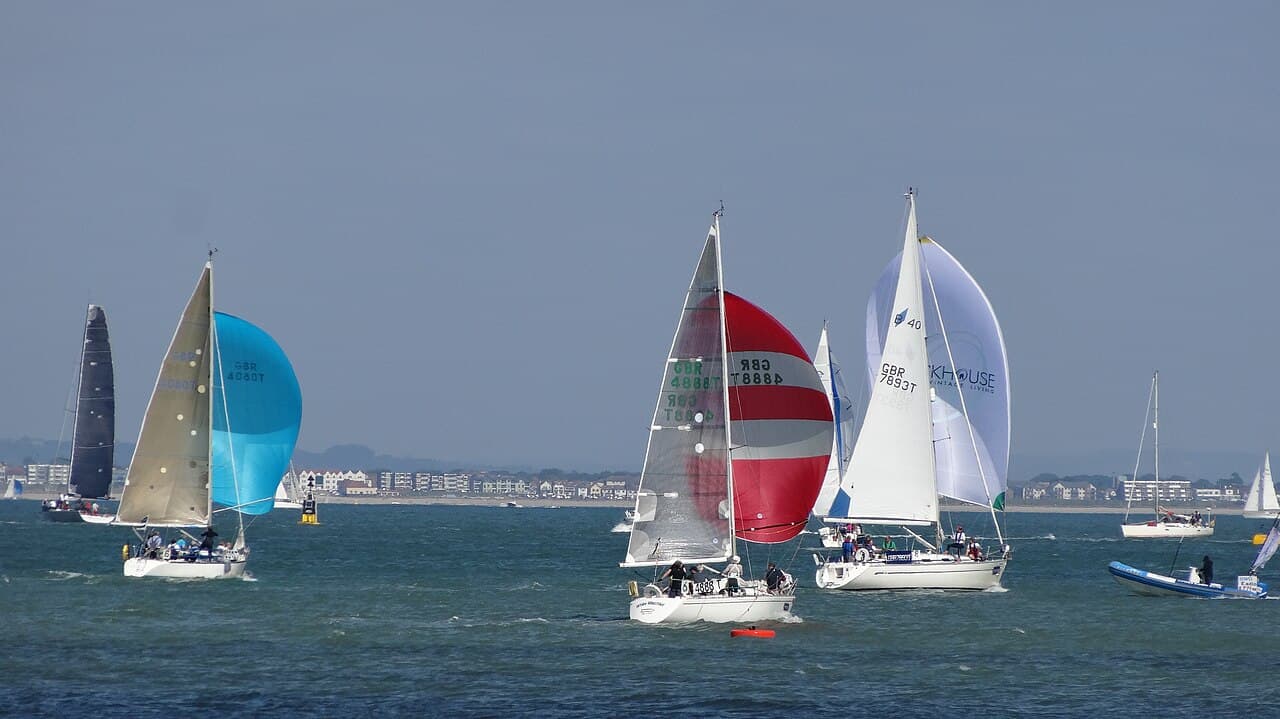
Heating up and soaking
Downwind sailing is a constant trade between two modes:
- Heating up — turning towards a broad reach for more speed.
- Soaking — bearing away lower, closer to dead downwind, for a more direct course but less speed.
You heat up to build pressure and speed, then soak low in the puffs when you have speed to spare. Reading the gusts coming down the course and timing these gains is much of the skill of downwind sailing.
Gybing down the course
Just as a boat tacks to zig-zag upwind, it gybes to zig-zag downwind. You sail a fast broad-reaching angle on one gybe, then gybe onto the other to work down towards the mark, alternating between the two. Each gybe swaps which side the wind comes over and sets the boat on its next fast angle.
Flying the spinnaker
Downwind is where the spinnaker comes out — a big, light sail that scoops up far more wind than the ordinary headsail. It is trimmed continuously: eased until the leading edge just curls, then trimmed to take the curl out. On a modern boat with an asymmetric spinnaker on a bowsprit, you fly it at those hotter angles and gybe between them — exactly the technique the fastest downwind sailing demands. For more on the manoeuvre, see spinnaker hoists and drops, and the sailing terms glossary for the language.
Frequently asked questions
- How do you sail downwind fast?
- Counter-intuitively, you sail fast downwind by not pointing straight downwind. Because a boat is faster reaching than running dead before the wind, you sail at hotter angles — the wind coming from behind but off to one side — and gybe back and forth between them. Those angles build apparent wind and speed, so even though you sail further, you get to a downwind mark sooner.
- Why not sail straight downwind?
- Because it is slow. Dead downwind, the boat can only go as fast as the wind pushes it, and the apparent wind — the wind the sails feel — drops right off. By heating up to an angle, the boat's own speed adds to the wind it feels, keeping the sails powered and the boat moving faster. The extra distance is more than repaid by the extra speed, which is measured as velocity made good.
- What is soaking and heating up downwind?
- Heating up means turning towards a broad reach for more speed; soaking means bearing away lower towards dead downwind for a more direct course but less speed. Downwind sailing is a constant trade between the two — you heat up for pressure and speed, and soak low in the puffs when you have speed to spare, all to make the best progress to the mark.
- How do you use the spinnaker downwind?
- Downwind you hoist a spinnaker or gennaker — a big, light sail that captures far more wind than the ordinary headsail. It is trimmed constantly: eased until the leading edge just curls, then trimmed to take the curl out. On a boat with an asymmetric spinnaker flown from a bowsprit, you sail the hotter angles and gybe, exactly as the fastest downwind technique demands.
- What does gybing downwind achieve?
- Gybing lets you zig-zag downwind the way tacking lets you zig-zag upwind. Since the fastest progress is made at an angle rather than dead downwind, you sail a broad reach on one gybe, then gybe onto the other to work down towards the mark. Each gybe changes which side the wind comes over and sets you on the next fast angle.