Crew Weight and Hiking: Moving Ballast
Crew are movable ballast: their outboard lever arm sets righting moment side to side, their fore-and-aft position sets trim and pitch gyradius, and hiking effort is a measurable, sustainable contribution to upwind righting moment you control gust to gust.
10 min read
On a Grand Prix keelboat the crew are the most powerful piece of movable ballast on the boat. Where they sit sets the boat's righting moment side to side and its trim and pitch behaviour fore and aft, and how hard they hike is righting moment you can measure, control and lose in real time. It is performance that costs only discipline and fitness, and on a canting-keel one-design it works alongside the canting keel: the keel supplies the big, steady righting moment, and the crew supply the fast tuning the keel cannot.
Righting moment: the number that governs upwind speed
Upwind in a breeze, boat speed is limited by righting moment (RM) — the torque that resists heel. Every unit of RM lets you carry more sail area and trim it harder before the boat heels past its target angle, and sail-driving force scales with RM up to the point where the hull and foils, not the crew, are the constraint. For a monohull the fundamental relationship at modest angles is
RM = W · GM · sin θ
where W is the sailing weight, GM the metacentric height, and θ the heel angle. On a keelboat that base curve is dominated by the ballast; the crew and, on a canting boat, the keel cant are the terms you can move on the water. Because sin θ is close to linear out to roughly 20–25°, RM builds almost proportionally with heel over the normal upwind range and then flattens — which is exactly why you sail to a target heel rather than "as flat as possible" or "let it lie over".
Excess heel is slow twice over. First, the rig loses drive geometrically: as the boat heels, the sail plan's force vector tips out of the horizontal, so useful forward thrust falls roughly with the cosine of the heel angle while an increasing share of the force becomes heeling and vertical load that does no useful work. Second, the appendages lose grip: heeling the hull tilts the keel and rudder off vertical, so only the horizontal component of their lift resists leeway. A commonly cited approximation is a keel around 94% effective at 10° of heel but only about 71% effective at 45° — you make more leeway and pay more induced drag for the side force you do get, and a heeled hull adds an asymmetric-immersion drag penalty on top. Holding the boat near its designed heel keeps the foils loaded near their best lift-to-drag and the hull tracking straight.
Crew righting moment itself is simple statics: crew mass multiplied by the horizontal distance from their combined centre of gravity to the boat's centre of buoyancy — near the centreline when upright. Mass is fixed on the water; the lever arm is not. Every body that moves further outboard adds moment in direct proportion to how far it travels, which is why a fully committed rail is worth far more than a slumped one carrying identical kilos.
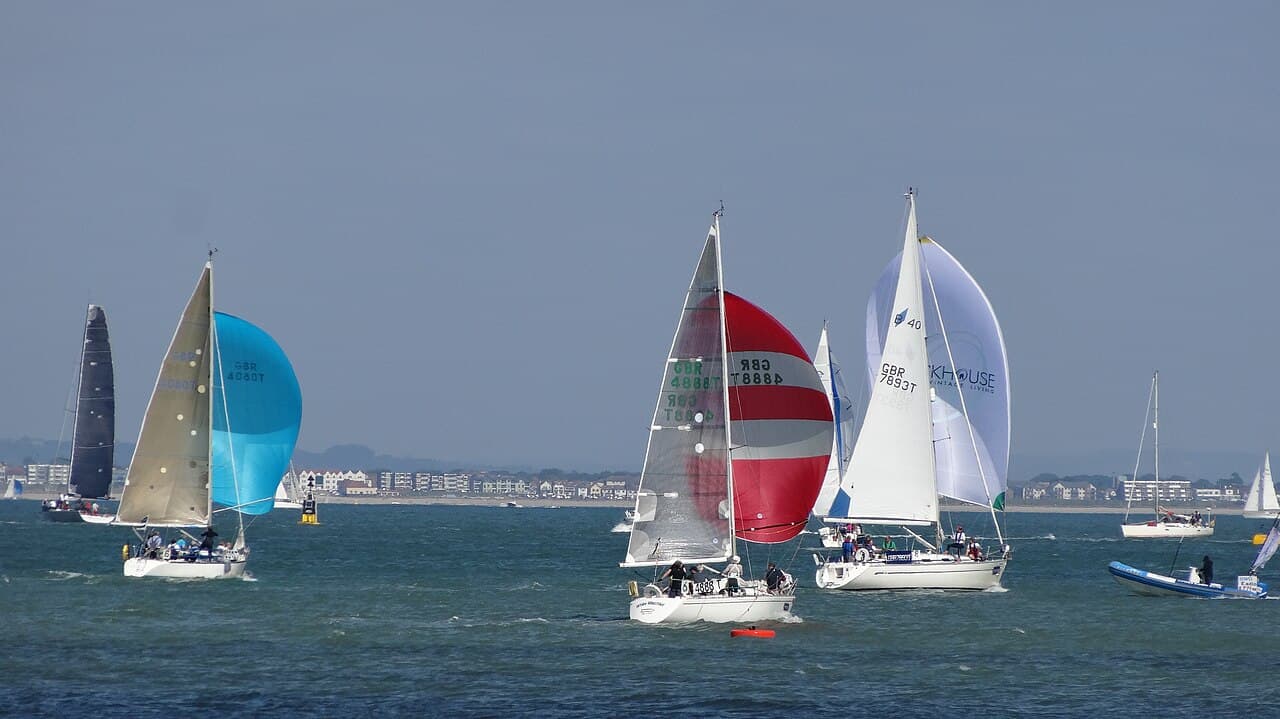
Hiking technique: buying the lever arm
Hiking is moving your mass as far to windward as the boat and the rules allow. The gain is geometric, so it is all about how far outboard you get your centre of gravity, not how uncomfortable you look. A sustainable, effective position is specific:
- Feet anchored under a strap or against a purchase so the legs, not grip, hold the torso out.
- Hips at or beyond the gunwale, so the CG is genuinely outboard of the deck edge rather than perched inside it — the last 100mm of hip position is worth more moment than the whole torso lean.
- Load through the legs, not the back: the position is a prolonged quasi-isometric contraction of the quadriceps (and trunk), so it lives or dies on leg endurance. The lower back and abdominals fatigue and fail far sooner.
- The whole rail as one line, evenly spaced, no gaps and no one sitting in — a single body inboard is a hole in the righting-moment budget.
The difference between a lazy rail and a committed one is several hundred millimetres of lever arm per person. Across a full crew that is a meaningful slice of total righting moment, delivered for free — the equivalent, in RM terms, of a chunk of extra ballast you did not have to carry through the light patches. Whether hiking straps or hiking outside the lifelines are even legal is a class-rules question: confirm what the class and the boat's measurement documentation allow before you build technique around it.
Hiking is real athletic work, and endurance is a boat-speed asset. Studies of simulated upwind hiking put the aerobic cost only modestly high — on the order of ~40% of VO₂peak — but with heart rate climbing to roughly 70% of maximum, driven by the sustained isometric quadriceps load that restricts blood flow and accelerates local fatigue; quadriceps discomfort routinely persists into the next day. Righting moment is only worth anything if the rail can hold it for the length of a beat, in waves, race after race. A crew that hikes hard for three minutes and then folds gives away exactly the moment it most needs at the top of the beat, where lanes are tightest. Trained legs, deliberate hydration and shared "hike on" calls through the gusts turn a strong rail into a consistent one. This is core upwind trim: the trimmers and driver keep the boat in the groove, and the rail keeps it standing up so they can.
Read the priority correctly. Hiking only pays once the boat is fully powered and heel-limited — when reducing heel by a degree measurably lets you point higher or foot faster. Below that threshold, in light air or through a lull, driving weight to the rail simply burns the crew for nothing and can even hurt you by putting mass where it lifts the leeward sections awkwardly. In those conditions weight belongs low and inboard. Hiking hard in the wrong conditions is one of the most common misapplications of effort on the racecourse.
Fore-and-aft trim: waterline, transom and pitch gyradius
Where the crew sit along the boat controls two distinct things, and good crews manage them separately.
The first is static trim — how the hull floats, and therefore its wetted surface and transom immersion. The second is pitch gyradius: the fore-and-aft distribution of mass sets the hull's moment of inertia about its pitch axis, which governs how readily it pitches in a seaway. Concentrating crew mass near the longitudinal centre lowers that moment of inertia, so the boat pitches more freely and follows the waves; spreading bodies toward the ends raises it and damps the motion. Neither is automatically "better" — you want the ends light enough that the bow rides over a wave train rather than ploughing through it, but not so lively that the boat hobby-horses and stalls the rig. This is why performance hulls favour light ends and why the crew normally sit shoulder-to-shoulder near the centre of buoyancy rather than strung out along the rail.
Practical targets by condition:
- Light air — move weight forward and inboard. Lifting the flat aft sections clears a wetted, gurgling transom out of the water, cutting transom drag, and lets the finer forward sections do the work. Keep weight low and central as well as forward to hold pitch gyradius down so the bow works the chop instead of stalling on it.
- Powered up — weight moves progressively aft as apparent wind and boat speed build, stopping the bow burying and settling the hull at its fast fore-and-aft angle; some crews also spread slightly to add pitch damping as the waves grow.
- Downwind, fully powered — weight well aft to lift the bow, release the hull and help it hold onto the plane; this connects directly to finding the boat's fast downwind mode.
None of these are fixed rules — they are targets you tune by watching the transom wake and the pitching. A dragging, gurgling transom in light air means weight too far aft. A bow that noses in and decelerates on the waves means weight too far forward, or a pitch gyradius that lets the ends dig. The crew are a continuously adjusted trim and motion control, not a static load.
Movement in manoeuvres: choreography, not chaos
The fastest crews are not the strongest — they are the ones whose weight moves smoothly and together. Sudden, uncoordinated movement upsets the boat: a body crossing at the wrong instant changes heel, the rig pumps, the hull pitches, the rudder loads up to correct, and that corrective rudder is pure induced drag — speed washes off precisely when a clean, flat exit matters most, in tacks, gybes and mark roundings.
Good crew work makes each transition choreographed: every person knows their path across the boat, when they move, and where they finish, so weight crosses late and smoothly rather than early and in a rush. On a boat this quick to accelerate, keeping it near its target heel and trim all the way through the turn — instead of stalled, heeled and slow on the exit — is worth real distance. It is the same discipline that separates a clean start from a scrambled one — see starting strategy for big boats — and it is learned by repetition, not by strength.
How it plays out on a Melges 40
The Melges 40 is a light, powerful, Botin-designed canting-keel one-design built in epoxy-infused carbon over a foam core, and it makes an unusually instructive case because you can see the division of labour between keel and crew in the numbers. Publicly reported figures put lightship displacement at about 3,250kg, with roughly 1,200kg of ballast — around 1,100kg of it in the bulb — swinging on a fin that cants to 45° on a draught near 3.20m, driving a 72m² square-top main, 49m² jib and a 200m² gennaker. The class is reported to sail with nine (or ten) crew, up to a maximum crew weight of about 750kg. Treat every one of those as boat- and class-specific: crew number, any weight cap, sail dimensions and the legality of hiking aids are governed by the current class rules and the boat's own measurement documentation and must be verified there, not assumed — sister classes have carried crew-weight limits that were later removed, so figures date fast.
The canting keel changes the emphasis but not the principle. Swinging that bulb to windward is a righting-moment multiplier: with the fin fully canted to 45° the bulb's mass acts on a long horizontal lever, which is how the boat is reported to generate on the order of ten per cent more righting moment than a Fast 40+ from roughly half the bulb weight (again, a boat-specific claim to verify). The system that does it is a Cariboni-type single ram with a double-acting cylinder — it both pushes and pulls the fin — driven by a 24V electric power pack; the actuation details (electric versus electro-hydraulic) should be confirmed against the boat's own documentation. Upwind the fin usually sits fully canted to 45°; downwind, crews report backing it off — around 20° in the low-to-mid teens of breeze, or centred in lighter air — because a fully canted fin adds wetted area and its own drag once the righting moment is no longer the limit.
Because the keel carries so much of the load, the crew are a smaller share of the total righting-moment budget than on an unballasted hiking boat — but their contribution is far from redundant, and it is the fast contribution. They set fore-and-aft trim and pitch gyradius entirely on their own; they add and shed righting moment gust to gust, faster than the ram can cycle the fin; and they govern the boat's manners through every manoeuvre. On a hull this light and quick to accelerate — reported to touch the low-to-mid twenties of knots downwind — sloppy weight work shows up immediately in lost speed and height. Getting crew weight right is one strand of what makes the boat fast, and, done poorly, one of the easiest places to give it back, as covered in common speed killers.
Frequently asked questions
- How much speed does hiking actually add?
- Crew righting moment is mass multiplied by the horizontal distance from each body's centre of gravity to the boat's centre of buoyancy — roughly the centreline upright. Moving from slumped to fully committed shifts a person's CG 300–500mm further outboard; across a nine-person rail at ~85kg average that is on the order of 300–380kg·m of extra moment, all free. The benefit is conditional: righting moment only buys speed once you are heel-limited, i.e. fully powered and trimming the boat down to its target heel. Under that threshold, hiking hard just burns quadriceps for no measurable gain, and weight is better placed low and inboard to reduce pitch gyradius.
- Where should the crew sit fore and aft?
- Fore-and-aft position controls two separate things: static trim (where the hull floats, and therefore wetted surface and transom immersion) and pitch gyradius (how readily the boat pitches in waves). In light air, weight moves forward and inboard to lift the flat aft sections and unstick a dragging transom, and low and central to cut the pitch moment of inertia so the bow follows the waves instead of ploughing them. As apparent wind and boat speed build, weight moves progressively aft to stop the bow burying and to release the hull downwind. There is no fixed rule — you read the transom wake and the pitching, not a mark on the rail.
- Does a canting keel make crew hiking irrelevant?
- No. A canting keel swings its bulb to windward and applies a large, steady righting moment through the whole beat — on the Melges 40 the reported figure is around ten per cent more righting moment than a Fast 40+ from roughly half the bulb weight (verify against class data). But the keel cycles slowly and cannot change fore-and-aft trim at all. Crew still trim the hull fore and aft entirely on their own, still add and shed righting moment gust to gust faster than the ram can move the fin, and still govern the boat's manners through every manoeuvre. On a canting one-design the keel does the heavy lifting; the crew do the fast, fine tuning.
- Is there a crew weight limit in the Melges 40 class?
- Public sources report the class sailing with nine (or ten) crew up to a maximum crew weight of about 750kg — but crew number and any weight cap are set by the current Melges 40 class rules, which date quickly (sister classes have carried weight limits that were later removed) and must be checked directly. Verify the exact permitted number, any total-weight cap, and whether hiking straps or hiking outside the lifelines are legal against the current class rules and the boat's own measurement documentation before racing.
- How do you keep crew weight from hurting you in manoeuvres?
- Uncoordinated movement scrubs speed: a body crossing at the wrong instant changes heel, the rig pumps, the hull pitches, and the rudder loads up to correct — an induced-drag penalty right when you need a clean exit. The fix is choreography: every crew member knows their path, timing and final position for each tack, gybe and rounding, and weight crosses late and smoothly rather than early and in a rush, so the boat stays near its target heel and trim through the turn. On a hull as light and quick to accelerate as a Grand Prix 40, this is worth several boat lengths a beat.
Related articles
Upwind Trim Basics on a Powered-Up Keelboat
Expert upwind trim: matching jib and main twist to the 3-5° wind-gradient shear, tuning headstay sag to the sailmaker's luff hollow, holding target heel so induced drag (which climbs with leeway squared) stays low, and steering the groove for best VMG on a canting-keel one-design.
Read the articleWhat Makes the Melges 40 Fast?
The Melges 40 is fast because a ~3,250 kg carbon platform with a D/L near 66, a 1.1-tonne canting bulb worth roughly double the crew's righting moment, and a 200 m² gennaker drive it past Froude 1.0 into full planing — an integrated power-to-weight package, not one clever part.
Read the articleCommon Speed Killers
Seven avoidable faults bleed the most boatspeed — over-trimming, wrong gear, dirty air, rough helming, weight placement, a dragging rudder and a fouled bottom. The physics behind each, the numbers that define good, and how to fix the cause not the symptom.
Read the article