Starting Strategy for Big Boats
A heavy canting-keel keelboat starts on stored kinetic energy, not reflexes. Win the bias call with trigonometry, solve the run-in as a time-and-distance problem, protect a leeward hole so the keel never stalls, and cross at target VMG in a defended lane.
10 min read
A heavy canting-keel keelboat starts on stored kinetic energy, not reflexes. You cannot park it on the line and burst away like a dinghy, so a good start on a boat such as the Melges 40 is built from four decisions locked in before the gun: which end is favoured and by how much, how the timed run-in is shaped, where the hole to leeward sits, and how the lane is defended for the first thirty seconds. Get those right and a powerful boat dictates its own first beat. Get them wrong and its mass, the very thing that makes it fast once it is going, works against you.
Why mass changes the whole game
The governing physics is that translational kinetic energy scales as ½mv². Public class figures put the Melges 40 at roughly 3,250 kg displacement on a hull just under 12 metres, with about 1,200 kg of that in a lead bulb of the order of 1,100 kg slung on a ~3.4 m carbon fin that cants electro-hydraulically to 45 degrees (verify every one of these against the class rules and the boat's own measurement documentation before you rely on it). Run the energy numbers on that mass. At a close-hauled target of about 7 knots (3.6 m/s) the hull carries on the order of 21 kJ of translational kinetic energy. Let it bleed to 4 knots (2.1 m/s) and only about 7 kJ remains — roughly two-thirds of the energy has to be rebuilt through the rig, against hull, skin-friction and wavemaking drag, before the boat is racing again.
That has two practical consequences. First, the boat holds way: ease the sheets or feather up and it keeps gliding, because there is a large energy reservoir to dissipate, so precise speed control means working the sails and the steering angle together, not stabbing the helm. Second, once genuinely stopped it is slow to rebuild speed. As a rule of thumb a displacement keelboat covers its own length in four to six seconds close-hauled — call it five for a 12 m hull, which is a through-the-water target of roughly 2.4 m/s. A dinghy trades on acceleration; a keelboat trades on never fully spending its energy in the first place.
That single fact reframes everything. Where a dinghy sailor can sit head-to-wind with three seconds to go and still win the pin, a keelboat sailor who does the same is dead in the water at the gun with 20 kJ to find and no time to find it. The heavy-boat approach is a controlled deceleration into a controlled acceleration, timed so the low point of speed comes early enough that the boat is back at target VMG by the moment the line goes live.
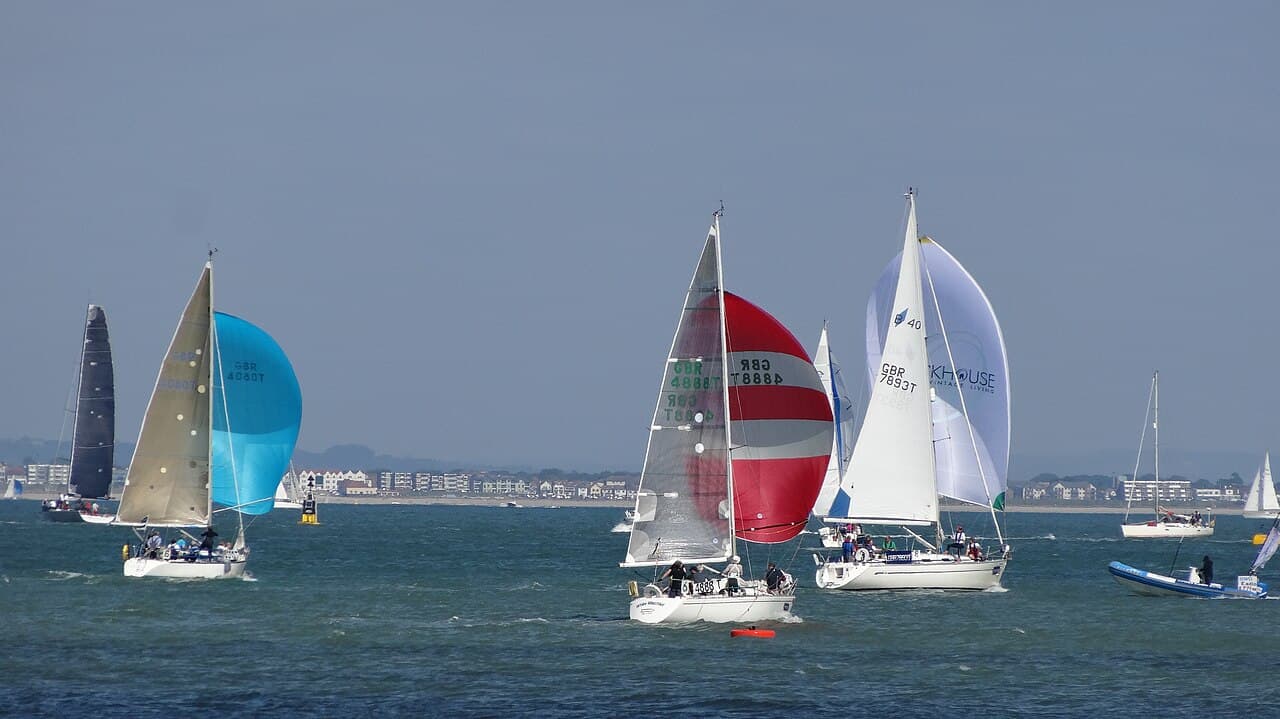
Reading line bias, and what it is worth
Bias is the first decision and the cheapest gain available, and the geometry is trigonometric rather than a matter of feel. The distance advantage of the favoured end is approximately the line length multiplied by the sine of the bias angle. On a 200 m line, a 6-degree bias yields 200 × sin(6°) ≈ 21 m of free distance to windward — close to two boat-lengths on this hull, gained before the gun even fires. Double the bias to 12 degrees and the gain roughly doubles to about 42 m; halve the line to 100 m and it halves. That linearity, for small angles, is why long lines and modest biases still matter.
Measure it, do not guess it. The clean instrument method is a compass bearing: sail down the line and read its bearing, then add 90 degrees if you took it from the starboard (committee-boat) end or subtract 90 degrees from the pin end. That gives the neutral line wind — the true wind direction that would make the line perfectly square. Compare it against the measured true wind and the difference is your bias, with its sign telling you the favoured end. Cross-check by shooting the line head-to-wind near its midpoint (the end the bow points to is upwind), or by sailing both tacks close-hauled under main alone and comparing the headings.
But bias is only part of the equation, and chasing it blindly is a classic error. The favoured end is also the crowded end, and a heavy boat buried in that crush loses far more than 21 m of bias was worth. Weigh three things together: the magnitude of the bias, the density of hulls likely to fight for that end, and where the first shift and the favoured side of the beat actually send you. A modest bias at an uncrowded end, on the side you want, beats a strong bias in a wall of boats you cannot escape from a standing start.
The timed run-in
This is where big-boat starting is won, and it is an explicit time-and-distance calculation. Use a transit — a shore feature or committee-boat mark lined up behind the pin — so you read true distance to the line instead of eyeballing it, because a line viewed from an angle foreshortens badly. First calibrate the boat: sail upwind at full speed and time ten boat-lengths, which gives seconds-per-length for the conditions (60 seconds means six seconds a length; 40 seconds means four). Then run the "time to burn" sum: time available before you must commit equals the distance to the line divided by your approach speed, minus the seconds the boat needs to accelerate from that approach speed to target.
On a heavy boat that acceleration allowance is the whole game, because it is long — several seconds and a good fraction of the reservoir — so you commit earlier and from further out than instinct suggests. Build the run-in from repeatable references and rehearse it until it is choreography, not improvisation: a known approach speed at a known time, a known point on the transit where the bow goes down. A robust default is to hold slightly high and slow through the last forty to sixty seconds, then bear away and sheet on so the boat is accelerating hard through the final ten to fifteen seconds and hits the line square at the gun. The powerful trick, when the geometry allows, is to arrive on a close reach and luff to close-hauled as the gun fires: crossing on a slightly freed sheet lets the boat exceed its close-hauled speed at the line, then round up into the wind with maximum way on. Begin your acceleration before, or at the very latest with, the boats around you — if you wait until they go you will still be climbing the acceleration curve while they are already at full pace and rolling you.
The hole to leeward
Everything about the run-in exists to preserve one thing: open water immediately to leeward of the bow. That gap is the hole to leeward, and it is where you bear away to build speed and then convert that speed into height off the line. The mechanism is hydrodynamic. The keel and rudder are low-aspect foils that only make useful lift within a working band of angle of attack; foil sections typically begin to separate flow well before their stall, which for keel planforms sits somewhere in the 10-to-30-degree range, and the lift-to-drag ratio at the optimum angle can be up to three times what it is at the stall. To hit that optimum the foil needs flow speed and a small, controlled leeway angle — which means the boat needs room to put the bow down and get moving. Without a hole there is nowhere to accelerate, the keel sits at high leeway and low speed on the wrong side of its L/D curve, and you slide sideways and get pinned.
Creating the hole means arriving high and slow so there is room beneath you, then defending it. In the last minute be proactive: luff to hold your lane and keep just enough speed that the keel still has attached flow to steer on, because a stalled keel with no flow cannot bear away or hold its slot — it is the single worst state to be in on the line. The recurring threat is the "vulture" reaching in late from behind to take your space; the counter is to turn down in front of it before it can establish a leeward overlap, force it to head up to your windward side, then luff hard to save the gap. Good looks like a clean lane a couple of boat-widths wide beneath the bow at the gun; bad looks like a bow buried in a neighbour's transom, unable to foot or point.
Holding the lane and the first thirty seconds
Crossing well is only half the job; the first thirty seconds decide whether you keep clear air. A boat that lands in a competitor's wind shadow sees two penalties at once: reduced apparent wind speed, and a header, because the shadowing boat deflects the flow to leeward. That disturbed zone is a bent triangle whose base runs along the boat's centreline and whose apex points off along the apparent-wind axis; it is roughly five mast-heights long in moderate air and stretches to seven mast-heights or the better part of ten boat-lengths in light air, where the wind lacks the energy to re-establish flow quickly. Because your recovery cost scales with velocity squared, you cannot simply power out of it.
You have two levers. Sheet on hard and sail a touch free to keep the foils loaded and the boat in its groove, holding the lane by speed. Or, if the lane is closing, foot off early — deliberately trade five to ten degrees of height for a clear lane, re-power, and only then start pointing again. The trap is trying to pinch up inside dirty air: you push the keel toward its stall angle, lose the speed you cannot cheaply rebuild, and slide sideways into worse air still. On a heavy boat, footing to clear air is almost always the higher-percentage call.
When the start goes wrong: second-row recovery
Sometimes the plan fails and you are in the second row in bad air. The instinct to tack away immediately is usually wrong on a heavy boat, because a tack sheds way — the boat comes near head-to-wind, the foils briefly detach as leeway spikes, and you have to rebuild the reservoir on the new tack, often into more traffic. Instead, sail for clear air and pressure first: bear away to reattach flow, accept losing a little height, and let the boat return to its mode. Then take the first genuinely clean lane to tack onto the lifted or favoured side and use the long waterline and straight-line speed to grind back over the beat. Patience and keeping the boat loaded recover more places than a panicked tack ever does.
The heavy-boat mindset
Big-boat starting rewards planning over reflex because the physics is unforgiving of stopped mass. Make the bias call with the trigonometry, the crowd and the first shift in mind; run a timed, transit-referenced approach built from a real time-to-burn sum; defend a hole to leeward so the keel always has speed and attached flow; and cross at target VMG in a defended lane. Because a powerful keelboat is slow to rebuild energy but formidable once it is carrying it, the payoff for a disciplined start is large: get off the line in clear air at full speed and the boat sets the terms of the race. For what follows, study the common speed killers that turn a mediocre start into a ruined beat, and the upwind trim basics that keep the boat in its groove once you are away.
Frequently asked questions
- How is starting a big keelboat different from a dinghy?
- Stored kinetic energy is the difference, and it scales with the square of speed. A three-tonne keelboat at target close-hauled speed carries roughly 20 kilojoules of translational kinetic energy; a dinghy carries a fraction of that. A dinghy can luff head-to-wind on the line, sit stationary, then bear away and plane in two or three lengths because it has almost no mass to re-accelerate. A keelboat that stops must rebuild that energy through the sails against hull and wavemaking drag, which takes many lengths and several seconds. So the start becomes a time-and-distance problem solved backwards: you fix the moment you must commit to acceleration so the boat arrives at target speed, in clear air, at the gun. Momentum management and lane control dominate; reflex boat handling does not.
- How do I read line bias correctly?
- The geometry is trigonometric. The distance advantage of the favoured end is approximately the line length multiplied by the sine of the bias angle, so on a 200-metre line a 6-degree bias is worth about 21 metres, or a couple of boat lengths on a 12-metre hull. Measure it with a compass: sail the line, take its bearing, add or subtract 90 degrees to get the neutral (square) wind direction, then compare that against the measured true wind to read the bias and its sign. Cross-check by luffing head-to-wind mid-line, or by sailing both tacks close-hauled under main alone and comparing headings. On a long Grand Prix line even five to ten degrees is worth several lengths, but that reward collapses if the favoured end is crowded or the first shift argues the other way.
- Why is clear air so critical for a heavy boat?
- A boat in another's wind shadow sees reduced apparent wind speed and a header from the deflected flow, so it loses both drive and pointing. That shadow is a bent triangle roughly five mast-heights long in moderate air and up to ten boat-lengths in light air. A heavy boat cannot accelerate out of it: because kinetic energy scales with velocity squared, recovering the lost speed costs disproportionate energy and time, often the length of the beat. Dirty air also forces you to foot low to keep flow attached to the keel, sailing extra distance while surrendering the shift. A defended lane of clean air off the line is therefore worth more than an aggressive but exposed slot at the favoured end.
- What is the hole to leeward and how do I create one?
- It is the open water immediately to leeward of your bow that you bear away into to accelerate, and then use to build height. Create it by approaching high and slow through the last forty to sixty seconds, luffing to hold a gap of a couple of boat-widths, then bearing away and sheeting on so the boat is accelerating through the final ten to fifteen seconds. Guard it against boats reaching in late from behind: force them to head up onto your windward side, then luff hard to protect the gap. Without a hole there is nowhere to put the bow down, so the keel never sees enough angle of attack at speed to make lift, and you get rolled and pinned immediately.
- How do you recover from a poor start on a big boat?
- Treat lost energy as sunk cost and sail for pressure and clear air, not the front row. Pinching in backwind is the trap: the keel is already near its stall angle and you slide sideways while bleeding the speed you cannot cheaply rebuild. Instead bear away five to ten degrees to reattach flow and let the boat re-power in a lane where it can breathe, then take the first genuinely clean lane to tack onto the lifted or favoured side. Use the long waterline and straight-line speed to grind back over the beat. On a heavy boat, keeping it in its groove recovers more places than a rushed tack into fresh traffic ever will.
Related articles
Upwind Trim Basics on a Powered-Up Keelboat
Expert upwind trim: matching jib and main twist to the 3-5° wind-gradient shear, tuning headstay sag to the sailmaker's luff hollow, holding target heel so induced drag (which climbs with leeway squared) stays low, and steering the groove for best VMG on a canting-keel one-design.
Read the articleWhat Makes the Melges 40 Fast?
The Melges 40 is fast because a ~3,250 kg carbon platform with a D/L near 66, a 1.1-tonne canting bulb worth roughly double the crew's righting moment, and a 200 m² gennaker drive it past Froude 1.0 into full planing — an integrated power-to-weight package, not one clever part.
Read the articleCommon Speed Killers
Seven avoidable faults bleed the most boatspeed — over-trimming, wrong gear, dirty air, rough helming, weight placement, a dragging rudder and a fouled bottom. The physics behind each, the numbers that define good, and how to fix the cause not the symptom.
Read the article