The Retractable Bowsprit: Flying the Asymmetric
A retractable carbon bowsprit is a compression column that projects the asymmetric's tack forward of the bow into clean air and lengthens the sail-plan base, then retracts to shed weight and pitching inertia — carrying tack loads that can exceed a tonne in fresh breeze, spiking far higher on collapse-and-refill.
13 min read
A retractable carbon bowsprit projects the tack of the asymmetric forward of the bow into clean air, lengthens the base of the sail plan, then withdraws upwind to shed weight and pitching inertia. That single sliding spar is why a modern Grand Prix one-design can carry an enormous downwind sail, gybe it with a couple of hands, and still present a clean, light bow when the kite is stowed. It is also one of the highest-loaded structural members on the boat — a slender compression column reacting a concentrated, dynamic tip load — so it repays understanding as an engineering system, not just a piece of kit.
The principle: why project the tack forward
An asymmetric spinnaker has a fixed tack and a free-flying luff, and it works on apparent-wind angles like a deeply cambered, very large genoa rather than the parachute-like square-run sail a symmetric kite is. Flow attaches at the luff, accelerates over the cambered leeward surface and reattaches toward the leech; the sail generates lift, not just drag, and that lift has a forward component that drives the boat. For that airfoil to work the leading edge needs clean, undisturbed air — attached flow at the luff is the whole game.
The obstacle is the bow's own wake of disturbed flow: the backwind spilling off the leeward side of the mainsail and jib, the turbulence shed by the headstay and pulpit, and the boat's own upwash field. Tacking the kite at the stemhead drops its luff straight into that degraded air, so the leading edge stalls or luffs early and the top of the sail chokes. Projecting the tack a metre or two forward on a sprit does two mechanically distinct things:
- It relocates the tack into clean airflow ahead of the rig, so the luff sees near-freestream conditions and the whole sail sets to a fuller, more efficient shape with a stable leading edge.
- It lengthens the base of the sail plan, shifting the combined centre of effort forward. That both increases the projected area exposed to the wind and gives the crew the geometry to bear away and keep the kite drawing at deeper true-wind angles before it collapses behind the main.
The payoff is more usable projected area, improved downwind VMG, and a sail that stays pressurised lower than it otherwise would. If the aerodynamic side is new to you, our primer on sail aerodynamics covers why leading-edge flow matters this much.
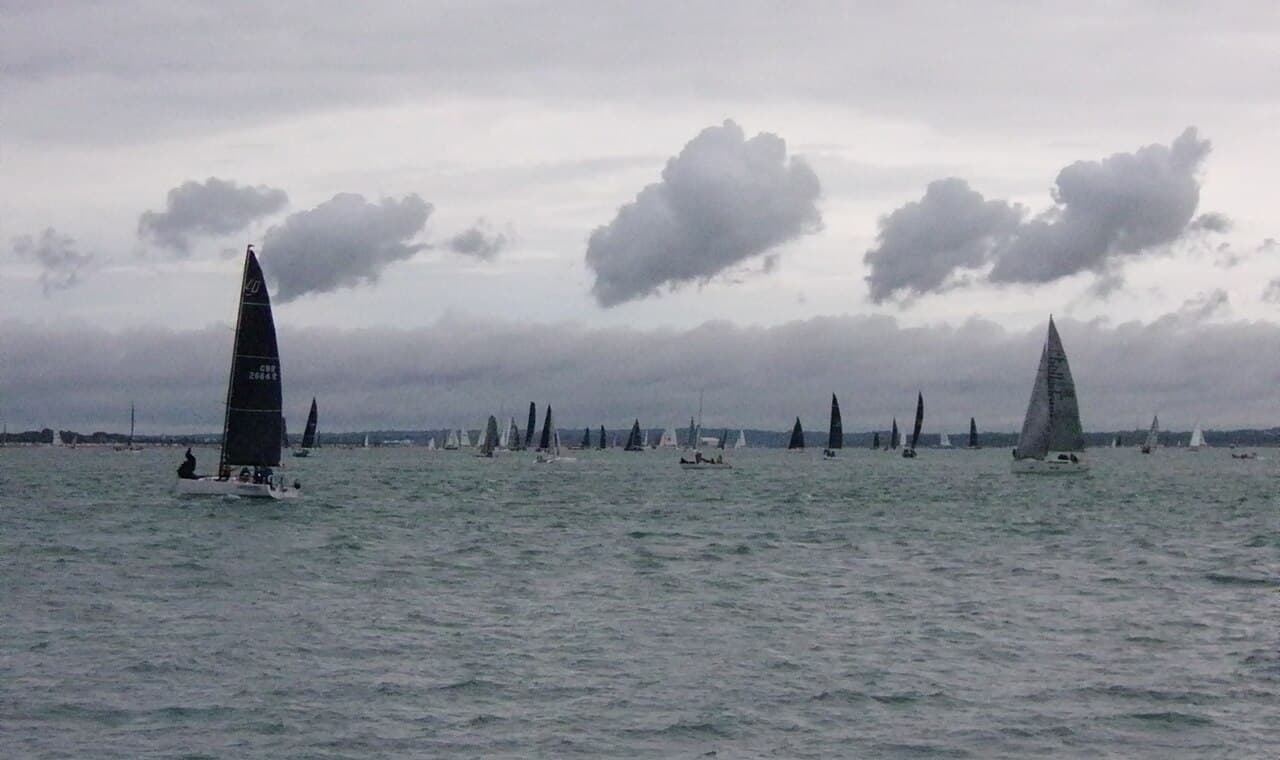
Sprit versus conventional pole
The centreline bowsprit is what makes the whole asymmetric package coherent. A traditional symmetric pole clips to a mast track and swings athwartships, positioned by a topping lift, a foreguy and an afterguy, with the guy carrying the load and the sheet controlling twist. Gybing means either dip-poling — tripping the outboard end, swinging it under the forestay and re-clipping — or end-for-ending the pole across the foredeck. Either way it is load-heavy work with crew forward of the mast in a seaway, and the pole is a bending-and-compression member that has to be tripped under load.
A bowsprit fixes the tack on or near the centreline and never moves side to side. The same asymmetric now sets on either gybe with nothing to shift up front. A gybe becomes an inside or outside rotation of the clew: ease the old sheet, trim the new one, and the sail swings around the fixed tack while the bow crew do nothing but tidy sheets. It is faster, needs fewer hands forward and is markedly safer — the gybe choreography is genuinely simpler. The cost is committed geometry: the tack sits on the centreline, so you sail apparent-wind angles and gybe through them rather than squaring off dead downwind, and the navigator trades extra distance sailed against the boatspeed the mode buys.
The numbers and the loads
This is where the sprit earns its engineering. Treat the aerodynamic force on the sail as F = ½ ρ A V² C_f, where ρ is air density (~1.225 kg/m³), A is sail area, V is apparent-wind speed and C_f is a force coefficient — for a spinnaker often taken around 2.5 from Marchaj/Bethwaite data. With the sail constrained at three corners, roughly half of that total resolves through the tack. Two independent estimates bracket the answer:
- Rule of thumb. A widely used sizing figure is a safe working load of about 5 kg/m² of sail area at the sprit end — so a 200 m² gennaker lands near a tonne at the tack.
- From the physics. At ~20 knots of apparent wind (≈10.3 m/s) over 200 m², F ≈ ½ × 1.225 × 200 × 10.3² × 2.5 ≈ 32 kN, of which the tack takes on the order of 1.5–1.6 tonnes. Same order as the rule of thumb, and both scale with the square of wind speed — so 25 knots apparent is not 25% more load than 20, it is closer to 55% more.
Both are steady-state figures, and steady state is not the design case. Two effects drive the real peaks:
- Shock loading. The worst case is a kite that collapses in a lull or behind a wave and then refills with a bang. Full-scale flapping measurements show dynamic aerodynamic force rising 50 to 70 per cent above the static value on refill, and the impulsive nature of it — high force delivered in a fraction of a second — is what fatigues fittings and initiates cracks in laminate. Hardware is sized for this multiple, not the average.
- Immersion. Bury the bow reaching in a breeze and the sprit itself can spear into solid water. Water is roughly 800 times denser than air, so even a modest immersion velocity generates a large, sudden, wrongly-directed load the spar was never intended to carry — an upward and side bending moment on a member designed principally for a near-axial pull.
Critically, the sprit is a cantilevered lever. The tack pull acts at the projected tip; the hull reacts it as a couple — a down-and-aft reaction at the outboard deck partner and an up-and-forward reaction at the heel (or the reverse, depending on load direction). The further the tack is projected, the longer the moment arm and the larger those reaction forces become relative to the sail load itself. So the load path runs from the tack fitting, into the spar, out through the two bearing reactions, and finally into a reinforced bulkhead or structural grid that closes the couple inside the boat. Every element is sized for the dynamic peak. If you want the underlying logic, see our explainer on load paths and structural engineering — the sprit is a textbook concentrated load fed into distributed structure.
Construction: a tapered carbon compression column
Modern racing sprits are mandrel-moulded high-modulus carbon tubes, usually tapered so section and wall thickness are greatest near the loaded outboard bearing and taper inboard where bending moment falls. The taper is a stiffness-and-mass optimisation: put the material where the bending moment lives, shed it where the moment goes to zero. Laminate schedules are dominated by 0-degree (longitudinal) fibre to resist the bending that immersion and off-axis sail loads impose, with ±45-degree plies added for torsional stiffness and, importantly, to raise buckling resistance.
Buckling is the governing failure mode for a slender spar in compression, and it is a stiffness problem, not a strength one. Euler's column relation, P_cr = π²EI / (KL)², says the critical load scales with the flexural rigidity EI and inversely with the square of the effective length KL. That is why carbon wins here: its high modulus E lets a tube reach a target EI at a fraction of the mass of aluminium, and pushing material to the outer wall (larger second moment of area I) buys buckling resistance far more cheaply than adding wall thickness. It is also why effective length matters so much — halving the unsupported length quadruples the critical load, which is the whole logic behind well-spaced, well-fitted bearings. (Note the practical caveat from CFRP testing: the Euler formula is accurate for slender columns but over-predicts capacity for stubbier ones, so real sprits are engineered with test data and margin, not the textbook number alone.)
Two architectures dominate. An under-deck, tube-launched sprit slides through a moulded trunk inside the hull and exits at the stemhead — clean aerodynamically, well supported, and it stows completely out of the airflow. An on-deck extending sprit runs in bearings on the foredeck; simpler to fit and inspect, at some cost in windage. Typical foredeck extending sections on 40-footers run around 88 mm diameter with total lengths up to roughly 3000 mm, though on a purpose-built one-design the section, extension and taper are all bespoke to the class.
Deployment, retraction and trim
Deployment is driven either by a line-and-purchase (2:1 or 4:1) tackle — an out-haul to run the sprit forward, a separate line or the same system to retract it — or, on larger and higher-load boats, by hydraulics. The crew runs the sprit out as part of the hoist sequence and pulls it back on the drop, so its timing is baked into the manoeuvre rather than being a separate job.
Good practice on the water:
- Deploy early and lock it. Run the sprit fully out before the kite loads and confirm the lock is home at full extension. A sprit that is not fully out, or that creeps back under load, both moves your tack aft (killing projection) and hammers the retraction system with cyclic load it is not designed to hold.
- Trim the tack line to conditions. The tack line — from the sail's tack to the sprit end — is a genuine trim control, effectively the outhaul of the kite. Ease it in light air to let the luff float up, project to windward and rotate the sail to a fuller, deeper shape for depth; snug it down as breeze builds to pull the luff straighter, stabilise the leading edge and stop the sail wandering. It works with the sheet, not independently: the sheet sets twist and how much curl you carry, the tack line sets luff height and projection. The classic target is easing the sheet until the luff shoulder curls gently every few seconds, then holding it right there.
- Sail the mode. The productive band is roughly 80–120 degrees off the apparent wind, with the fast reach-to-run groove near 90 degrees AWA. Head up a few degrees to build apparent wind and speed, then bear away and cash it in; catch speed dips early and settle back into the groove to protect VMG.
- Retract cleanly on the drop. Bring the sprit in as the sail comes down and the boat rounds up, presenting a clean bow upwind. Left deployed it is weight, windage and — worst of all — pitching inertia right at the bow, where it damps the boat's ability to lift over waves.
What good looks like: a sprit that runs out in one smooth pull, locks with no slop and lets the tack line load evenly. What bad looks like: a notchy, sticky slide, fore-and-aft play at full extension, or a tack line that jumps under load — each a symptom the bearings, the lock or the structure need attention before the next race.
Care, inspection and failure modes
Because it is a high-load spar living permanently in spray and grit, the sprit is a scheduled inspection item, not fit-and-forget. Work it into your pre-race inspection checklist and a deeper look at each annual service.
- Operation. Full deployment and clean, positive locking with no fore-and-aft play. Slop at the lock is the classic early warning that bearing clearances have opened up or the lock has worn.
- Bearing surfaces and seals. Scoring, wear or water ingress at the deck partner and heel where the sprit passes through the hull. Keep them clean and correctly lubricated; ingressed grit becomes a lapping paste that accelerates wear and, in a wet trunk, feeds galvanic and crevice attack at any alloy fittings.
- The outboard end. The tack fitting, its pin or shackle and the tack line and its wear points. Chafe and fatigue concentrate exactly where the load is highest and the cyclic snatch of collapse-and-refill does its damage.
- Structure. The heel fitting, the bulkhead that closes the reaction couple and the surrounding laminate — look for crazing, cracks or witness marks that betray movement. This is where a carbon inspection pays off: a hairline in the gelcoat over a highly-loaded bond line is a warning, not a cosmetic blemish.
Typical failure modes, in rough order of how they present: a seized or gritty slide from neglected bearings; a tack fitting, pin or line that fatigues and lets go under a peak snatch load; delamination or a compression failure of the spar from a bow-burying immersion; and, most seriously, laminate damage or bond-line failure around the heel and bulkhead from years of cyclic shock loading. None of these fail gracefully — a compression member that buckles does so suddenly and completely — which is precisely why the whole assembly is inspected as primary structure.
On a Grand Prix one-design like the Melges 40
The Melges 40 is a Botín Partners design, built by Premier Composite Technologies and introduced in 2017, conceived from the outset to fly a large asymmetric off a retractable carbon bowsprit. Published class-adjacent figures put it at around 11.99 m overall on a 3.53 m beam, roughly 3,250 kg displacement carrying about 1,200 kg of ballast in a deep fin-and-bulb keel, under a two-part twin-spreader deck-stepped Southern Spars rig with composite rigging — see what makes the Melges 40 fast and how the sprit fits the wider systems package. The gennaker is commonly quoted near 200 m², which against roughly 72 m² of main and 49 m² of jib and a sub-4-tonne displacement is what generates its very high sail-area-to-displacement ratio and its downwind pace. Run the 5 kg/m² sizing rule against that 200 m² and you land near a tonne of steady tack load — the number the sprit, its bearings, the tack hardware and the bow structure are all engineered around, with dynamic margin on top.
Every one of those figures is a boat-specific number to verify, not a spec to design against. The exact sprit length, section and maximum extension, the gennaker's rated area, and the tack-load ratings for the hardware and structure must be taken only from the current Melges 40 class rules and the individual boat's own build and rig documentation. Published sail-area and dimension numbers vary between sources — different measurement conventions, revisions and rounding — so confirm them against the class documents before relying on them for tuning, sail selection or any structural decision. The engineering principles here are class-agnostic; the numbers are not, and on a one-design the class rule is the authority.
The retractable bowsprit is the piece that turns a big asymmetric into real downwind speed, then gets out of the way upwind — power when you want it, a clean and light bow when you don't, all through one well-engineered sliding column. Understand it as a lever that feeds a dynamic, tonne-plus tip load into your bow structure, trim its tack line like the control it is, and inspect it like the primary structure it is.
Frequently asked questions
- What does a retractable bowsprit actually do?
- Two things at once. It carries the tack of the asymmetric forward of the stemhead, out beyond the headstay and the band of disturbed air spilling off the rig, so the sail's leading edge feeds on clean flow. And it lengthens the effective base of the sail plan, moving the combined centre of effort forward so the boat can bear away and keep the kite pressurised at deeper apparent-wind angles instead of collapsing into the lee of the main. Retractable means the spar runs out only for reaching and running, then withdraws for upwind legs where a fixed pole would add weight, windage and pitching inertia at the worst possible point — the bow.
- Why not just use a conventional spinnaker pole?
- A symmetric pole clips to the mast and swings athwartships on a topping lift, foreguy and afterguy, and gybing means dip-poling or end-for-ending the spar across the foredeck. A centreline bowsprit fixes the tack on or near the centreline, so the same asymmetric sets on either gybe with nothing to shift forward. A gybe reduces to easing the old sheet and trimming the new one as the clew passes inside or outside the luff — fewer hands forward, faster, and far safer in a seaway. The trade-off is a fixed geometry: you sail apparent-wind angles and gybe through them rather than running dead square, so the tactician trades distance-sailed against boatspeed on every leg.
- How big are the loads on a bowsprit tack point?
- Large, and dynamic. A useful first estimate is a safe working load of about five kilograms per square metre of sail area, which puts a 200-square-metre gennaker near a tonne at the tack. Working it from the physics — force equals half air density times sail area times apparent-wind-speed squared times a force coefficient near 2.5, with roughly half taken through the tack — gives a similar order in around 20 knots of apparent wind. Both are static numbers. Real peaks come from collapse-and-refill snatch, which flapping studies show can add 50 to 70 per cent instantaneously, and from bow immersion. Because the sprit projects the load forward on a lever arm, the reaction couple through the bearings is what the structure really has to survive.
- What should you check on a retractable bowsprit?
- Run it fully out and confirm it deploys smoothly and locks positively at full extension with zero fore-and-aft slop — slop at the lock is the classic early warning. Inspect the bearing surfaces at the deck partner and heel for scoring, wear and water ingress, since the spar lives in spray and grit that turns a bearing into grinding paste. Check the outboard tack fitting, its pin or shackle and the tack line for chafe and fatigue where the load is highest. Sight the heel fitting, the structural bulkhead behind it and the surrounding laminate for crazing, cracks or witness marks that betray movement. Keep the bearings clean and correctly lubricated so deployment stays smooth under load.
Related articles
The Southern Spars Carbon Rig
The Melges 40 carries a two-part, twin-spreader, deck-stepped high-modulus carbon rig from Southern Spars with discontinuous EC3 composite rigging. This is the engineering — laminate architecture, mast column stability, the mechanics of bundled carbon standing rigging, how the rig is tuned to feed the sail plan, and the inspection regime a Grand Prix spar demands.
Read the articleThe Complete Melges 40 Systems Guide
The Melges 40 is a canting-keel, twin-rudder, retractable-bowsprit one-design built by Premier Composite Technologies to a Botín design. This hub explains the engineering — the Cariboni hydraulics, the ECsix rig, the sandwich load paths — and how the systems interlock.
Read the articleWhat Makes the Melges 40 Fast?
The Melges 40 is fast because a ~3,250 kg carbon platform with a D/L near 66, a 1.1-tonne canting bulb worth roughly double the crew's righting moment, and a 200 m² gennaker drive it past Froude 1.0 into full planing — an integrated power-to-weight package, not one clever part.
Read the article