3 min read · Updated 22 June 2026
A sailboat can't sail straight into the wind — but it can sail at about 45 degrees to it, and by zig-zagging it makes progress upwind. It manages this because the sail works like a vertical wing to generate lift, and the keel underneath stops the boat sliding sideways, turning that force into forward drive. It is the single most counter-intuitive thing about sailing, and it comes down to two ideas working together: the sail as a wing, and the keel as a brake against sideways motion.
The no-go zone
Start with what a boat can't do. There is an arc of roughly 45 degrees either side of the wind — straight upwind — where a sail simply flaps and produces no drive. This is the no-go zone. Point the boat there and it stops. So a boat can never sail directly into the wind.
What it can do is sail as close as about 45 degrees to the wind. That is called sailing close-hauled, and it is the key to going upwind.
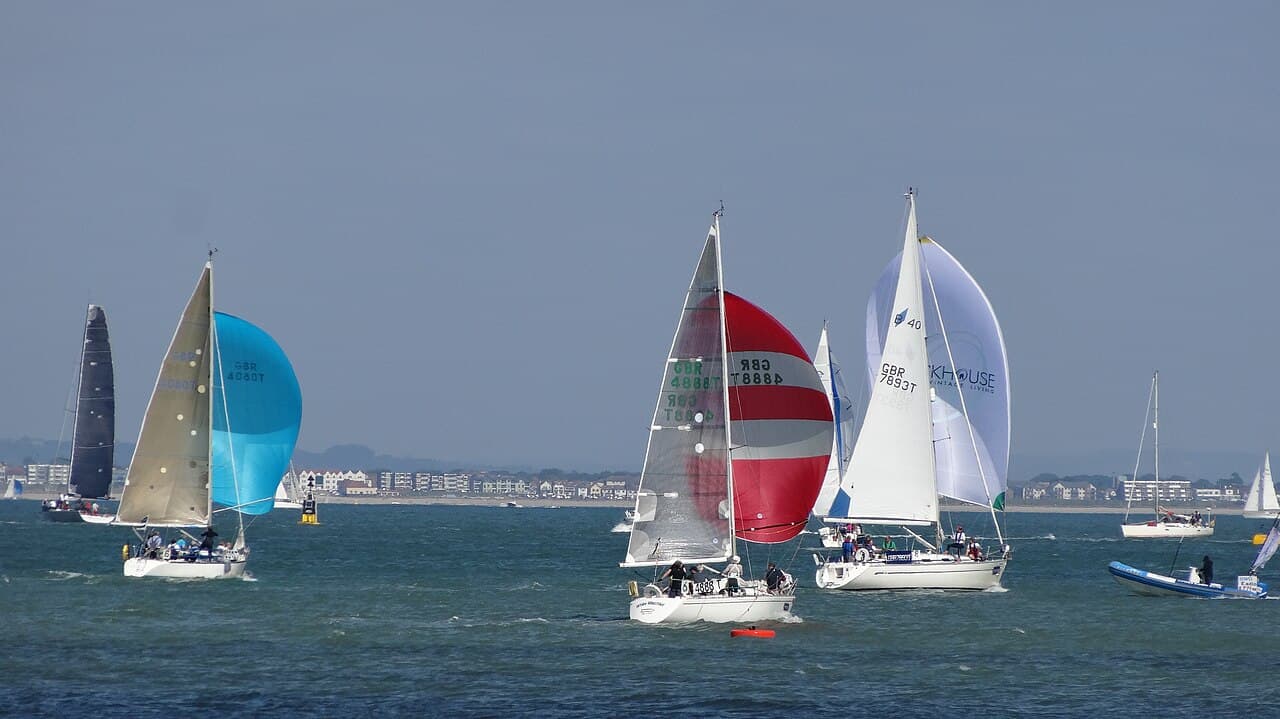
The sail as a wing
Close-hauled, the sail is not acting as a bag catching the wind — it is acting as a wing. Wind flows across the curved shape of the sail and is deflected, which creates lower pressure on the leeward (outer) side and higher pressure on the windward side. That pressure difference generates lift, exactly as an aircraft wing does, but with the "wing" standing vertically. This is the same principle explained in more depth in how do sails work.
The catch is that this lift points mostly sideways — trying to push the boat over and to leeward — with only a small component pointing forward.
The keel: turning sideways force into forward drive
This is where the keel comes in. The keel (or a centreboard on a dinghy) is a fin under the boat that strongly resists moving sideways through the water, while allowing the boat to move forward easily. So when the sail's force tries to shove the boat sideways, the keel resists it — and the boat, unable to go sideways, is squeezed forward instead.
The result: the small forward component of the sail's lift becomes the boat's drive, and the large sideways component is absorbed by the keel (showing up as a bit of heel and a little sideways slip called leeway). A keelboat is built around exactly this trade.
Tacking: zig-zagging to windward
Sailing at 45 degrees to the wind gets you across the wind, not straight into it. To make ground directly upwind, a boat tacks — it sails close-hauled on one side, then turns its bow through the wind and sails close-hauled on the other side, repeating in a zig-zag. Each leg carries the boat partly towards the wind, so the zig-zag as a whole works steadily to windward. The manoeuvre itself is explained in tacking vs gybing.
Put the three together — the sail making lift like a wing, the keel refusing to let the boat go sideways, and tacking to zig-zag — and a boat can sail almost anywhere relative to the wind. Which direction it points relative to the wind is its point of sail, and for the full vocabulary, see the sailing terms glossary.
Frequently asked questions
- How does a sailboat sail into the wind?
- A sailboat cannot sail directly into the wind, but it can sail at an angle of roughly 45 degrees to it. At that angle the sail acts like a vertical wing, generating aerodynamic lift, while the keel underneath stops the boat from simply sliding sideways. The forward part of that force drives the boat ahead, and by zig-zagging back and forth — tacking — the boat gradually works its way upwind.
- Can a sailboat sail directly into the wind?
- No. There is an arc of roughly 45 degrees either side of the wind direction — the 'no-go zone' — where a boat cannot generate drive and the sails just flap. To make ground directly upwind, a boat sails as close to the wind as it can on one side, then turns through the wind and sails close-hauled on the other side, repeating to zig-zag towards the wind.
- Why doesn't a sailboat just get blown sideways when sailing upwind?
- Because of the keel (or centreboard) — a fin under the boat that resists sideways movement through the water. When the sail's force tries to push the boat sideways, the keel resists it, so most of that force is converted into forward motion instead. Without a keel, a boat sailing upwind would mostly slide sideways to leeward.
- How does the sail create forward force when pointing upwind?
- The sail works like an aircraft wing turned on its side. Wind flowing across the curved sail is deflected, creating lower pressure on the outer (leeward) side and higher pressure on the windward side. That pressure difference generates lift, mostly sideways but partly forward. The keel cancels the sideways part, leaving the forward part to drive the boat.
- What is the closest angle a boat can sail to the wind?
- Most sailing boats can sail about 40 to 45 degrees off the true wind. High-performance racing yachts with efficient keels and sails can point a little closer, while cruising boats point slightly less. Sailing as close to the wind as possible while keeping good speed is called sailing close-hauled, or 'pointing'.