2 min read · Updated 19 May 2026
The points of sail are the directions a boat can sail relative to the wind — and the one direction it cannot. Moving from straight into the wind around to dead downwind, they run: the no-go zone, close-hauled, close reach, beam reach, broad reach and running. Knowing them is the foundation of reading any race, and of the manoeuvres and tactics covered across our guides.
The no-go zone
A sail makes power from air flowing across it — see how sails work — so pointed straight into the wind it just flutters and stops driving. The arc too close to the wind to sail — roughly 45 degrees either side of the wind direction — is the no-go zone. A boat caught head-to-wind with no drive is said to be "in irons". To make ground upwind, a boat cannot sail straight there; it sails as close as it efficiently can and zig-zags, a process explained in tacking vs gybing.
Upwind: close-hauled
Close-hauled (or "beating") is sailing as close to the wind as the boat efficiently can, just outside the no-go zone, with the sails sheeted in hard and flat. It is how a boat works to windward, tacking from one close-hauled course to the other to climb up towards an upwind mark — the counter-intuitive trick explained in how a sailboat sails into the wind. It is demanding sailing — the boat heels, the rig is loaded, and small changes in trim and steering make a real difference to height and speed.
Across the wind: reaching
As the boat turns away from the wind, it begins to reach, and the sails are eased out. A close reach has the wind just forward of the beam; a beam reach has it on the beam, square to the boat; a broad reach has it aft of the beam. Reaching is usually the fastest, most comfortable sailing, and on a fast planing boat a broad reach is often where it lifts onto the plane and accelerates hardest.
Downwind: running
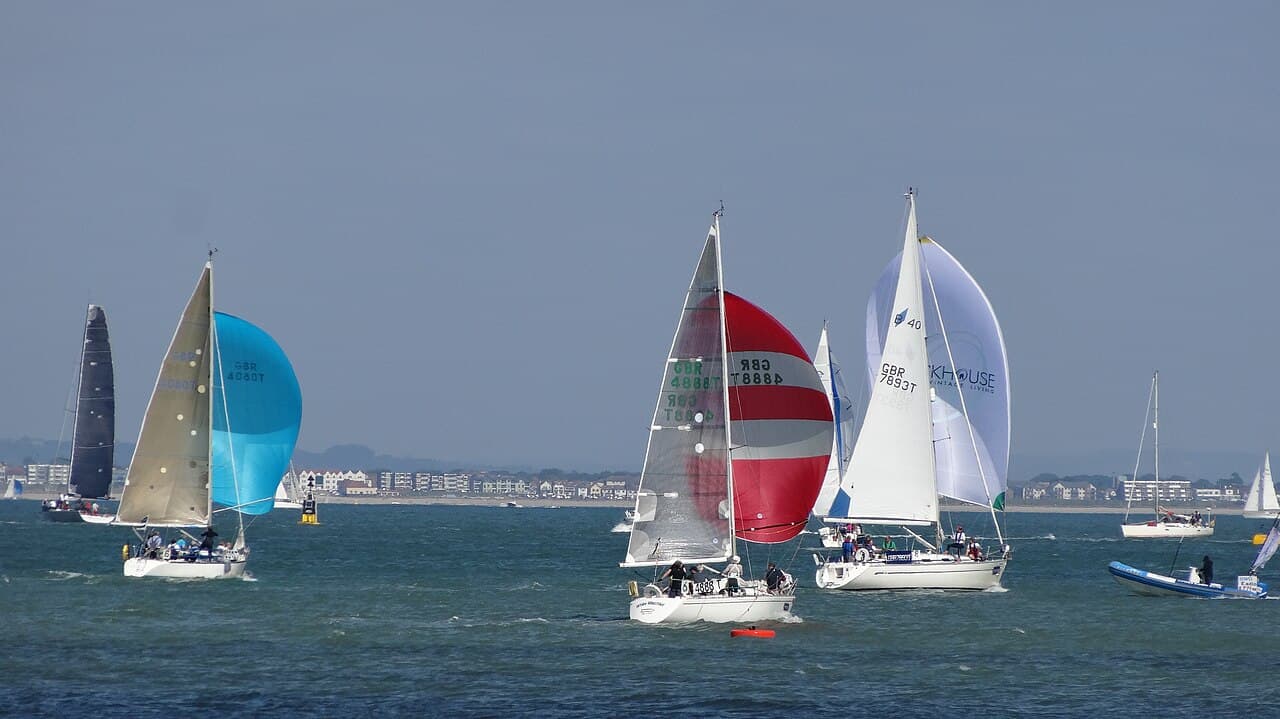
Running is sailing with the wind coming from directly astern. Here a boat sets its big downwind sails — a spinnaker or gennaker — to capture as much wind as possible. Because a yacht is faster reaching than dead downwind, racing crews rarely run straight at a downwind mark; they sail a series of broader angles and gybe between them to make better progress, the principle of velocity made good.
Which side of the boat the wind blows over at any of these points determines its windward and leeward sides — and that, in turn, drives the right-of-way rules and much of the tactics. For the full vocabulary, see the sailing terms glossary, and to see these points of sail in action, read about the boat.
Frequently asked questions
- What are the points of sail?
- The points of sail are the boat's headings relative to the wind: the no-go zone straight into the wind where a boat cannot sail, then close-hauled, close reach, beam reach, broad reach and running as the boat turns progressively away from the wind. Each has a typical sail trim, from sheeted in hard upwind to eased right out downwind.
- Why can't a boat sail directly into the wind?
- A sail generates drive by airflow passing across it, and pointed straight into the wind it simply flaps and makes no power. The angle too close to the wind to sail is called the no-go zone, typically around 45 degrees either side of the wind. To make ground upwind, a boat sails close-hauled and tacks in a zig-zag.
- What is the fastest point of sail?
- For most boats a reach — with the wind roughly on the beam — is the fastest and most comfortable point of sail, because the sails can be set efficiently and the boat is not fighting straight into or running away from the wind. Fast planing boats can be quickest on a broad reach as they lift onto the plane.
- What is the difference between reaching and running?
- Reaching is sailing with the wind coming from the side, from a close reach (wind forward of the beam) to a broad reach (wind aft of the beam). Running is sailing with the wind coming from directly behind. Reaching is generally faster and more controllable, while running points most directly downwind.